
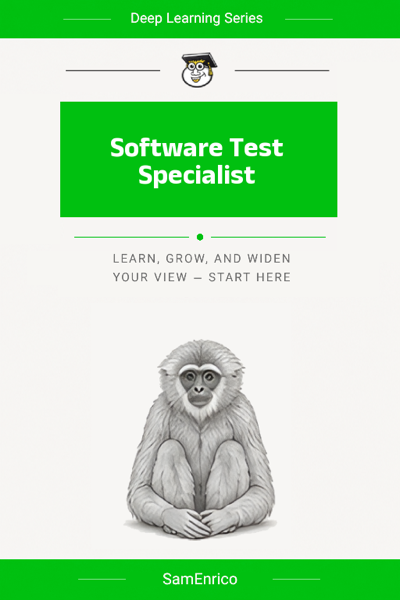
Non-FictionInformativeEducational
Software Test Specialist eBook
A Coursebook on Software Test Specialist
A Coursebook on Software Test Specialist
Formats
Free sample
Chapter 1: The Testing Illusion...--The meeting was going well. Too well.Seated around a polished conference table were twelve engineers, two product managers, and a director of quality assurance. On the screen behind the presenter glowed a familiar green checkmark — the universal symbol of "everything is fine." The QA director had just announced that their flagship product had passed 98% of all regression tests. The room applauded.Six weeks later, that same product caused a $47 million loss.The failure wasn't a asteroid strike or a once‑in‑a‑century edge case. It was a simple date calculation: February 29 on a non‑leap year.
The system had been tested against hundreds of thousands of test cases. It had passed all of them. But no one had asked the right question: What business risk are we actually trying to prevent?That QA director lost their job. But more importantly, they lost something that cannot be regained: the trust of their stakeholders. They had confused activity with value.
They had measured success by test cases executed rather than by risks mitigated. They had fallen into what this chapter calls The Testing Illusion — the belief that more tests, more automation, and more green checkmarks equal better quality.This book exists to shatter that illusion.What This Book Is (And Is Not)Before we write a single line of code or design a single test case, you need to understand what you are about to learn. This is not a beginner's guide to testing. It will not teach you how to write your first Selenium script or how to log a bug in Jira. You are expected to know the basics: what a test case is, how to run a test, the difference between verification and validation.Instead, this book is a transformation manual for experienced testers who want to become Test Specialists.What distinguishes a Test Specialist from a competent tester?
The answer is simple but profound: mindset over method.A competent tester follows test cases. A Test Specialist questions whether those test cases should exist at all.A competent tester reports bugs. A Test Specialist reports business risk.A competent tester asks "How do I test this?" A Test Specialist asks "What is the most valuable test I can run in the next hour?"Throughout this book, the term "Test Specialist" refers to a mindset and skill set, not a formal job title. Some organizations call this role "Senior Test Analyst," "SDET," or "Quality Architect." The label matters less than the way you think. (Specific specialist career paths — Performance Architect, Security Tester, SDET — are explored in Chapter 11.)By the time you finish this book, you will have built what Chapter 11 calls a T‑shaped skillset: broad awareness across all testing domains combined with deep expertise in one area that aligns with your passion and the market's needs.The Seven Deadly Assumptions of Novice Testers To understand the mindset shift required, we must first identify the assumptions that keep good testers from becoming great specialists.
Each of these assumptions is seductive because it contains a grain of truth. But each is also dangerously incomplete.Assumption 1: "If it passes all tests, it is ready for production."This is the Absence of Errors Fallacy — one of the seven core testing principles first codified by Glenford Myers in The Art of Software Testing and later formalized in the ISTQB syllabus. A system can pass every test you design and still fail catastrophically in the field. Why? Because tests are only as good as the oracles (what Myers called "the test oracle") we use to judge them.Consider the Therac‑25 radiation therapy machine.
It passed its manufacturer's tests. The FDA approved it. Yet between 1985 and 1987, six patients received massive overdoses of radiation. Two died. The software had a race condition that only appeared during a specific sequence of keystrokes — a sequence that no test case had captured.The lesson is brutal but liberating: your tests are not reality.
They are merely a model of reality. And every model is wrong. Some are useful.Assumption 2: "The goal of testing is to find bugs."No. The goal of testing is to provide information about risk so that stakeholders can make informed decisions. Bugs are merely evidence.
The distinction matters enormously.If your goal is to find bugs, you will:Prioritize high‑volume bug discovery over high‑impact risk assessment Celebrate the 500th trivial UI misalignment as much as the one data corruption bug Optimize for bug counts, which leads to testing low‑value, high‑volume areas If your goal is to provide risk information, you will:Ask "What keeps the product owner awake at night?"Focus testing on areas where failure would cause financial loss, safety hazards, or reputation damage Communicate findings in terms of business impact, not technical trivia Assumption 3: "More test coverage is always better."Coverage is a tool, not a goal. This is the Pesticide Paradox — another of Myers' principles: if you run the same tests repeatedly, they will eventually stop finding new bugs. The system evolves, the environment changes, user behavior shifts — but your test suite remains frozen in time.Coverage metrics (line coverage, branch coverage, path coverage) tell you what you have tested. They tell you nothing about what you should test. A system can have 100% line coverage and still have catastrophic security vulnerabilities or performance failures.The Test Specialist uses coverage as a safety net, not a scoreboard.
You aim for "enough coverage" where enough is defined by risk, not by an arbitrary percentage.Assumption 4: "Automation will solve our quality problems."Automation scales execution, not judgment. A poorly designed test suite, when automated, simply fails faster and more expensively. In fact, automation amplifies design flaws.The most common failure mode is what Fewster and Graham called the Inverted Pyramid in their book Test Automation (which we explore in Chapter 8). Teams automate too many GUI tests because they "look like the user experience." The result: slow, brittle, expensive test suites that drain maintenance budgets and provide diminishing returns.Automation is a powerful tool — but it is a tool for strategy, not a replacement for strategy.Assumption 5: "If a bug escapes to production, the tester failed."Bugs escape because the system — not a single person — failed. The requirements were ambiguous.
The design was flawed. The code was rushed. The test environment didn't match production. The release process skipped sanity checks.The sole tester who misses a bug is rarely the root cause. They are often the last person to touch a problem created by many others.This book teaches you to use Root Cause Analysis (RCA) — a technique we cover in depth in Chapter 3 — to trace escaped defects back to their systemic origins.
The goal is not to assign blame but to prevent recurrence. When you stop blaming individuals and start fixing systems, quality improves.Assumption 6: "Testing and development are opposing forces."The best teams treat testing and development as complementary. Testing is not the police force that catches developers' mistakes. Testing is the user's advocate embedded within the development process.The tension between testers and developers usually arises from misaligned incentives. Developers are measured on shipping features.
Testers are measured on finding problems. Without deliberate alignment, these become zero‑sum games.The solution — introduced in Chapter 3 and…
This is the end of the free sample. Get the eBook to keep going. Buy now
About this book
Details
- Author
- Lovelace Gabriele
- Publisher
- SamEnrico
- Language
- English
- Genre
- Non-Fiction, Informative, Educational
- Released
- 2026-05-07
- Pages (approx.)
- 154
- Available as
- eBook, Audiobook

Read better in the ZLOADR app
Your eBooks on your phone or tablet. Sign in with your SamEnrico account and start reading.
More by Lovelace Gabriele
 Trans Siberian Off RoadLovelace Gabriele$11.99
 Antwerp Heist Book vs RealityLovelace Gabriele$11.99
 EQ Self Awareness Training CourseLovelace Gabriele$11.99
 Environmental Toxins And AutoimmunityLovelace Gabriele$11.99
 Stress and Derealization GuideLovelace Gabriele$11.99
 The Viking Reawakening: Rediscovering the Forgotten Canoe Routes of EuropeLovelace Gabriele$11.99
 Silk & Sabotage: The Unseen War of Fashion’s Golden AgeLovelace Gabriele$11.99
 Remote Conflict CoachingLovelace Gabriele$12.99
 Low Income Product Fit WorkbookLovelace Gabriele$12.99
 How to Become a Circulating Process InspectorLovelace Gabriele$11.99
 Understanding Fetal Iodine SyndromeLovelace Gabriele$17.99
You may also like
 Hong Kong Handover 1997Dunn Johnnie$11.99
 Zumba For Postnatal Recovery CourseNeal Christian$11.99
 Zumba for BeginnersLadner Nikia$11.99
 YouTube Comment Mining GuideHumes Pandora$12.99
 Worry Box MeditationCarlin Rudy$11.99
 Workplace Stress MeditationNguyen Lynn$11.99
 Workplace Stress and Sleep RepairHawley Ivory$11.99
 Workplace Perfectionism CureDelaney Jeffry$11.99
 Workplace Injustice Anger GuideWallen Isabelle$11.99
 Work Addiction and Burnout LinkGreenwood Ester$11.99
 Women in Yoga and WellnessBeattie Galina$11.99
 Women in Stand Up ComedyChun Evangeline$11.99