
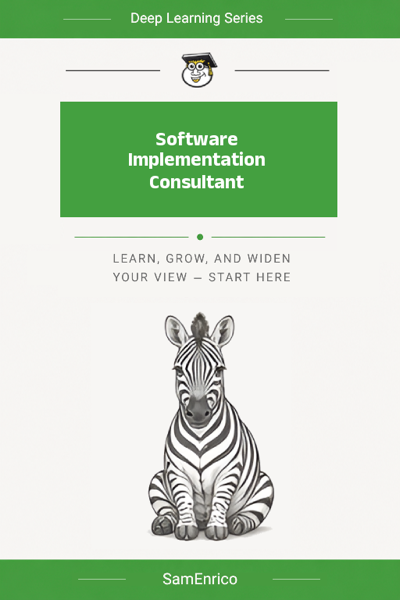
Software Implementation Consultant eBook
A Coursebook on Software Implementation Consultant
A Coursebook on Software Implementation Consultant
Formats
Free sample
Chapter 1: The Hidden Truth...--The $2 million software implementation was flawless. Every module configured correctly. Every deadline met. Every budget target hit. The consultants shook hands, collected their final payment, and moved on to the next client.Six months later, the system sat abandoned.
Users had quietly returned to their spreadsheets, their sticky notes, their shadow IT workarounds. The client had spent two million dollars on a digital museum.When the post-mortem asked users why they had rejected the system, the answers were devastating. Not because the system was broken, but because no one had prepared them for it. No one had explained why their old way of working needed to change. No one had asked them what would make the new system better.
No one had treated them as participants rather than obstacles.The technical consultants had done everything right. And they had failed completely.This is the hidden truth of software implementation consulting: technical perfection without human adoption delivers zero business value. You can configure the perfect system, map every workflow, migrate every record, and test every edge case. If the humans who must use the system reject it, you have built nothing of value.This chapter exists because that truth is rarely taught. New implementation consultants enter the field believing they are project managers who happen to touch software, or technicians who happen to talk to clients.
Neither belief is correct. The role you are about to learn is something else entirely: a profession that sits at the intersection of technology, process, and psychology. A role that requires you to think like a project manager, speak like an engineer, persuade like a salesperson, and listen like a therapist.If that sounds overwhelming, good. It should. This is not an easy profession.
But it is a lucrative, respected, and deeply satisfying one for those who master its core competencies.This chapter defines who you must become. Not the tasks you will perform, but the identity you must adopt. Because before you can implement software for others, you must first implement a new understanding of yourself.The Great Role Confusion Walk into any software company and ask ten people what an implementation consultant does. You will receive twelve different answers.Some will tell you implementation consultants are specialized project managers who focus on software deployments. Others will describe them as technical support with better communication skills.
Still others will confuse them with sales engineers, solution architects, or business analysts.This confusion is not accidental. The implementation consultant role sits at the intersection of four distinct professions, borrowing elements from each while being defined by none.Consider the four roles most commonly confused with implementation consulting:The Project Manager focuses on timeline, budget, and resources. Success for a project manager means delivering on time and on budget. The project manager cares about process compliance, risk mitigation, and stakeholder reporting. When a project succeeds, the project manager points to the Gantt chart.
When a project fails, the project manager points to the change log.The Software Engineer focuses on code quality, architecture, and functionality. Success for an engineer means building working software that meets specifications. The engineer cares about test coverage, technical debt, and performance metrics. When the software works, the engineer celebrates. When it breaks, the engineer fixes it.The Sales Engineer focuses on demonstrating value and closing deals.
Success for a sales engineer means signing contracts. The sales engineer cares about product positioning, competitive differentiation, and executive relationships. When a deal closes, the sales engineer moves to the next opportunity. When a deal dies, the sales engineer blames the product.The Technical Support Specialist focuses on resolving issues and restoring functionality. Success for support means closing tickets quickly with satisfied customers.
The support specialist cares about response times, resolution rates, and customer satisfaction scores. When a ticket closes, the support specialist moves to the next one.The implementation consultant borrows from all four. You must manage timelines like a project manager, understand technical constraints like an engineer, demonstrate value like a sales engineer, and resolve issues like support. But your ultimate metric is none of theirs.Your success is not on-time delivery. It is not working software.
It is not signed contracts or closed tickets.Your success is client behavior change. Specifically, your success is the client using the software you helped implement to achieve measurable business outcomes. If the software works perfectly but no one uses it, you have failed. If everyone uses it but achieves nothing of value, you have also failed.This is the first and most important distinction of this entire book. Burn it into your memory now:The implementation consultant does not deliver software.
The implementation consultant delivers adoption, capability, and value. Software is merely the vehicle.The Triple Competency Model If your success depends on behavior change rather than technical completion, then your competencies must extend far beyond technical knowledge. The Triple Competency Model defines the three domains every implementation consultant must develop: Technical Fluency, Process Expertise, and Emotional Intelligence.Technical Fluency Technical fluency is the most obvious competency and the one most new consultants over-index on. It includes platform knowledge, data modeling, API understanding, configuration expertise, and troubleshooting ability.The warning sign of insufficient technical fluency is the phrase "I don't know how to do that in the system" becoming a default response. Clients hire consultants because they lack internal expertise.
If you cannot answer their technical questions, you have failed at the most basic level.However, technical fluency alone is insufficient. A consultant who knows every configuration option but cannot map a business process or manage client resistance will build beautiful systems that no one uses. Technical fluency without process expertise produces automated chaos. Technical fluency without emotional intelligence produces robotic responses to human problems.Process Expertise Process expertise is the ability to understand, document, analyze, and improve how work actually flows through an organization. It includes business process mapping, gap analysis, workflow optimization, and root cause diagnosis.The warning sign of insufficient process expertise is clients consistently saying "that's not how we do things" after you have configured the software.
When this happens, you have built a solution that does not match reality. You skipped the As-Is mapping. You assumed the documented process was the actual process. You built for how work should happen rather than how it does happen.Process expertise requires intellectual humility. You must accept that you do not understand the client's business better than they do.
Your value is not in knowing their processes; your value is in seeing patterns they cannot see because they are too close to the work. The outsider's perspective is your greatest asset, but only if you earn the right to use it by first understanding what is actually happening.Emotional Intelligence Emotional intelligence is the most underrated competency and the one that separates great implementation consultants from merely competent ones. It includes client reading, resistance management, communication adaptation, trust building, and conflict navigation.The warning sign of insufficient emotional intelligence is projects that have technical success but the client requests a new consultant. The system works. The timeline was met.
The budget was honored. And still the client wants you gone. This happens when you have failed to build trust…
This is the end of the free sample. Get the eBook to keep going. Buy now
About this book
Details
- Author
- Fenner Melvin
- Publisher
- SamEnrico
- Language
- English
- Genre
- Non-Fiction, Informative, Educational
- Released
- 2026-05-07
- Pages (approx.)
- 149
- Available as
- eBook, Audiobook

Read better in the ZLOADR app
Your eBooks on your phone or tablet. Sign in with your SamEnrico account and start reading.
More by Fenner Melvin
 Walking Meditation For Weight Loss HandbookFenner Melvin$11.99
 Vision Loss Memory ConnectionFenner Melvin$11.99
 Project Float ManagementFenner Melvin$11.99
 The Body Scan for Students GuideFenner Melvin$11.99
 Empty Nest Alcohol RecoveryFenner Melvin$11.99
 The Poisoner of Lyon: The Deadly Charms of Hélène JégadoFenner Melvin$11.99
 Understanding Obstructive Sleep ApneaFenner Melvin$17.99
 German Part Time Job HandbookFenner Melvin$12.99
 Crown Holdings SWOTFenner Melvin$12.99
 How to Become a Compression-molding-machine TenderFenner Melvin$11.99