
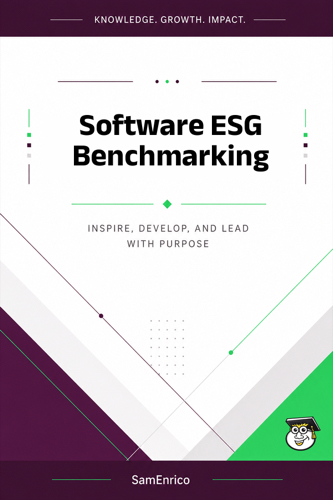
Software ESG Benchmarking eBook
Evaluate cloud efficiency and e waste policies amo
Evaluate cloud efficiency and e waste policies among enterprise software vendors.
Formats
Free sample
Chapter 1: The Procurement Paradox...--–- Maria Voss had never considered herself an environmentalist. As Chief Procurement Officer at a mid-sized European manufacturing firm, she cared about cost, reliability, and legal compliance – in that order. But on a cold Tuesday morning in March 2025, her CEO slammed a thick binder on her desk. Inside was a preliminary audit report from the company's external accountants. Buried on page 47, a single line caught Maria’s breath: Estimated Scope 3 emissions from software and cloud vendors: 47,000 metric tons CO2e – more than the company’s entire European manufacturing footprint.The CEO didn't yell.
He didn't need to. "Maria," he said quietly, "our net-zero pledge is due to the board in six months. Explain to me how our Zoom calls and CRM software produce more carbon than our factories."Maria couldn't. And that was the problem.The Great Invisible: Why Your Software Has a Carbon Footprint You’ve Never Measured This chapter establishes the fundamental problem that drives this entire book: while enterprises have spent billions reducing their direct emissions (Scope 1 and 2), the vast majority – up to 90% – of their carbon footprint lies in Scope 3, the supply chain. And within that supply chain, no category has grown faster or remained more ungoverned than software procurement.Let that sink in.
Every time your company signs a contract with a Software-as-a-Service (Saa S) vendor – Salesforce, Workday, Zoom, Adobe, or thousands of smaller players – you are not just buying a tool. You are renting a portion of a global data center infrastructure that consumes roughly 1-1.5% of the world's electricity, a figure that rivals the aviation industry. And unlike the fuel burned in a 747, the carbon emitted by your software stack is invisible, silent, and almost never audited.This chapter introduces the critical vocabulary and mental models you will need to benchmark software vendors effectively. By the end, you will understand the difference between embodied and operational carbon, the three vendor archetypes that require different auditing approaches, and why your net-zero pledge is a fiction if you cannot answer one simple question: How efficient is the software I am buying?The Scope 3 Blind Spot: Why 90% of Your Emissions Are Someone Else's Problem To understand the software ESG crisis, you must first understand how corporate carbon accounting works. The Greenhouse Gas (GHG) Protocol, the global standard for emissions reporting, divides emissions into three "scopes":Scope 1: Direct emissions from sources you own or control – company vehicles, on-site boilers, factory smokestacks.Scope 2: Indirect emissions from the electricity, heating, and cooling you purchase.Scope 3: All other indirect emissions in your value chain – purchased goods and services, transportation and distribution, employee commuting, and the use of sold products.For most enterprises, Scope 3 accounts for 80-90% of total emissions.
A retailer like Walmart, for example, has relatively low Scope 1 emissions from its stores but enormous Scope 3 emissions from the products it sells, the trucks that deliver them, and – crucially – the software that runs every transaction.The problem is that Scope 3 is optional. Under current reporting frameworks, companies are not required to disclose Scope 3 emissions – although that is changing rapidly with regulations like the EU's Corporate Sustainability Reporting Directive (CSRD), which we will cover in Chapter 2. As a result, most companies have ignored Scope 3 entirely, or they have outsourced the problem to third-party consultants who produce high-level estimates based on spend data: "You spent $10 million on software last year, so your emissions are approximately X."These estimates are almost useless. They assume all software has the same carbon intensity, which is like assuming all cars have the same fuel efficiency. A Ferrari driven at 150 mph produces dramatically more CO2 per mile than a Toyota Prius at 55 mph – and similarly, a poorly optimized, data-hoarding software vendor can consume 10x more energy per transaction than an efficient competitor, even when both run on the exact same cloud infrastructure.This book exists to close that gap.
You will learn to move from high-level estimates to vendor-specific technical audits that measure actual energy consumption, code efficiency, and hardware lifecycle management.The Three Carbon Categories: Upfront, Operational, and End-of-Life Before we can benchmark vendors, we must establish a consistent vocabulary for where carbon enters the software lifecycle. Many ESG reports blur these categories together, making it impossible to compare vendors or identify the source of inefficiency. This book will use three distinct categories, defined here once and referenced throughout.Upfront Embodied Carbon (Manufacturing)Definition: The CO2 emitted during the mining, refining, manufacturing, assembly, and transportation of the physical hardware that runs software – servers, networking gear (routers, switches), storage devices (SSDs, HDDs), cooling systems, and backup power equipment.Critical Timing Rule: Upfront embodied carbon is emitted the day the hardware is manufactured, not the day it is installed, used, or retired. This is a one-time emission that occurs in the hardware manufacturer's supply chain, typically in countries like China, Taiwan, or South Korea.Magnitude: Manufacturing a single standard server (2U, 48 cores, 512GB RAM) produces approximately 1,500-2,000 kg CO2e. A typical hyperscale data center contains 50,000-100,000 such servers.
The upfront embodied carbon of just the servers in a single AWS region is roughly equivalent to the annual emissions of 50,000 gasoline-powered cars.Why This Matters for Benchmarking: When you sign a contract with an Iaa S vendor (AWS, Azure, Google Cloud), you are implicitly responsible for a share of that upfront embodied carbon through your Scope 3 purchased goods and services category. When you sign with a Saa S vendor, you are indirectly responsible for their Iaa S provider's hardware. An efficient vendor that runs on older, well-amortized hardware (10-year refresh cycles) has dramatically lower annualized embodied carbon than a vendor that requires new hardware every 3 years.Operational Carbon (Electricity Consumption)Definition: The CO2 emitted from the electricity consumed to run software – powering CPU cycles, memory access, disk reads/writes, and network transfers – as well as the electricity consumed by cooling systems and power distribution units.Critical Timing Rule: Operational carbon is emitted continuously as electricity is generated. The carbon intensity of that electricity varies by location (grid mix: coal vs. gas vs.
nuclear vs. hydro vs. solar) and by time of day (a grid running on solar is clean during daylight but switches to gas at night).Magnitude: A single high-end server running at 80% utilization consumes approximately 4,000-6,000 k Wh per year. At the average US grid carbon intensity (0.4 kg CO2e per k Wh), that is 1.6-2.4 metric tons CO2e per server per year. For a data center with 50,000 servers, that's 80,000-120,000 metric tons annually – roughly the operational carbon of 15,000 homes.Why This Matters for Benchmarking: Operational carbon is where code efficiency matters most.
A vendor that writes efficient code (fewer CPU cycles per transaction, optimized database queries, minimal memory allocation) can reduce operational carbon by 5-10x compared to a vendor with bloated, inefficient code. Unlike embodied carbon, which is fixed at manufacturing, operational carbon is variable and directly controllable by the vendor's engineering team.End-of-Life Emissions (Disposal)Definition: The CO2 and other greenhouse gases (methane from landfills, refrigerants from cooling systems) emitted when hardware is retired – including incineration (immediate CO2 release), landfilling (slow methane release), and recycling (processing emissions, but recovering materials).Critical Timing Rule: End-of-life emissions occur at disposal, which may be…
This is the end of the free sample. Get the eBook to keep going. Buy now
About this book
Details
- Author
- Hammett Lamonica
- Publisher
- SamEnrico
- Language
- English
- Genre
- Non-Fiction, Strategic Atlas, Software ESG
- Released
- 2026-06-06
- Pages (approx.)
- 158
- Available as
- eBook, Audiobook

Read better in the ZLOADR app
Your eBooks on your phone or tablet. Sign in with your SamEnrico account and start reading.
More by Hammett Lamonica
 The Healthcare Nonverbal GuideHammett Lamonica$11.99
 The Animal Metta GuideHammett Lamonica$11.99
 The Witness Confidence ParadoxHammett Lamonica$11.99
 Ashermans Syndrome Loss WorkbookHammett Lamonica$11.99
 The Unbreakable Streak: How a Teenager Defied the ImpossibleHammett Lamonica$11.99
 Understanding Schindler DiseaseHammett Lamonica$17.99
 Zendrop Dropshipping GuideHammett Lamonica$12.99
 Video Introduction for Mentor OutreachHammett Lamonica$12.99
 Plumber (Apprentice)Hammett Lamonica$11.99
 10 Ways to Use Dialdehyde Starch (Recipe Book)Hammett Lamonica$11.99