
Non-FictionInformativeEducational
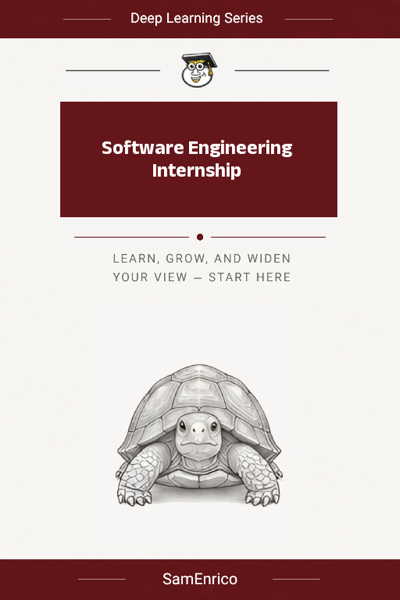
Software Engineering Internship eBook
A Coursebook on Software Engineering Internship
A Coursebook on Software Engineering Internship
Formats
Free sample
Chapter 1: The Return Offer Trap...--–- Most students believe an internship is about learning. They are wrong. An internship is a 12-week interview for a full-time job, and the moment you accept an offer, the clock starts ticking on a process that will determine your starting salary, your first employer’s brand on your resume, and potentially the entire trajectory of your early career. Yet ninety percent of interns walk through the door without understanding the single most important metric that separates those who get job offers from those who don’t.This chapter will reframe everything you think you know about software engineering internships. We will dismantle the “learning vacation” myth, expose why internships are actually more competitive than full-time roles, and give you a strategic framework for choosing where to apply that alone will double your odds of success.
By the end of this chapter, you will have a Target Company Matrix tailored to your specific situation and a self-assessment rubric that tells you exactly whether you are ready to apply or need four to six more weeks of preparation.Let us start with a story. Two computer science students, identical on paper—both 3.7 GPAs, both completed the same data structures and algorithms course, both had one personal project on Git Hub. Alex applied to two hundred companies using the same generic resume. Jamie applied to twenty companies using a targeted strategy based on the framework in this chapter. Alex received two interviews and zero offers.
Jamie received six interviews and three offers. The difference was not skill. The difference was understanding that an internship is not a lottery. It is a matching problem, and the students who treat it as such win.The Brutal Truth About Internships That Nobody Tells You Here is the first truth that career centers and well-meaning professors will not say out loud: internships are not primarily educational experiences. They are extended, low-risk auditions.
Companies do not spend ten thousand to thirty thousand dollars per intern (salary, housing stipends, recruiter time, mentor hours) out of charity or civic duty. They invest that money because the return on investment is enormous. Hiring a full-time engineer costs fifty thousand to one hundred thousand dollars in recruiting fees, relocation, sign-on bonuses, and the productivity loss of a new hire who takes six months to become net positive. Converting a successful intern costs almost nothing by comparison—a single conversation and a signed offer letter.This dynamic creates what economists call a “bilateral screening” process. You are evaluating the company as much as they are evaluating you.
But the power imbalance is real. For every desirable internship position at a top technology company, there are between one hundred and five hundred applicants. At Google, for example, the company receives over three million applications annually across all roles, and the internship acceptance rate hovers below two percent. Compare that to the full-time software engineer acceptance rate, which is higher—not because full-time candidates are better, but because the internship pipeline has already filtered out most of the risk.The second brutal truth: conversion rates matter more than prestige. A conversion rate is the percentage of interns who receive a full-time return offer at the end of their internship.
At some companies, that number is ninety percent or higher. At others, it is below thirty percent. Most students obsess over company brand names—Google, Microsoft, Facebook—without realizing that a high conversion rate at a less famous company often leads to a better outcome than a low conversion rate at a famous one. Why? Because a return offer gives you leverage.
A student who converts their internship has a guaranteed job waiting. That student can then negotiate from a position of strength with other companies. A student who interns at a prestigious company but does not receive a return offer enters the full-time job market in the fall with no leverage and a ticking clock.The third brutal truth: the “spray and pray” method—applying to hundreds of companies with the same resume and cover letter—is mathematically suboptimal. Sending one hundred generic applications yields approximately the same number of interviews as sending twenty well-targeted applications, but the latter consumes far less energy and allows you to customize each submission. The algorithms that power applicant tracking systems penalize generic applications.
When your resume contains keywords that do not match the job description, the system flags you as a low-relevance candidate and your application never reaches a human.The Return Offer Dynamic: Why Companies Play the Internship Game To understand why internships operate the way they do, you must understand the economics from the employer’s perspective. A full-time software engineer costs a company approximately two hundred thousand to three hundred thousand dollars annually when you factor in salary, bonus, equity, benefits, office space, and management overhead. Recruiting that engineer—paying external recruiters, running technical screens, flying candidates to onsite interviews—costs an additional twenty thousand to fifty thousand dollars per hire. And even after all that investment, the failure rate for external hires is high. Studies of technical hiring show that up to thirty percent of new engineering hires underperform or leave within the first twelve months.Now consider the intern-to-full-time conversion model.
An intern costs the company perhaps fifteen thousand dollars for a summer. That intern receives mentorship from existing employees who would be working anyway. The intern’s code contributions, even if modest, often provide net value. And most importantly, the company gets twelve weeks of real-time observation. They see how the intern handles ambiguity, how they ask for help, how they respond to code review feedback, how they interact with colleagues, and whether they actually deliver working software.
By the end of twelve weeks, the company has more data on that intern than they could gather in six months of interviewing an external candidate.This is why conversion rates are so high at well-run internship programs. The company has already done the hard work of filtering. They have already invested in your growth. They already know whether you are a culture fit. Extending a return offer is simply acknowledging the obvious.
At companies with mature internship programs—think Stripe, Dropbox, Jane Street, or the Google Engineering Residency—conversion rates routinely exceed eighty percent.The trap for students is assuming that all internship programs are created equal. They are not. Some companies treat interns as first-class citizens, assign them meaningful projects, assign dedicated mentors who actually have time to help, and run structured conversion processes. Other companies treat interns as cheap labor, assign them to write documentation or fix low-priority bugs, provide no mentorship, and have no clear process for return offers. Your job in the months before you apply is to tell the difference.The Target Company Matrix: Your Strategic Filter Most students organize their internship search by company name recognition.
This is a mistake. Instead, you should organize your search using a two-by-two matrix that evaluates companies on two independent dimensions: tech stack relevance and internship program maturity.Let us define these dimensions precisely.Tech stack relevance measures how closely a company’s primary technologies match the skills you want to build. If you are aiming for…
This is the end of the free sample. Get the eBook to keep going. Buy now
About this book
Details
- Author
- Thode Delores
- Publisher
- SamEnrico
- Language
- English
- Genre
- Non-Fiction, Informative, Educational
- Released
- 2026-05-09
- Pages (approx.)
- 140
- Available as
- eBook, Audiobook

Read better in the ZLOADR app
Your eBooks on your phone or tablet. Sign in with your SamEnrico account and start reading.
More by Thode Delores
 The Recovery First Productivity SystemThode Delores$11.99
 Manufacturing PMI SentimentThode Delores$11.99
 Loneliness in Chronic IllnessThode Delores$11.99
 Grade Anxiety Coping SkillsThode Delores$11.99
 Ultimate Handbook Guide to Cetinje : (Montenegro) Travel GuideThode Delores$11.99
 Agile Risk Management StartupThode Delores$12.99
 How to Produce Baby Safety Locks and GuardsThode Delores$11.99
You may also like
 Hong Kong Handover 1997Dunn Johnnie$11.99
 Zumba For Postnatal Recovery CourseNeal Christian$11.99
 Zumba for BeginnersLadner Nikia$11.99
 YouTube Comment Mining GuideHumes Pandora$12.99
 Worry Box MeditationCarlin Rudy$11.99
 Workplace Stress MeditationNguyen Lynn$11.99
 Workplace Stress and Sleep RepairHawley Ivory$11.99
 Workplace Perfectionism CureDelaney Jeffry$11.99
 Workplace Injustice Anger GuideWallen Isabelle$11.99
 Work Addiction and Burnout LinkGreenwood Ester$11.99
 Women in Yoga and WellnessBeattie Galina$11.99
 Women in Stand Up ComedyChun Evangeline$11.99