
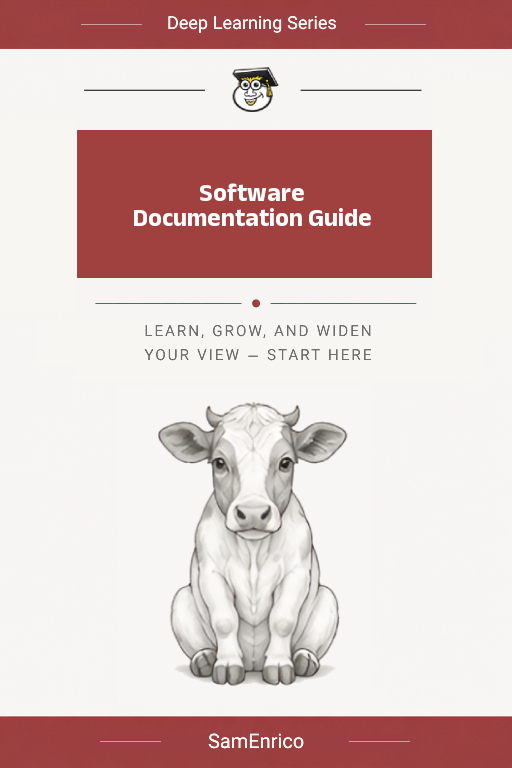
Non-FictionAI OperatorSoftware Docs
Software Documentation Guide eBook
Craft prompts for comprehensive software documenta
Craft prompts for comprehensive software documentation including features and configuration.
Formats
Free sample
Chapter 1: The Silent Crisis--–- Every year, software companies lose an estimated $85 billion to a problem they refuse to name. It is not bad code, security breaches, or missed deadlines—though it contributes to all three. It is the silent crisis of documentation: the invisible tax that engineers pay every time they answer a question already written down somewhere, every time a user abandons a product because they cannot figure out how to configure it, every time a team rebuilds a feature because the spec was unreadable.This crisis has a name in the industry: documentation debt. And unlike technical debt, which engineers understand, track, and occasionally refactor, documentation debt is invisible, unmeasured, and growing faster than ever. The average software company now spends 34% of its engineering time on tasks directly related to poor documentation—interpreting outdated guides, answering the same Slack questions, reverse-engineering their own systems. Yet when budgets tighten, documentation is the first line item cut.This book exists because that equation is backwards.We are entering an era where the distinction between software and its documentation is dissolving. The most valuable software products of the next decade will not be those with the most features, but those with the most usable, findable, and trustworthy documentation. And the teams that produce that documentation will not rely on heroic technical writers or patient engineers. They will rely on a new skill: the ability to craft prompts that transform raw code, scattered notes, and tribal knowledge into structured, user-centered documentation.This chapter lays the foundation. It will show you why the old model of documentation is broken, how artificial intelligence changes the economics of documentation, and what you must unlearn before you can write a single effective prompt. By the end, you will have a clear diagnosis of your own documentation debt and a roadmap for the rest of this book.The Iceberg You Cannot See Every software project has two versions: the one in the code and the one in the minds of the people who built it. Documentation is supposed to bridge these two versions, but in practice, it creates a third, even more dangerous version: the one that was true six months ago.Consider a typical mid-sized Saa S company with forty engineers, eighty internal microservices, and three thousand paying customers. By the numbers, this company might have excellent "documentation coverage"—a wiki page per service, a user guide for each feature, API references generated from Swagger. But when you ask a new engineer to deploy a development environment, they spend three days hunting for the correct configuration variables. When you ask a customer to reset their API key, they open a support ticket because the guide shows a UI that changed last quarter. When you ask the product manager why a feature shipped with the wrong behavior, they point to a spec that no one updated after the last sprint planning meeting.This is the documentation iceberg. Above the water: files, pages, and guides that look complete. Below the water: the silent costs of missing cross-references, outdated examples, contradictory instructions, and information that was never written down at all.The cost is real and measurable. A study by the Consortium for Information and Software Quality found that poor documentation accounts for 15-20% of all software rework—not bugs, but rework caused by misunderstood requirements, incorrect setup assumptions, and missing error handling information. For a team of ten engineers, that is two engineers working full-time on problems that good documentation would have prevented.But most organizations never measure this. Documentation debt remains invisible because it is normalized. Engineers assume that "documentation is always out of date." Product managers assume that "users never read it anyway." And leadership assumes that "technical writers are a luxury we cannot afford." These assumptions feed on each other, creating a culture where bad documentation is expected, and good documentation is impossible.Why Waterfall Killed Documentation (And Agile Didn't Save It)To understand why documentation is broken, you have to understand where it came from. The traditional approach to software documentation was born in the Waterfall era of the 1980s and 1990s, when software development followed a rigid sequence: requirements, design, implementation, testing, deployment. Documentation was produced in massive volumes before a single line of code was written. The Functional Requirements Document (FRD) might run five hundred pages. The Design Document another three hundred. The User Manual was printed and shipped in a box.This approach had a logic to it. When software changed slowly—measured in years, not weeks—upfront documentation could stay accurate. But it also created a culture where documentation was seen as a bureaucratic hurdle, not a tool for users. Engineers wrote documents because they had to, not because they wanted to. And readers learned to distrust anything older than the current release.Then Agile arrived, and with it, the promise of "just-in-time" documentation. The Agile Manifesto famously values "working software over comprehensive documentation," a phrase that many interpreted as "documentation is optional." What the authors actually meant was that documentation should be minimal, sufficient, and continuously updated—not abandoned. But in practice, many Agile teams dropped documentation entirely, relying on face-to-face communication and "self-documenting code" to fill the gap.Self-documenting code is a myth. Code tells you what happens, not why it happens, not how to configure it, not what the user should expect. A well-named variable and a clean function structure are valuable, but they do not replace a task-oriented guide or a troubleshooting flow. The Agile pendulum swung too far, and documentation debt accumulated faster than ever.Today, we are in a third phase: continuous documentation, powered by AI-assisted generation and retrieval. The goal is not to return to Waterfall's heavy upfront documents, nor to accept Agile's minimalism. It is to produce documentation that is modular, versioned, and updated automatically whenever the underlying software changes. This is the new ecology of software documentation, and it is the only path out of the crisis.The Three Document Types (And Why You Need All Three)Before you can write effective prompts for documentation, you must understand the three fundamental types of documentation that every software project needs. These categories come from information architecture research, particularly the work of David Weinberger and the DITA (Darwin Information Typing Architecture) standard. They are not arbitrary; they reflect how humans actually seek and use information.1. Concept documentation answers the question "What is this?" It explains the underlying model, the architecture, the relationships between components. Concept documentation is read when a user is learning for the first time, onboarding to a new system, or trying to understand why something works a certain way. It is written in explanatory language, often with diagrams and analogies.Example: "The Event Bus is a publish-subscribe system that allows microservices to communicate asynchronously. When a service publishes an event, any subscribed service receives it within 200ms."2. Task documentation answers the question "How do I do this?" It provides step-by-step instructions for achieving a specific goal. Task documentation is read when a user is active, trying to complete work. It is written in imperative language, with numbered steps, screenshots, and warnings about common mistakes.Example: "To reset your API key: 1. Navigate to Settings → Security. 2. Click 'Generate New Key'. 3. Copy the key immediately—it will not be shown again."3. Reference documentation…
This is the end of the free sample. Get the eBook to keep going. Buy now
About this book
Details
- Author
- Quinlan Earlene
- Publisher
- SamEnrico
- Language
- English
- Genre
- Non-Fiction, AI Operator, Software Docs
- Released
- 2026-05-30
- Pages (approx.)
- 152
- Available as
- eBook, Audiobook

Read better in the ZLOADR app
Your eBooks on your phone or tablet. Sign in with your SamEnrico account and start reading.
More by Quinlan Earlene
 Parent Vs Non Parent WellnessQuinlan Earlene$11.99
 Metta for Alzheimer's CaregiversQuinlan Earlene$11.99
 Ethiopia Not Colonized ExceptionQuinlan Earlene$11.99
 Garden of Peace VisualQuinlan Earlene$11.99
 The Imposter Syndrome Failure Log GuideQuinlan Earlene$11.99
 The Cairo Bank Heist: The Betrayal of Trust in the Golden AgeQuinlan Earlene$11.99
 Understanding Morillo–cucci–passarge SyndromeQuinlan Earlene$17.99
 Insurance AssistantQuinlan Earlene$11.99
 Maersk Shipping GuideQuinlan Earlene$12.99
 How to Become a Cloth-shrinking-machine OperatorQuinlan Earlene$11.99
You may also like
 Hong Kong Handover 1997Dunn Johnnie$11.99
 Zumba For Postnatal Recovery CourseNeal Christian$11.99
 Zumba for BeginnersLadner Nikia$11.99
 YouTube Comment Mining GuideHumes Pandora$12.99
 Worry Box MeditationCarlin Rudy$11.99
 Workplace Stress MeditationNguyen Lynn$11.99
 Workplace Stress and Sleep RepairHawley Ivory$11.99
 Workplace Perfectionism CureDelaney Jeffry$11.99
 Workplace Injustice Anger GuideWallen Isabelle$11.99
 Work Addiction and Burnout LinkGreenwood Ester$11.99
 Women in Yoga and WellnessBeattie Galina$11.99
 Women in Stand Up ComedyChun Evangeline$11.99