
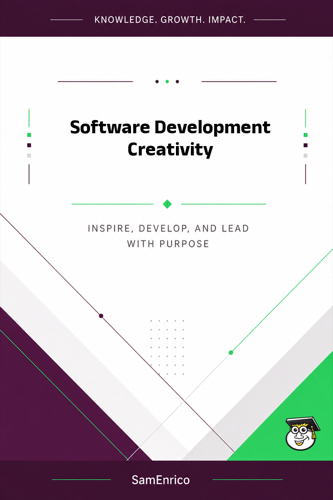
Software Development Creativity eBook
Apply creative coding approaches and novel archite
by Weed Twanna
Apply creative coding approaches and novel architectural solutions to tech problems.
Formats
Free sample
Chapter 1: The Generative Edge...–- Every software developer has felt it at least once: the quiet desperation of adding another well-documented, perfectly formatted, entirely predictable function to a system that is already drowning in predictability. You write the code, you run the tests, you deploy to production, and somewhere in the back of your mind, a small voice whispers: There has to be another way. That voice is not wrong. It is the voice of creative hunger, and in most software organizations, it is systematically starved into silence.The problem is not that developers lack creativity. The problem is that the dominant methodologies of the past three decades—waterfall, Agile, Scrum, SAFe, and their countless variations—have been optimized for repeatability, not novelty.
They treat software development as a manufacturing problem: requirements in, code out, with minimal variance. Variance, after all, is risk. Risk is bad. And so the machinery of modern software engineering grinds away at every interesting idea until nothing remains but flat, predictable surfaces.But here is the truth that the best-selling books and the conference talks rarely admit: the most valuable software systems in the world were not built by following best practices. They were built by breaking them—intelligently, deliberately, and creatively.
The original UNIX operating system was a creative rejection of the monolithic Multics design. The first web browser was a creative hack on top of the academic internet. The earliest version of Google's Map Reduce was a creative workaround for hardware constraints that were supposed to be impossible to solve.This book is about reclaiming that creative edge. Not as a luxury for "artistic" programmers, but as an engineering discipline with its own principles, practices, and measurable outcomes. This chapter establishes the foundation: why traditional methodologies kill creativity, what creative coding actually means, and how to recognize the difference between productive novelty and pointless novelty.
We will introduce a framework—the 7 Dimensions of Creative Programming—that will serve as a reference model for every subsequent chapter. And we will conclude with a new case study that illustrates AI-augmented creativity without overlapping with later physical prototyping material.The Death of Creativity by Methodology Let us begin with an uncomfortable observation. Agile methodologies were created to solve a real problem: the inability of waterfall projects to respond to changing requirements. But in their widespread adoption, Agile and its derivatives have become their own form of rigidity. The daily standup, the sprint planning, the retrospective, the story points—these rituals were never designed to maximize creativity.
They were designed to maximize throughput.Consider the core assumption of most Agile frameworks: that work can be broken into small, independently valuable units (user stories), estimated with reasonable accuracy, and delivered at a predictable velocity. This assumption works well for well-understood problems. Adding a login button? Yes. Updating a payment gateway integration?
Probably. Designing a novel caching strategy for a distributed graph database? The assumption collapses immediately.The psychologist Teresa Amabile, in her decades of research on creativity in organizations, identified a phenomenon she called the "creativity kill." It occurs when extrinsic constraints (deadlines, metrics, surveillance) overwhelm intrinsic motivation. Agile, with its burndown charts and velocity tracking, is a machine for generating extrinsic constraints. Every story point becomes a measure of worth.
Every missed commitment becomes a blemish. And in that environment, the safest thing to do is the thing you already know how to do.This is not an argument against structure. Creativity without constraints is not creativity; it is chaos. But the constraints must be the right kind of constraints—what we will call generative constraints in Chapter 4. The difference is this: destructive constraints limit possibility space without adding structure.
Generative constraints limit possibility space in a way that reveals new pathways.A destructive constraint: "You must estimate every task in story points, and your velocity cannot drop below 20 points per sprint."A generative constraint: "You must implement this feature using no more than 128KB of memory."The first constraint encourages grinding, repetition, and sandbagging. The second constraint forces novel solutions. The problem with modern software methodology is that it has optimized for the first kind of constraint while actively suppressing the second.Defining Creative Coding: A Deliberate Practice If creativity is not the absence of constraints, what is it? For the purposes of this book, we define Creative Coding as follows:Creative coding is the deliberate application of novel solutions to technical problems, where novelty is measured not by aesthetic whimsy but by the unexpectedness and effectiveness of the solution relative to the problem context.This definition has three critical components.First, it is deliberate. Creative coding is not random tinkering or "hacking until it works." It is a disciplined practice with its own techniques, heuristics, and evaluation criteria.
The creative developer does not hope for inspiration; they systematically generate and test candidate solutions.Second, it is problem-directed. The goal is not to produce code that is "interesting" in isolation. The goal is to solve a technical problem in a way that is better—along some dimension—than the obvious solution. Sometimes "better" means faster. Sometimes it means more maintainable.
Sometimes it means more surprising. But the problem provides the anchor.Third, it defines novelty in terms of unexpectedness and effectiveness. A solution that is surprising but useless is not creative; it is merely weird. A solution that is effective but entirely predictable is not creative; it is merely competent. True creative coding occupies the intersection: the solution is both effective and not obvious in advance.This definition distinguishes creative coding from related but distinct activities.
It is not "code golf" (writing the shortest possible solution), though compression can be a creative constraint. It is not "clever code" (writing something that impresses other developers but is hard to maintain), though cleverness can be a byproduct. It is not "generative art" (using code to produce visual patterns), though the techniques overlap.Creative coding, in this book, is a professional engineering practice that sits alongside testing, refactoring, and code review. It is not a replacement for those practices. It is an augmentation of them.The 7 Dimensions of Creative Programming To make creative coding teachable and measurable, we synthesize the work of Wouter Groeneveld and others into a unified framework: the 7 Dimensions of Creative Programming.
Each dimension is a skill that can be practiced, assessed, and improved. Together, they form the "creativity stack" that underlies every subsequent chapter in this book.Dimension 1: Technical Knowledge This is the most obvious dimension and the one most traditional education emphasizes. Technical knowledge includes fluency with programming languages, frameworks, data structures, algorithms, and system design patterns. But here is the key insight: technical knowledge enables creativity only when it is structural rather than superficial. Knowing that Python has a dictionary comprehension is superficial.
Understanding how hash tables handle collisions well enough to implement a novel distributed cache is structural.Depth of technical knowledge is the raw material for combinatorial creativity—the ability to merge two unrelated concepts into a new solution. Without deep knowledge in at least two domains, you cannot usefully combine them. Chapter 2 is dedicated entirely to this dimension.Dimension 2: Curiosity Curiosity is the drive to explore beyond the known. In software…
This is the end of the free sample. Get the eBook to keep going. Buy now
About this book
Details
- Author
- Weed Twanna
- Publisher
- SamEnrico
- Language
- English
- Genre
- Non-Fiction, Self-Help, Software Engineering
- Released
- 2026-06-08
- Pages (approx.)
- 154
- Available as
- eBook, Audiobook

Read better in the ZLOADR app
Your eBooks on your phone or tablet. Sign in with your SamEnrico account and start reading.
More by Weed Twanna
 Accountability Systems That WorkWeed Twanna$11.99
 Executive Temper Management GuideWeed Twanna$11.99
 Forgiving a Cheating PartnerWeed Twanna$11.99
 The Mexico Interview Attire GuideWeed Twanna$11.99
 The Midnight Healers: The Secret Surgeons of the Mali EmpireWeed Twanna$11.99
 Understanding Trisomy 12 MosaicismWeed Twanna$17.99
 Three Market VAT HandbookWeed Twanna$12.99
 African Edtech YC GuideWeed Twanna$12.99
 How to Become a Pit SupervisorWeed Twanna$11.99
 Coffee RoastingWeed Twanna$11.99