
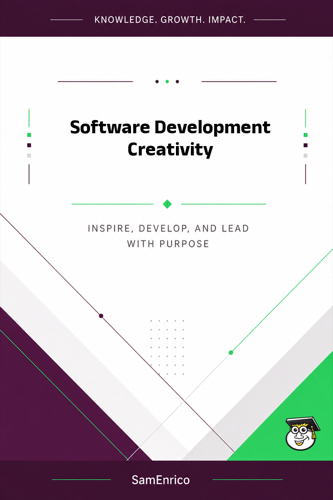
Software Development Creativity
Apply creative coding approaches and novel archite
by Weed Twanna
Apply creative coding approaches and novel architectural solutions to tech problems.
Formats
About this book
Free sample
Chapter 1: The Generative Edge...–- Every software developer has felt it at least once: the quiet desperation of adding another well-documented, perfectly formatted, entirely predictable function to a system that is already drowning in predictability. You write the code, you run the tests, you deploy to production, and somewhere in the back of your mind, a small voice whispers: There has to be another way. That voice is not wrong. It is the voice of creative hunger, and in most software organizations, it is systematically starved into silence.The problem is not that developers lack creativity. The problem is that the dominant methodologies of the past three decades—waterfall, Agile, Scrum, SAFe, and their countless variations—have been optimized for repeatability, not novelty.
They treat software development as a manufacturing problem: requirements in, code out, with minimal variance. Variance, after all, is risk. Risk is bad. And so the machinery of modern software engineering grinds away at every interesting idea until nothing remains but flat, predictable surfaces.But here is the truth that the best-selling books and the conference talks rarely admit: the most valuable software systems in the world were not built by following best practices. They were built by breaking them—intelligently, deliberately, and creatively.
The original UNIX operating system was a creative rejection of the monolithic Multics design. The first web browser was a creative hack on top of the academic internet. The earliest version of Google's Map Reduce was a creative workaround for hardware constraints that were supposed to be impossible to solve.This book is about reclaiming that creative edge. Not as a luxury for "artistic" programmers, but as an engineering discipline with its own principles, practices, and measurable outcomes. This chapter establishes the foundation: why traditional methodologies kill creativity, what creative coding actually means, and how to recognize the difference between productive novelty and pointless novelty.
We will introduce a framework—the 7 Dimensions of Creative Programming—that will serve as a reference model for every subsequent chapter. And we will conclude with a new case study that illustrates AI-augmented creativity without overlapping with later physical…
This is the end of the free sample. Get the eBook to keep going. Buy now
Contents
- Chapter 1
- Chapter 2
- Chapter 3
- Chapter 4
- Chapter 5
- Chapter 6
- Chapter 7
- Chapter 8
- Chapter 9
- Chapter 10
- Chapter 11
- Chapter 12
Details
- Author
- Weed Twanna
- Publisher
- SamEnrico
- Language
- English
- Genre
- Non-Fiction, Self-Help, Software Engineering
- Released
- 2026-06-08
- Pages (approx.)
- 154
- Available as
- eBook, Audiobook

Read better in the ZLOADR app
Your eBooks on your phone or tablet. Sign in with your SamEnrico account and start reading.
More by Weed Twanna
 Accountability Systems That WorkWeed Twanna$11.99
 Executive Temper Management GuideWeed Twanna$11.99
 Forgiving a Cheating PartnerWeed Twanna$11.99
 The Mexico Interview Attire GuideWeed Twanna$11.99
 The Midnight Healers: The Secret Surgeons of the Mali EmpireWeed Twanna$11.99
 Understanding Trisomy 12 MosaicismWeed Twanna$17.99
 Three Market VAT HandbookWeed Twanna$12.99
 African Edtech YC GuideWeed Twanna$12.99
 How to Become a Pit SupervisorWeed Twanna$11.99
 Coffee RoastingWeed Twanna$11.99