
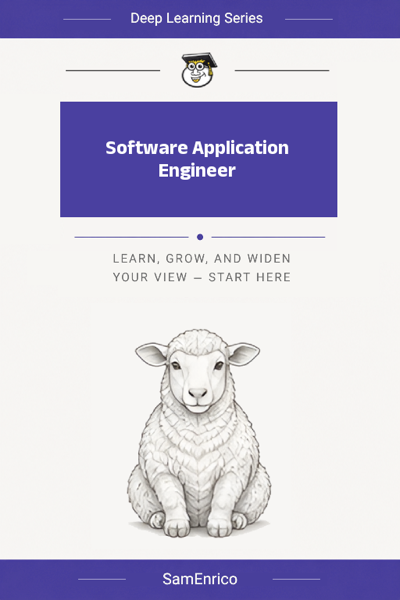
Software Application Engineer
A Coursebook on Software Application Engineer
by Colvin Adena
A Coursebook on Software Application Engineer
Formats
About this book
Free sample
Chapter 1: The Living Code--–- On a Tuesday afternoon in 2015, a single line of code—nine characters long—caused a nationwide outage of one of the world’s largest cloud providers. A development team had written a routine that deleted a small set of storage volumes. The code worked correctly in testing. It passed all reviews. It was deployed with standard procedures.
And within minutes, tens of thousands of customer websites, mobile apps, and backend services went dark.The post‑mortem revealed something surprising: the code was not wrong. It did exactly what it was told to do. The problem was that the engineers had misunderstood the nature of the system they were modifying. They had treated software as if it were a static artifact—unchanging, predictable, and fully knowable. In reality, the system had evolved over years into a complex web of dependencies, implicit assumptions, and emergent behaviors that no single person fully understood.That misunderstanding is the most dangerous mistake an application engineer can make.
And it is epidemic in our industry.This chapter dismantles that mistake at its root. You will learn why software is fundamentally different from every other engineered artifact. You will discover that code, once written, is not frozen—it is alive, constantly interacting with changing environments, shifting user expectations, and evolving dependencies. You will adopt a precise vocabulary for software quality that will serve you through every subsequent chapter. And you will confront the uncomfortable truth that entropy is not a bug in your system—it is a feature of your universe, and fighting it is not optional.By the end of this chapter, you will never again think of software as something you “finish.” You will see it as something you tend—like a garden, not a brick wall.The First Mistake: Believing Software Is a Material Every other engineering discipline works with physical materials.
Civil engineers build bridges from steel and concrete. Mechanical engineers design engines from aluminum and titanium. Electrical engineers route signals through copper and silicon. In each case, the material has predictable properties. Steel has known tensile strength.
Concrete has known compressive strength. These properties can be measured, modeled, and relied upon for decades.Software has no such properties.You…
This is the end of the free sample. Get the eBook to keep going. Buy now
Contents
- Chapter 1
- Chapter 2
- Chapter 3
- Chapter 4
- Chapter 5
- Chapter 6
- Chapter 7
- Chapter 8
- Chapter 9
- Chapter 10
- Chapter 11
- Chapter 12
Details
- Author
- Colvin Adena
- Publisher
- SamEnrico
- Language
- English
- Genre
- Non-Fiction, Informative, Educational
- Released
- 2026-06-02
- Pages (approx.)
- 149
- Available as
- eBook, Audiobook

Read better in the ZLOADR app
Your eBooks on your phone or tablet. Sign in with your SamEnrico account and start reading.
More by Colvin Adena
 Perfectionism Burnout ConnectionColvin Adena$11.99
 Ocean Breath for InsomniaColvin Adena$11.99
 Alcohol Calories and Weight LossColvin Adena$11.99
 Validation for Elderly ParentsColvin Adena$11.99
 The DMX Ruff Ryder StoryColvin Adena$11.99
 The Silk Road to Timbuktu: African Merchants Who Shaped the WorldColvin Adena$11.99
 Scrum vs Kanban for StartupsColvin Adena$12.99
 Learn to Play the SubidorColvin Adena$11.99
 How to Become a Stem-processing-machine OperatorColvin Adena$11.99