
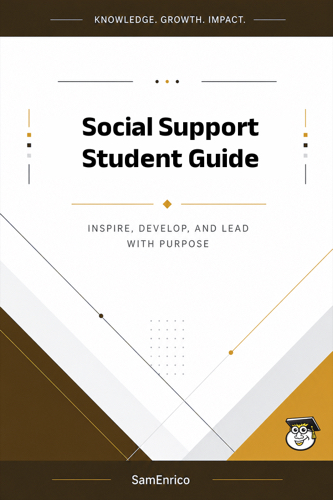
Non-FictionSelf-HelpSocial Support
Social Support Student Guide eBook
Talk to friends and family about academic pressure
by Seaman Sudie
Talk to friends and family about academic pressure.
Formats
Free sample
Chapter 1: The Ninety-Second Lie--The average student waits exactly ninety seconds between thinking I need help and deciding not to ask for it. This is not a metaphor. Researchers who study help-seeking behavior in adolescents have clocked it. A student sits at a desk, staring at a grade they cannot process. Their heart rate increases.
Their palms sweat. Their brain, in a perfectly normal protective response, generates the thought I should tell someone. Then the ninety-second countdown begins.For the first thirty seconds, the student rehearses. I will say, “I’m really struggling with this class.” I will say it right after dinner. I will text my friend first so I can’t back out.
The words feel possible. The body begins to relax slightly.For the next thirty seconds, the doubts creep in. What if they think I’m lazy? What if they tell me I should have studied harder? What if they already know I’m failing and they’re just waiting for me to admit it?
The words that felt possible now feel radioactive. The student’s shoulders tense again.For the final thirty seconds, the decision calcifies. Never mind. I’ll figure it out. It’s not that bad.
Other people have real problems. I just need to try harder. The thought I need help is buried under a pile of shame, comparison, and fear. The student closes the laptop, puts their head down, or opens Tik Tok to stop thinking entirely. Ninety seconds have passed.
The window has closed.This is the ninety-second lie. It is the lie that says asking for help is more dangerous than suffering alone. It is the lie that says your struggle is a personal failure rather than a universal human experience. It is the lie that says silence is safety.This book exists because the ninety-second lie is killing your grades, your relationships, and your mental health—and you have been told your whole life that the opposite is true. You have been told that successful people figure it out on their own.
You have been told that admitting weakness is the first step to losing respect. You have been told that everyone else is handling it, so you should too.Those are all lies. And this chapter is going to show you why.The Anatomy of a Hidden Struggle Before you can talk to anyone about your academic pressure, you have to understand what you are actually feeling. Most students cannot name their own distress because they have never been taught the vocabulary. They know something is wrong.
They know they feel bad. But when asked What’s wrong? the only answer they can produce is I don’t know or Everything or I’m just stressed.Let’s get specific.Academic pressure shows up in two distinct channels: physical symptoms and emotional symptoms. They feed each other. One bad grade triggers a physical stress response, which makes studying harder, which triggers another bad grade, which deepens the emotional spiral.
Understanding both channels is the first step toward breaking the loop.Physical Symptoms: What Your Body Is Telling You Your body knows you are struggling before your brain is willing to admit it. This is not weakness; it is biology. When you face a perceived threat—and yes, a failing grade registers as a threat to your social standing, future prospects, and self-concept—your nervous system activates the fight-or-flight response. Cortisol floods your system. Your heart rate increases.
Your digestion slows. Your muscles tense.These responses are designed for being chased by a predator, not for opening an email from your professor. But your body does not know the difference.Common physical symptoms of academic pressure include:Sleep disruption. You cannot fall asleep because your brain replay every mistake you made today. Or you fall asleep easily but wake up at 3 AM with your heart racing.
Or you sleep twelve hours and still wake up exhausted because your sleep quality is destroyed by stress hormones.Appetite changes. You forget to eat because you are too focused on avoiding your to-do list. Or you eat constantly because chewing is the only thing that quiets the anxiety. Or you have no interest in food at all, and your friends start asking if you are okay.Gastrointestinal distress. Stomach aches before exams.
Nausea when you think about checking your grades. The kind of digestive chaos that makes you wonder if you have developed a food allergy—except you have not. It is the pressure.Muscle tension. Clenched jaw. Shoulders up by your ears.
Headaches that start in the back of your neck and radiate forward. You do not notice you are holding tension until someone points it out, and then you realize you have been clenching for hours.Fatigue. Not the normal tiredness of a long day. This is the bone-deep exhaustion of carrying a secret. You wake up tired.
You go to class tired. You come home and collapse on your bed, scroll your phone for an hour, and still feel tired. Your body is spending enormous energy just keeping you functional while you hide your struggle.Racing heart. When you think about the thing you are avoiding—opening the grade portal, going to that professor’s office hours, showing your parents your report card—your heart pounds like you just ran up stairs. This is not anxiety about the task itself.
It is anxiety about the shame you believe will follow.Nail-biting, skin-picking, or other repetitive behaviors. These are self-soothing attempts gone haywire. Your body is trying to regulate itself through repetitive motion because your nervous system is stuck in high alert.If you recognize any of these symptoms in yourself, stop for a moment. Do not judge yourself. Just notice.
Your body has been trying to tell you something for weeks or months. You are not broken. You are not making it up. You are having a normal physiological response to an abnormal amount of pressure that you have been trying to manage alone.Emotional Symptoms: What Your Mind Is Telling You The physical symptoms are uncomfortable. The emotional symptoms are devastating.
This is where the ninety-second lie does its deepest damage.Shame. Not guilt—guilt is about something you did. Shame is about who you believe you are. The student who thinks I am a bad student rather than I did poorly on that test is experiencing shame. Shame tells you that your struggle is evidence of your fundamental worthlessness.
Shame is the voice that says Of course you are failing. You were never smart enough to be here.Fear of disappointing others. This is different from fear of failure. Fear of failure is about consequences—bad grades, lost scholarships, closed doors. Fear of disappointing others is about relationships.
It is the sick feeling in your stomach when you imagine telling your parents about your grade and watching their faces fall. It is the dread of your favorite teacher looking at you with pity instead of pride.Imposter syndrome. The belief that every success was luck and every failure is the truth finally coming out. The student with imposter syndrome lives in constant terror of being “found out.” They…
This is the end of the free sample. Get the eBook to keep going. Buy now
About this book
Details
- Author
- Seaman Sudie
- Publisher
- SamEnrico
- Language
- English
- Genre
- Non-Fiction, Self-Help, Social Support
- Released
- 2026-06-06
- Pages (approx.)
- 134
- Available as
- eBook, Audiobook

Read better in the ZLOADR app
Your eBooks on your phone or tablet. Sign in with your SamEnrico account and start reading.
More by Seaman Sudie
 Mindfulness for MusiciansSeaman Sudie$11.99
 Financial Stress and Tax DebtSeaman Sudie$11.99
 Tobacco Cessation for Restaurant WorkersSeaman Sudie$11.99
 The Tokyo Syndicate: The Yakuza's European ExpansionSeaman Sudie$11.99
 Etsy Seller App Growth StrategiesSeaman Sudie$11.99
 How to Produce Auto ElectronicsSeaman Sudie$11.99
 Monetary Policy Reaction FunctionsSeaman Sudie$12.99
 How to Start a Ferro Concrete Bar Bending and Fixing Contractor Business (Beginners Guide)Seaman Sudie$11.99
You may also like
 Hong Kong Handover 1997Dunn Johnnie$11.99
 Zumba For Postnatal Recovery CourseNeal Christian$11.99
 Zumba for BeginnersLadner Nikia$11.99
 YouTube Comment Mining GuideHumes Pandora$12.99
 Worry Box MeditationCarlin Rudy$11.99
 Workplace Stress MeditationNguyen Lynn$11.99
 Workplace Stress and Sleep RepairHawley Ivory$11.99
 Workplace Perfectionism CureDelaney Jeffry$11.99
 Workplace Injustice Anger GuideWallen Isabelle$11.99
 Work Addiction and Burnout LinkGreenwood Ester$11.99
 Women in Yoga and WellnessBeattie Galina$11.99
 Women in Stand Up ComedyChun Evangeline$11.99