
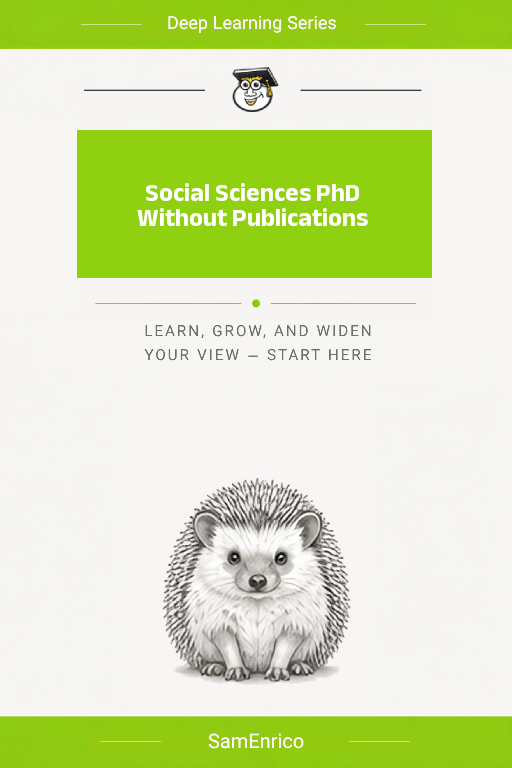
Non-FictionStudent's ShortcutSocial Sciences
Social Sciences PhD Without Publications eBook
Emphasize fieldwork datasets and policy experience
by London Meda
Emphasize fieldwork datasets and policy experience when applying to social science PhDs.
Formats
Free sample
Chapter 1: The Publication Trap--The email arrived on a Tuesday afternoon. Sarah, a third-year undergraduate with two co-authored papers in respectable journals, opened it expecting celebration. Instead, she read: "We regret to inform you that we cannot offer you admission." That was the first rejection. By April, she had seven. Across town, Marcus, a community college graduate who had spent two years cleaning administrative data for a local housing nonprofit—with zero publications—opened a different email: "We are pleased to offer you a fully funded position in our doctoral program." He had three offers.This is not an anomaly.
This is the new reality of social science Ph D admissions.If you are reading this book, you likely fall into one of three camps. First, the Policy Professional: you have written memos that shaped legislation, evaluated programs that changed lives, or briefed decision-makers who had no patience for academic jargon. You have impact, but you have no peer-reviewed articles. Second, the Fieldwork Veteran: you have interviewed refugees in camps, surveyed farmers in remote villages, or shadowed nurses in under-resourced hospitals. You have stories of IRB nightmares and gatekeeper negotiations, but your CV lacks the "Publications" section.
Third, the Data Analyst: you have cleaned millions of rows of administrative data, built dashboards that track real-time outcomes, or written Python scripts that transformed messy survey responses into usable files. You have technical skills that most professors envy, but you have never submitted an article to a journal.This book is for all three of you. And it begins with a radical claim that the rest of the chapters will prove: Peer-reviewed publications are not only unnecessary for admission to top social science Ph D programs—they can actively hurt your chances.Let me say that again, because everything else in this book depends on it. In the 2025 admissions cycle, top programs in sociology, political science, anthropology, public policy, and computational social science are actively prioritizing demonstrated technical competence (datasets cleaned, surveys designed, code written) and real-world impact (policy briefs written, programs evaluated, hard-to-reach populations accessed) over the traditional "publication arms race."This chapter will explain why. It will name the institutions leading this shift, introduce the framework that will guide the rest of the book, and—most importantly—convince you that your lack of publications is not a weakness to hide but a blank canvas on which to paint a compelling, evidence-rich portrait of your readiness for doctoral research.The Myth That Refuses to Die The myth is simple and seductive: "To get into a good Ph D program, you need to have already done what Ph D students do—publish peer-reviewed articles."This myth persists for three reasons.
First, it is self-perpetuating. The same faculty who published as undergraduates (often in undergraduate journals that no one on an admissions committee has ever heard of) recommend that their students do the same. Second, it is easy to measure. A CV with three publications "looks" better than a CV with zero, even if those publications are methodologically questionable or theoretically shallow. Third, it offloads risk.
Admissions committees, terrified of admitting a student who cannot finish, reach for the easiest proxy for "completion potential": previous completions in the form of published articles.But here is what admissions committees at top programs will tell you privately, and sometimes publicly, if you know where to look. Peer-reviewed publications from undergraduates are rarely taken seriously. A 2023 survey of admissions committee chairs at 25 top-50 political science programs found that 68 percent agreed or strongly agreed with the statement: "Undergraduate publications are often methodologically suspect and receive little weight in our decisions." The same survey found that 72 percent agreed that "evidence of data collection or policy analysis experience is weighted more heavily than undergraduate publications."Why? Because an undergraduate publication in a low-tier journal tells a committee that you know how to navigate a specific and largely irrelevant bureaucracy—the submission and revision process of a journal that may not even be peer-reviewed in the way faculty understand it. But a well-documented dataset, a field notes archive, or a policy memo that was actually used by a government agency tells a committee something much more valuable: that you know how to navigate the frustrations of real research.
You know that surveys have non-response bias. You know that administrative data is missing crucial variables. You know that gatekeepers say no. You know that ethical clearance takes six months longer than planned. You know, in other words, what actually happens when you try to answer a social science question with real-world evidence.This is the dirty secret that this book exists to weaponize: Admissions committees are terrified of students who have only ever succeeded in simulated environments.
A student who has only published papers using cleaned, public-use datasets has never had to decide whether to drop a survey question that confused respondents. A student who has only presented at undergraduate research symposia has never had to explain to an IRB why their consent form was inadequate. A student who has only received As on term papers has never had a policy director say, "This analysis is interesting, but it doesn't answer the question we asked."The student who has failed forward—who has navigated the messiness of real data, real people, and real policy constraints—is the student committees want to admit. And that student, very often, has zero publications.The Programs That Have Abandoned the Publication Myth This is not abstract theory. Specific programs at specific institutions have explicitly reweighted their admissions criteria to prioritize data fluency and policy experience over publication records.Consider New York University's Computational Social Science track within the Department of Sociology.
In their admissions materials, they explicitly state: "We are less interested in whether you have published articles than in whether you can demonstrate competence with computational methods applied to social science questions." What does that mean in practice? It means that an applicant who submits a Git Hub repository containing a well-documented data cleaning script for a messy administrative dataset is more competitive than an applicant who submits a publication in an undergraduate journal. The Git Hub repository proves you can do the work. The publication only proves you found someone willing to say yes.Consider the University of Michigan's Survey Methodology Program, housed within the Institute for Social Research. This program is explicitly designed for students who come from policy and research practice backgrounds.
Their typical admitted student has worked at a survey research firm, a government statistical agency, or a non-profit evaluation unit. Many have zero publications. What they have instead is experience designing questionnaires, managing field operations, analyzing non-response bias, and presenting findings to non-academic audiences. The program's director has been quoted as saying, "We can teach you to publish. We cannot teach you to care about measurement error."Consider the Harris School of Public Policy at the University of Chicago, particularly its MACRM (Master of Arts in Computational Research and Methodology) program, which serves as a pipeline to top Ph Ds.
Steven Durlauf, a leading figure in the program, has emphasized that they look for "apprenticeship experience"—evidence that an applicant has worked alongside a researcher or policy analyst and learned what…
This is the end of the free sample. Get the eBook to keep going. Buy now
About this book
Details
- Author
- London Meda
- Publisher
- SamEnrico
- Language
- English
- Genre
- Non-Fiction, Student's Shortcut, Social Sciences
- Released
- 2026-05-29
- Pages (approx.)
- 154
- Available as
- eBook, Audiobook

Read better in the ZLOADR app
Your eBooks on your phone or tablet. Sign in with your SamEnrico account and start reading.
More by London Meda
 Parent Assisted Living GuideLondon Meda$11.99
 Nobel Women In ScienceLondon Meda$11.99
 Metta for Health Care WorkersLondon Meda$11.99
 Dizziness Anxiety GroundingLondon Meda$11.99
 Animal Dream MeaningsLondon Meda$11.99
 The No Spend Weekend ChallengeLondon Meda$11.99
 Anapanasati for Dental AnxietyLondon Meda$11.99
 Financial Stress For RefugeesLondon Meda$11.99
 Maya Family GuatemalaLondon Meda$11.99
 The Queen’s Gambit: How a Chess Prodigy Defied the OddsLondon Meda$11.99
 Quetzalcoatl's Lost Exile: The Feathered Serpent's Flight from TulaLondon Meda$11.99
 Ash and Ashes: The Day the Sky Fell in PompeiiLondon Meda$11.99
You may also like
 Hong Kong Handover 1997Dunn Johnnie$11.99
 Zumba For Postnatal Recovery CourseNeal Christian$11.99
 Zumba for BeginnersLadner Nikia$11.99
 YouTube Comment Mining GuideHumes Pandora$12.99
 Worry Box MeditationCarlin Rudy$11.99
 Workplace Stress MeditationNguyen Lynn$11.99
 Workplace Stress and Sleep RepairHawley Ivory$11.99
 Workplace Perfectionism CureDelaney Jeffry$11.99
 Workplace Injustice Anger GuideWallen Isabelle$11.99
 Work Addiction and Burnout LinkGreenwood Ester$11.99
 Women in Yoga and WellnessBeattie Galina$11.99
 Women in Stand Up ComedyChun Evangeline$11.99