
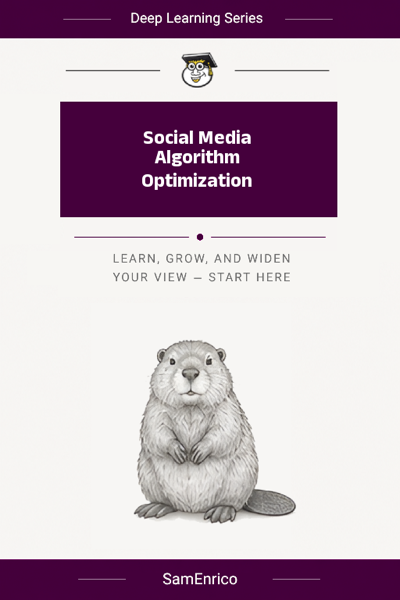
Social Media Algorithm Optimization eBook
A Coursebook on Social Media Algorithm Optimizatio
A Coursebook on Social Media Algorithm Optimization
Formats
Free sample
Chapter 1: The Attention Engine--–- In 2018, a little-known Chinese company called Byte Dance released an app that would forever change how the internet works. The app was Tik Tok, and within eighteen months, it had done something Facebook, You Tube, and Instagram had spent a decade trying to accomplish: it had cracked the code of human attention so completely that the average user spent ninety minutes per day inside it. Not per week. Per day.Here is what made Tik Tok different. Every previous social platform had organized content around social graphs—the network of people you followed.
Tik Tok abandoned that entirely. Its For You Page did not care who you followed, who your friends were, or what you had liked yesterday. It cared about one thing and one thing only: what made you stay.The other platforms panicked. Facebook’s internal leaked documents from 2019 reveal executives watching Tik Tok’s growth with what one memo called “extreme concern bordering on fear.” Instagram rushed to copy the format, launching Reels in 2020. You Tube created Shorts.
Even Linked In, the most professional of networks, began testing a video-first feed. Every platform realized simultaneously that the old rules had changed. The algorithm was no longer a recommendation system. It had become an attention engine.This chapter is about that engine. Not the myths surrounding it, not the speculation, not the conspiracy theories—the actual mechanical reality of how platforms decide what to show, to whom, and why.
By the time you finish these pages, you will understand something most creators never grasp: the algorithm is not judging your content as good or bad. It is measuring your content as sticky or slippery. And once you understand what sticky actually means, you stop being a victim of the algorithm and start being an operator of it.The One Metric That Rules All Others Let me state the central truth of this entire book in one sentence: every algorithm on every social platform exists to maximize a single number called session time.Session time is the total number of consecutive minutes a user spends on an app before closing it or switching to another task. If you open Instagram, watch three reels, scroll your feed for two minutes, read five comments, and then lock your phone, you have generated approximately four minutes of session time. If you open the same app, see one post you do not like, and close it after ten seconds, you have generated ten seconds of session time.The algorithm’s job is to maximize the former and minimize the latter.This is not speculation.
This is the explicit business model of every major platform. Meta’s 2023 10-K filing with the Securities and Exchange Commission states clearly: “Our revenue is primarily generated from advertising. Our ability to generate revenue depends on our ability to maintain and grow user engagement across our products.” Engagement is the polite corporate word for session time. The longer you stay, the more ads you see. The more ads you see, the more money the platform makes.Every design decision you have ever noticed on social media—and dozens you have not noticed—exists to extend session time.
Infinite scroll removes the natural stopping point of a page break. Auto-play video removes the decision to click play. Push notifications pull you back into the app when you have left. The “you’re all caught up” message is not a convenience; it is a psychological trick that creates a sense of completion so you feel comfortable starting another session.Even the features creators complain about most are session extenders. Why does Instagram show you posts from people you do not follow?
Because your social graph is too small to keep you scrolling indefinitely. Why does Tik Tok loop videos automatically? Because a second watch extends session time without requiring the algorithm to find new content. Why do comments sort by “most relevant” instead of chronological? Because the most engaging comments keep you reading longer.Understanding session time is the foundation of everything else in this book.
Every signal we will discuss—retention, completion, shares, saves, dwell time—is a proxy for session time. The algorithm does not actually care about your content. It cares about whether your content keeps people on the platform. If it does, the algorithm will amplify you. If it does not, the algorithm will ignore you.
There is no morality here. There is no judgment. There is only math.The History of How We Got Here To understand why session time became the supreme metric, you need to understand the three eras of social media feeds. Each era taught platforms something new about attention, and each era left behind creators who refused to adapt.Era One: The Chronological Feed (2004–2012)In the beginning, there was order. Facebook launched in 2004 with a feed that showed every post from every friend in reverse chronological order—newest first, oldest last.
Twitter followed in 2006 with the same model. Instagram joined in 2010. The chronological feed was simple, transparent, and utterly democratic. You followed someone, you saw everything they posted.The problem was volume. By 2010, the average Facebook user followed more than 200 pages and friends.
The average Twitter user followed more than 400 accounts. Users were missing posts from their closest friends because those posts were buried under twelve hours of memes, news articles, and baby photos. Session time suffered because users felt overwhelmed, not engaged. They would scroll for a few minutes, feel the anxiety of falling behind, and close the app.Platforms realized that more content was not better content. Users needed a filter—someone or something to decide what actually mattered.Era Two: The Interest-Based Feed (2012–2018)In 2012, Facebook introduced Edge Rank, the first major algorithmic feed.
Edge Rank scored every post based on three factors: affinity (how often you had interacted with the creator), weight (the type of content—video scored higher than text), and recency (newer posts scored higher). Suddenly, not all followers were equal. A post from your best friend appeared before a post from a brand you had liked three years ago.This was a revolution. The algorithm began guessing what you wanted to see, not just showing you everything in order. User session time increased by 30 percent within six months of Edge Rank’s deployment.
Instagram followed in 2016, despite massive user protests. “I miss the chronological feed!” users screamed on Twitter, Instagram, and Facebook. Then they kept scrolling. Average time spent on Instagram jumped from twenty-one minutes per day to thirty-two minutes per day after the algorithmic change.The lesson was brutal but clear: users say they want control, but their attention reveals they want curation.Era Three: The AI-Driven Feed (2018–Present)Tik Tok shattered the remaining assumptions in 2018. Previous algorithms still considered the social graph—they recommended content from people you followed or people similar to those you followed.
Tik Tok’s For You Page abandoned the social graph entirely. It did not care who you followed. It cared about what you watched to completion, what you rewatched, what you shared, and what you scrolled past instantly.The results were staggering. Within two years, Tik Tok had more than one billion active users. Average…
This is the end of the free sample. Get the eBook to keep going. Buy now
About this book
Details
- Author
- Knudsen Melodi
- Publisher
- SamEnrico
- Language
- English
- Genre
- Non-Fiction, Informative, Educational
- Released
- 2026-06-02
- Pages (approx.)
- 158
- Available as
- eBook, Audiobook

Read better in the ZLOADR app
Your eBooks on your phone or tablet. Sign in with your SamEnrico account and start reading.
More by Knudsen Melodi
 Immigrant Dance Studio Chain SuccessKnudsen Melodi$11.99
 Creative Block MythsKnudsen Melodi$11.99
 Active Listening For Grief SupportKnudsen Melodi$11.99
 Wholesaling Dialer SystemsKnudsen Melodi$11.99
 Triathlon Injury PreventionKnudsen Melodi$11.99
 The Car Ride HomeKnudsen Melodi$11.99
 Assertiveness With Aging ParentsKnudsen Melodi$11.99
 Traffic Jam Patience GuideKnudsen Melodi$11.99
 Hollywood Family Master GuideKnudsen Melodi$11.99
 The Last Laugh: How a 19th-Century Joke Changed the WorldKnudsen Melodi$11.99
 Whispers from the Underworld: The Secret Burials of the Roman EliteKnudsen Melodi$11.99
 The Enlightenment: Seeds of Modern ReasonKnudsen Melodi$11.99