
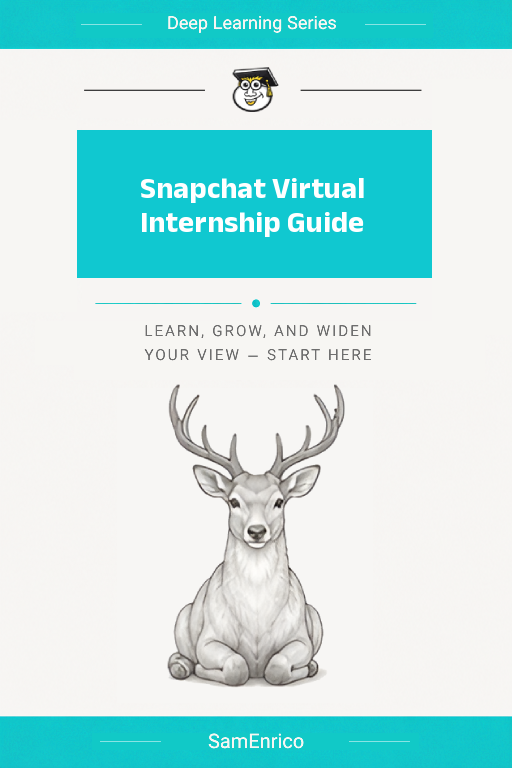
Snapchat Virtual Internship Guide eBook
Find remote internships at Snap Inc. in augmented
by Beeler Kizzy
Find remote internships at Snap Inc. in augmented reality, engineering, or product design.
Formats
Free sample
Chapter 1: The Ghost Strategy...--Snap Inc. is not a social media company. This is the single most important misunderstanding that separates rejected applicants from interns who build features used by a billion people. If you walk into an interview talking about how much you love streaks, filters, or Snap Map, you have already lost. The company that started as a disappearing-photo app has spent the last eight years silently transforming into something else entirely: a spatial computing company that happens to have a social layer.
And the internship you are applying for exists not to help people send selfies, but to build the operating system for the next generation of computing—the one that will replace your phone screen with glasses.This chapter is not an introduction. It is a strategic reorientation. Most internship guides waste your time with generic advice about networking, resume formatting, and "showing enthusiasm." Those things matter, but they are hygiene factors. What actually gets you hired at Snap is something deeper: understanding why the company exists, where it is going, and how your specific skills fit into a roadmap that most applicants cannot even name. By the end of this chapter, you will see Snap the way its recruiters and hiring managers do.
More importantly, you will know whether you are truly ready to apply—or whether you need to go back and build skills that actually matter.Let us start with a simple question that most candidates answer incorrectly.What does Snap Inc. actually do?If you answered "Snapchat," you are wrong. That is like saying Apple sells computers or Amazon sells books. Snapchat is the distribution layer, the attention engine, the reason people open their phones. But the product is not the company.
The company is a camera company. This distinction is not semantic. It determines every strategic decision, every hiring priority, and every internship project you will ever touch at Snap.The camera is the input device for the next computing platform.Think about every major computing shift. Mainframes were for calculation. Personal computers were for documents.
The internet was for information. Smartphones were for apps. The next shift, the one happening right now, is from screens to spaces. Instead of looking down at a glowing rectangle, you will look through glasses that place digital objects in the physical world. This is spatial computing.
And the primary way we interact with spatial computing is through a camera—one that sees the world, understands surfaces, tracks faces, maps rooms, and renders digital objects as if they actually exist in front of you.Snap understood this before almost anyone else. In 2016, while other social media companies were copying each other's feeds and stories, Snap released Spectacles: sunglasses with a built-in camera. They were clunky, limited, and ahead of their time. The industry laughed. Then, in 2023, Apple announced Vision Pro, a $3,500 headset for spatial computing.
Suddenly, everyone realized that the future was not a bigger screen on your phone but no screen at all. Snap had been quietly building toward that future for seven years.Here is what matters for your internship application. When you join Snap, you are not joining a social media company that happens to have some AR features. You are joining a spatial computing company that uses social media as the distribution channel to train its algorithms, gather data, and keep users engaged while the hardware catches up. Every internship project, whether you are building a Lens, optimizing a renderer, or designing a gesture interface, feeds into one mission: making AR the primary way humans interact with computers.This is why your interview answer cannot be "I love Snapchat filters." That answer tells the hiring manager that you see Snap as a consumer, not as a builder.
The right answer connects your personal passion to the spatial computing thesis. For example: "I have been following Snap's AR roadmap since Spectacles 4. I am fascinated by the challenge of occlusion—how digital objects know when to disappear behind real ones. That problem sits at the intersection of computer vision, real-time rendering, and user experience. I want to help solve it."That candidate gets the interview.Snap has three strategic pillars that support its spatial computing thesis.
Each pillar represents a distinct area of investment, and each pillar creates specific internship opportunities. You do not need to work on all three. You need to understand how your track contributes to the whole system.The first pillar is Snapchat itself. With over one billion monthly active users, Snapchat is the distribution engine for everything Snap builds. Every Lens, every AR experience, every new feature gets tested at a scale that most companies can only dream of.
But here is the nuance that most applicants miss: Snapchat is not the destination. It is the on-ramp. The goal is to make AR so compelling that users spend more time in Lenses than in the camera roll. When that happens, the transition to Spectacles feels natural because users already understand AR as a medium. Your internship work on Snapchat—whether you are optimizing Lens performance, designing new camera tools, or analyzing engagement data—is directly feeding the long-term transition to glasses.The second pillar is Lens Studio.
This is Snap's creator tool, and it is the most underrated asset in the entire AR industry. More than three hundred thousand creators have built over three million Lenses using Lens Studio. That is not a feature. That is a moat. While Apple and Meta are trying to convince developers to build for their platforms, Snap already has a massive army of creators who build for free because they love the medium.
Lens Studio is also your primary entry point as an internship applicant. Regardless of your track, you need to understand Lens Studio intimately. AR Creators live inside it. Engineers need to understand its limitations so they can improve the underlying rendering pipeline. Product Designers need to prototype in it to test their ideas.
The best internship portfolios are not Power Point decks. They are QR codes that let recruiters try your Lenses on their own phones.The third pillar is Spectacles. This is the long bet. Spectacles are Snap's AR glasses, and they are still primarily a developer device. They are not ready for mass adoption.
The field of view is limited, the battery life is short, and the price is high. But every generation gets better. Spectacles 5, which you may encounter during your internship, includes hand tracking, world mesh mapping, and persistent content that stays in place even when you look away. If you are applying for Core Engineering or AR Engineering, you need to be excited about the constraints of wearable hardware. Low latency, thermal management, and real-time rendering on a battery are not academic problems.
They are the daily reality of building for Spectacles. The interns who get return offers are the ones who ship improvements to this stack.Now let us talk about what Snap actually expects from interns. This is where most guides mislead you. They tell you that internships are about learning, about networking, about "getting experience." That is true at companies where interns are treated as temporary help. At Snap, interns are treated…
This is the end of the free sample. Get the eBook to keep going. Buy now
About this book
Details
- Author
- Beeler Kizzy
- Publisher
- SamEnrico
- Language
- English
- Genre
- Non-Fiction, Student's Shortcut, AR
- Released
- 2026-05-30
- Pages (approx.)
- 132
- Available as
- eBook, Audiobook

Read better in the ZLOADR app
Your eBooks on your phone or tablet. Sign in with your SamEnrico account and start reading.
More by Beeler Kizzy
 Six Tastes Ayurvedic GuideBeeler Kizzy$11.99
 Binge Eating and Seasonal Affective DisorderBeeler Kizzy$11.99
 Renewable Energy Precedent GuideBeeler Kizzy$11.99
 Estonia Digital Nomad VisaBeeler Kizzy$11.99
 The Mental Health Facility SurvivorBeeler Kizzy$11.99
 Melatonin Phase ShiftBeeler Kizzy$11.99
 Dual Diagnosis Alcohol GuideBeeler Kizzy$11.99
 Exonerated by DNA After IdentificationBeeler Kizzy$11.99
 The Shadow of the Silver Screen: Elijah Craig and the Birth of American Cinema NoirBeeler Kizzy$11.99
 The Silk Conspiracy: Argentina's Great Stock Market Swindle (1929)Beeler Kizzy$11.99
 How to Become a Paraffin-machine OperatorBeeler Kizzy$11.99
 A Collector's Handbook to the Ford V8-48Beeler Kizzy$11.99