
Non-FictionInformativeEducational
Snake Bite Kit Restocking eBook
A Coursebook on Snake Bite Kit Restocking
A Coursebook on Snake Bite Kit Restocking
Formats
Free sample
Chapter 1: The Deadliest Box...-- The box arrived on a Tuesday, wrapped in bright yellow plastic with a cartoon snake on the front—fangs bared, eyes crossed, tongue sticking out in a mock threat. It looked like a toy. Inside, nestled in vacuum-formed plastic, lay a miniature scalpel blade, a plastic suction cup attached to a syringe, and a laminated instruction card showing a crude drawing of a man cutting an X into his own leg. The price tag read $29.99. The fine print read "Lifetime Guarantee." The expiration date on the antiseptic wipe read three years ago.This is the snake bite kit that will kill you.Not because it's empty.
Not because it's cheap. But because it contains exactly the wrong things, packaged with exactly the wrong instructions, sold with exactly the wrong confidence. The person who buys this kit believes they are prepared. They will pack it in their hiking bag, strap it to their ATV, or hang it on the wall of their hunting cabin. And when the fangs sink in—when the burning spreads up the arm or the vision blurs or the blood refuses to clot—they will reach for this kit.
They will follow the instructions. And they will make everything worse.This book exists to ensure that never happens to you.The history of snake bite treatment is not a story of steady progress. It is a graveyard of good intentions, littered with remedies that felt right, looked effective, and killed people faster than the venom itself. Before we can talk about restocking a snake bite kit—before we can list components, check expiration dates, or practice the Pressure Immobilisation Technique—we must understand how we arrived at this moment. Why do most commercial snake bite kits contain proven killers?
Why did it take until 1979 for anyone to publish the correct method? And why, forty-five years later, can you still walk into a pharmacy and buy a device that will actively pump venom deeper into your tissues?This chapter answers those questions. It is not comfortable reading. It will challenge what you think you know about first aid. It may make you angry—angry at the manufacturers, angry at the regulators, angry at yourself for trusting the wrong products.
That anger is useful. Channel it into the rest of this book, because the remaining eleven chapters will teach you how to build, maintain, and restock a kit that actually works. But first, the deadliest box.The Age of Poison and Prayer Before the invention of the modern snake bite kit—before anyone thought to package first aid supplies in a plastic box—victims relied on folk medicine, religious ritual, and desperate improvisation. The earliest recorded treatments appear in ancient Egyptian papyri, circa 1600 BCE, which recommend incantations over the wound followed by the application of roasted donkey dung. The Ebers Papyrus, one of the oldest complete medical texts, lists no fewer than twenty-two different snake bite remedies, including onion pulp, fermented beer, and the ground-up liver of a specific species of fish.
None worked. Some caused infection. The donkey dung, in particular, introduced Clostridium tetani spores into wounds with remarkable efficiency.Ancient Greek medicine made marginal improvements. Hippocrates—the same Hippocrates whose oath doctors still swear—observed that snake bite victims who remained calm and still survived longer than those who panicked and ran. This was the first documented recognition of what we now call the lymphatic venom transport system.
Hippocrates did not know about lymph nodes or capillaries, but he noticed that movement accelerated death. His prescription: lie still, bind the wound loosely, and wait. For two thousand years, this was the best advice available.Roman naturalist Pliny the Elder took a different approach. In his encyclopedia Naturalis Historia, he recommended sucking the venom out of the wound—by mouth, preferably by a person who had recently consumed large quantities of alcohol. The alcohol, he theorized, would neutralize the venom in the sucker's mouth.
It did not. But the practice of oral suction persisted for centuries, appearing in medieval European herbals, Arabic medical texts, and eventually the first printed first aid manuals of the nineteenth century.The Middle Ages contributed almost nothing useful. European physicians treated snake bite with bloodletting (removing the "poisoned blood"), trepanning (drilling holes in the skull to release evil spirits), and theriac—a sixty-four-ingredient concoction that included opium, viper flesh, and crushed pearls. Theriac remained in European pharmacopeias until the eighteenth century. It cost a fortune.
It did nothing. Patients who survived after taking theriac almost certainly would have survived anyway, but the drug took credit.The Cut-and-Suck Era The nineteenth century brought industrialization, scientific method, and the single most persistent bad idea in snake bite history: the cut-and-suck kit.In 1834, a French naval surgeon named Dr. François-Thomas Mangin published a pamphlet describing a new device for treating snake bite. It consisted of a razor blade (for cutting an X over the fang marks) and a glass suction cup with a rubber bulb (for drawing out the venom). Mangin claimed his device had saved dozens of sailors on colonial outposts.
He offered no data, no controlled trials, and no follow-up on the patients who died despite treatment. But the device was cheap to manufacture and easy to sell, and within a decade, cut-and-suck kits had spread across Europe, the Americas, and British colonial holdings.The problem with cut-and-suck is not that it fails to remove venom. It does fail at that, spectacularly. Studies using radioactive tracers have shown that even under ideal conditions—immediate application, perfect technique, unlimited time—suction removes less than one percent of injected venom. The problem is worse: cutting the wound creates an open portal for bacteria, increases bleeding, and damages underlying nerves and blood vessels.
In the case of viper bites, which cause tissue destruction and bleeding disorders, cutting the wound can transform a survivable envenomation into a hemorrhagic catastrophe.But the cut-and-suck kit had one advantage that kept it in production for 150 years: it gave people something to do. In an emergency, the human brain craves action. Standing still, lying down, and waiting feels wrong. Cutting and sucking feels like fighting back. That emotional appeal overwhelmed the evidence.
Even today, you can find cut-and-suck kits for sale on Amazon, e Bay, and in major outdoor retailers. The packaging has been updated. The plastic is shinier. The instructions are printed in four languages. But the content is exactly what Mangin described in 1834: a blade, a cup, and a lie.The Electric Interlude Between 1890 and 1920, electricity was the miracle cure for everything.
Snake bite was no exception.The theory, such as it was, held that high-voltage electrical current would "denature" venom proteins, rendering them harmless. A handful of snake bite kits from this era included handheld electrostatic generators—small wooden boxes with brass terminals and glass handles—that could deliver a painful shock across the wound. Advertisements claimed that "a single application of the Galvanic Snake Bite Neutralizer" would prevent all symptoms of envenomation. The device cost the equivalent of $400 in modern currency.It did nothing. High-voltage current does not denature venom in living tissue because the current follows the path of least resistance (typically along blood…
This is the end of the free sample. Get the eBook to keep going. Buy now
About this book
Details
- Author
- Wolff Conchita
- Publisher
- SamEnrico
- Language
- English
- Genre
- Non-Fiction, Informative, Educational
- Released
- 2026-06-02
- Pages (approx.)
- 154
- Available as
- eBook, Audiobook

Read better in the ZLOADR app
Your eBooks on your phone or tablet. Sign in with your SamEnrico account and start reading.
More by Wolff Conchita
 HRT For Women With Family History Cancer CourseWolff Conchita$11.99
 Validating Social Anxiety FearsWolff Conchita$11.99
 Forgiveness TriggerWolff Conchita$11.99
 Jumia Public Listing StrategyWolff Conchita$11.99
 Generative AI Spending ForecastWolff Conchita$11.99
 The Lady of the Land: How South Africa's First Female Property Mogul Defrauded a NationWolff Conchita$11.99
 Flutterwave Payment API GuideWolff Conchita$12.99
 Lagos Pop Up Electricity and PowerWolff Conchita$12.99
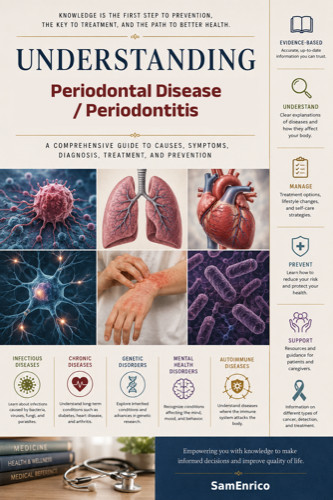 Understanding Periodontal Disease / PeriodontitisWolff Conchita$17.99
 How to Become a Office-machine ServicerWolff Conchita$11.99
You may also like
 Hong Kong Handover 1997Dunn Johnnie$11.99
 Zumba For Postnatal Recovery CourseNeal Christian$11.99
 Zumba for BeginnersLadner Nikia$11.99
 YouTube Comment Mining GuideHumes Pandora$12.99
 Worry Box MeditationCarlin Rudy$11.99
 Workplace Stress MeditationNguyen Lynn$11.99
 Workplace Stress and Sleep RepairHawley Ivory$11.99
 Workplace Perfectionism CureDelaney Jeffry$11.99
 Workplace Injustice Anger GuideWallen Isabelle$11.99
 Work Addiction and Burnout LinkGreenwood Ester$11.99
 Women in Yoga and WellnessBeattie Galina$11.99
 Women in Stand Up ComedyChun Evangeline$11.99