
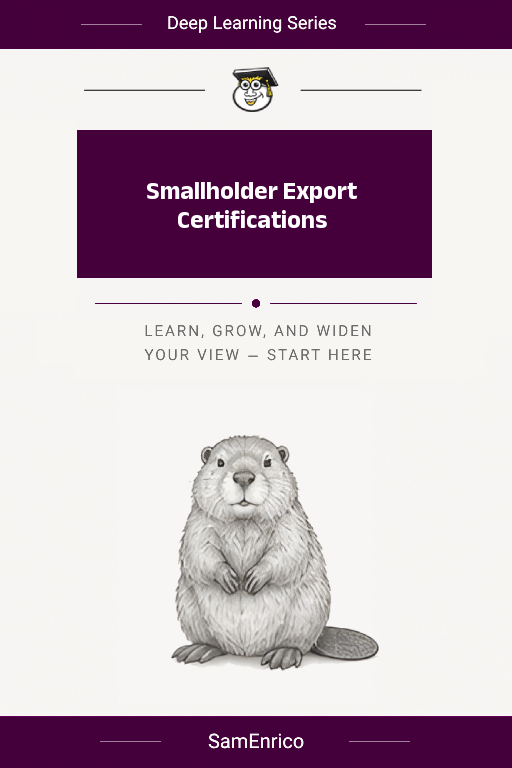
Smallholder Export Certifications eBook
Access sustainable certifications for smallholder
by Sharp Andrea
Access sustainable certifications for smallholder exports including Rainforest Alliance, UTZ, and 4C for coffee and cocoa.
Formats
Free sample
Chapter 1: The Coffee Origins...--In 1987, a small group of conservationists gathered in a humid conference room in New York City. They were worried about tropical rainforests, which were disappearing at a rate of nearly 80,000 acres per day. They had tried everything – petitions, protests, documentaries. Nothing had slowed the destruction.Then one of them had an unconventional idea. What if they could save the rainforest by making it more valuable standing than cut down?
What if they could create a label – a seal of approval – that told consumers which products came from farms that protected biodiversity, conserved water, and treated workers fairly?That idea became the Rainforest Alliance. And it changed the world.Thirty-five years later, the landscape of certification is unrecognizable. There are dozens of seals, labels, and standards. There are audits, traceability systems, and internal control procedures that would have seemed like science fiction to those 1987 conservationists. There is a bewildering alphabet soup of acronyms: UTZ, 4C, EUDR, ICS, CLMRS.
And there are smallholder farmers – the 25 million families who grow the coffee and cocoa the world craves – who are often confused, overwhelmed, and locked out of the very markets their beans supply.This chapter is the key to that confusion. You will learn where modern certification came from, why UTZ and Rainforest Alliance merged (and what that means for your existing certificate), how 4C fits in as an entry-level stepping stone, and which seals actually matter to European and North American buyers today. You will learn the critical nuance that most guides miss: UTZ certificates issued before mid-2022 are still valid until they expire. And you will finish with a clear roadmap of the current certification hierarchy – from 4C at the base to Rainforest Alliance in the middle, with Organic and Fair Trade as bolt-ons at the top.By the end of this chapter, you will understand not just the history of certification, but exactly where your cooperative stands in the landscape today.The Birth of Rainforest Alliance: Conservation Through Markets The Rainforest Alliance was founded in 1987 by Daniel Katz, a former environmental activist who had grown frustrated with the limitations of traditional conservation. Protecting rainforests as parks and reserves worked, but only in small areas.
The vast majority of tropical forests were being used for agriculture – coffee, cocoa, bananas, timber. If conservationists could not stop farming, Katz reasoned, they could change farming.The Rainforest Alliance Certified seal launched in 1992 for bananas, then expanded to coffee in 1994, and cocoa in 1995. The standard focused on three pillars that remain to this day: environmental stewardship (protecting biodiversity, conserving water, reducing agrochemicals), social responsibility (fair treatment of workers, access to healthcare and education, no child or forced labor), and economic viability (farm profitability, traceability, continuous improvement).For the first decade, Rainforest Alliance was the only major certification focused specifically on tropical agriculture. It grew steadily, but it was expensive and complex – accessible mainly to large farms and estates. Smallholders, who produced 80% of the world's coffee, were largely left out.This gap would soon be filled by a new certification born in the Netherlands.UTZ Kapeh: Traceability for the Smallholder The year 2002 was pivotal.
A Dutch roaster named Ward de Groote had a problem. He wanted to source sustainable coffee, but he could not prove where his beans came from. Traceability was a mess. Beans from a hundred different farms were mixed in a single container. If a farmer used child labor or cut down forest, there was no way to trace that bad bean back to the farm.De Groote created UTZ Kapeh (a Mayan word meaning "good coffee") with a radical innovation: a traceability system that followed certified beans from farm to roaster.
Each bag of UTZ coffee had a unique code. If there was a problem, the roaster could trace it back to the specific farm. This was revolutionary.But traceability was expensive. How could smallholders afford it?The solution was group certification. Instead of certifying each farm individually (costing 3,000−5,000perfarmperyear),UTZallowedcooperativestocertifyasagroup.Thecooperativebuiltan Internal Control System(ICS)–asetofinternalrules,inspections,anddocumentationthatallowedittoactasitsownpre−auditor.The ICSisexplainedindetailin Chapter2and Chapters8−9.Fornow,understandthatgroupcertificationreducedthecostperfarmerto3,000-5,000 per farm per year), UTZ allowed cooperatives to certify as a group.
The cooperative built an Internal Control System (ICS) – a set of internal rules, inspections, and documentation that allowed it to act as its own pre-auditor. The ICS is explained in detail in Chapter 2 and Chapters 8-9. For now, understand that group certification reduced the cost per farmer to 3,000−5,000perfarmperyear),UTZallowedcooperativestocertifyasagroup.Thecooperativebuiltan Internal Control System(ICS)–asetofinternalrules,inspections,anddocumentationthatallowedittoactasitsownpre−auditor.The ICSisexplainedindetailin Chapter2and Chapters8−9.Fornow,understandthatgroupcertificationreducedthecostperfarmerto10-20 per year – affordable for cooperatives.UTZ exploded. By 2015, UTZ was the largest certification program for coffee and cocoa in the world, covering over 500,000 farmers across dozens of countries.The 4C Baseline: A Door for the Poorest Farmers Not every smallholder could meet Rainforest Alliance or UTZ standards. The requirements – shade trees, water conservation, complex documentation – were beyond many of the poorest farmers, especially in West Africa and parts of Southeast Asia.In 2003, the coffee industry created the 4C Association (Common Code for the Coffee Community).
The 4C standard was deliberately basic. It was a baseline – an entry-level certification that any farmer could achieve with minimal investment. The requirements focused on eliminating the worst practices (child labor, forced labor, deforestation of primary forest, use of the most dangerous pesticides) rather than requiring positive practices (shade trees, composting, complex traceability).4C became the gateway certification. A cooperative that achieved 4C could then, over several years, upgrade to Rainforest Alliance. The 4C baseline provided income and experience that made the more rigorous standards attainable.Critical note: 4C remains active today.
It is not a stepping stone that disappears after a cooperative upgrades. Some cooperatives maintain both 4C and Rainforest Alliance simultaneously, selling 4C beans to buyers who only require the baseline, and Rainforest Alliance beans to premium buyers. Others graduate from 4C to Rainforest Alliance and drop the lower certification. The choice depends on your buyers' requirements.The 2018 Merger: Why UTZ and Rainforest Alliance Combined By 2015, the certification landscape had become confusing. A roaster in Europe faced a bewildering choice: Rainforest Alliance?
UTZ? 4C? Fair Trade? Organic? Each had different standards, different audits, different labels.
Consumers could not tell them apart. Farms were being audited multiple times per year by different certification bodies, at enormous cost.The solution was a merger. In 2018, UTZ and Rainforest Alliance announced they would combine into a single organization. The merger took two years to complete, concluding in 2020. The new organization retained the Rainforest Alliance name but incorporated the best practices from both programs: UTZ's traceability system and Rainforest Alliance's environmental standards.What does this mean for certified farmers?Your Current Certificate What Happens What You Should Do Rainforest Alliance (issued 2019 or earlier)Continues as is; no action needed Renew as usual UTZ (issued before mid-2022)Remains valid until expiration date Continue using UTZ label; do not recertify early UTZ (expired, seeking renewal)Must transition to Rainforest Alliance Apply for Rainforest Alliance certification Critical nuance – UTZ phase-out timeline:The UTZ label was phased out for new certifications by mid-2022.
However, and this is crucial, products certified under UTZ before that date remain valid until their individual certification expires. A UTZ…
This is the end of the free sample. Get the eBook to keep going. Buy now
About this book
Details
- Author
- Sharp Andrea
- Publisher
- SamEnrico
- Language
- English
- Genre
- Non-Fiction, Business Brief
- Released
- 2026-05-29
- Pages (approx.)
- 132
- Available as
- eBook, Audiobook

Read better in the ZLOADR app
Your eBooks on your phone or tablet. Sign in with your SamEnrico account and start reading.
More by Sharp Andrea
 The Religious Shame GuideSharp Andrea$11.99
 Life Purpose Vision Board GuideSharp Andrea$11.99
 Growth Mindset For ImmigrantsSharp Andrea$11.99
 ADHD Stimulant AbuseSharp Andrea$11.99ADHD Stimulant AbuseSharp Andrea$11.99
 CrossFit WOD Recovery GuideSharp Andrea$11.99
 The Desert Gambit: Rommel's Phantom War in the SandsSharp Andrea$11.99
 Pre Seed Fundraising EventsSharp Andrea$12.99
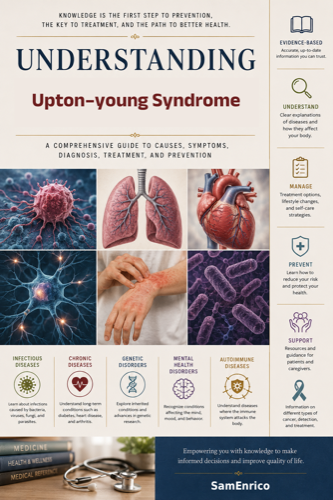 Understanding Upton–young SyndromeSharp Andrea$17.99
 How to Start a Petroleum Refineries BusinessSharp Andrea$11.99
 Food GardeningSharp Andrea$11.99
You may also like
 Hong Kong Handover 1997Dunn Johnnie$11.99
 Zumba For Postnatal Recovery CourseNeal Christian$11.99
 Zumba for BeginnersLadner Nikia$11.99
 YouTube Comment Mining GuideHumes Pandora$12.99
 Worry Box MeditationCarlin Rudy$11.99
 Workplace Stress MeditationNguyen Lynn$11.99
 Workplace Stress and Sleep RepairHawley Ivory$11.99
 Workplace Perfectionism CureDelaney Jeffry$11.99
 Workplace Injustice Anger GuideWallen Isabelle$11.99
 Work Addiction and Burnout LinkGreenwood Ester$11.99
 Women in Yoga and WellnessBeattie Galina$11.99
 Women in Stand Up ComedyChun Evangeline$11.99