
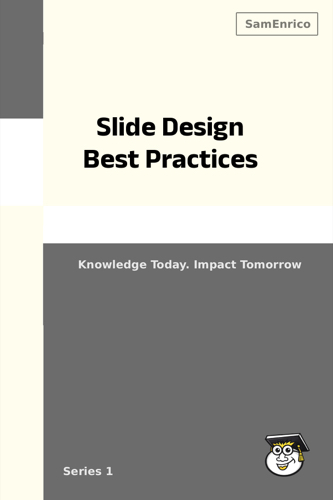
Non-FictionSelf-HelpVisual Communication
Slide Design Best Practices
Create visuals that support not distract from your
Create visuals that support not distract from your message using this guide.
Formats
About this book
Free sample
Chapter 1: The Blank Page Lie–- Every first slide is a lie. Not a malicious lie, not a deceptive lie, but a lie nonetheless. The blank page does not ask you questions. It does not challenge your assumptions. It does not whisper, “Why should anyone care about this?” It simply sits there, pristine and patient, waiting for you to fill it with whatever comes to mind.
And what comes to mind, for most professionals, is text. Lots and lots of text.This chapter opens with a provocative claim that will unsettle you: Power Point, Keynote, Google Slides—none of them are your enemy. Your enemy is the seductive silence of the blank canvas. Because when you open presentation software for the first time, you are not starting at zero. You are starting at negative ten.
You have already lost the battle before typing a single word.The reason is simple. Software does not care about your audience. Software does not know whether you are presenting to the C-suite or to summer interns. Software does not understand the difference between a live presentation and a document to be read alone. Software is a tool, but it is a tool that comes with default behaviors—and default behaviors are not neutral.
They are opinions. And the opinion of every presentation tool is this: fill me with text, use standard bullet points, and trust that more information is better information.That opinion is wrong.The Cognitive Cost of Reading While Listening Let us begin with science, because science does not care about your corporate template either. In the 1980s, researchers began studying what they called the “split-attention effect.” The finding was simple and devastating: when a person is asked to read text and listen to spoken words simultaneously, their brain cannot fully process both streams of information. It is not a matter of effort or intelligence. It is a matter of neurology.Your brain has two separate channels for processing information—one for visual input (reading, looking at images) and one for auditory input (listening, hearing sounds).
These channels can work at the same time, but they compete for a shared pool of cognitive resources. When you…
This is the end of the free sample. Get the eBook to keep going. Buy now
Contents
- Chapter 1
- Chapter 2
- Chapter 3
- Chapter 4
- Chapter 5
- Chapter 6
- Chapter 7
- Chapter 8
- Chapter 9
- Chapter 10
- Chapter 11
- Chapter 12
Details
- Author
- Humphreys Arianne
- Publisher
- SamEnrico
- Language
- English
- Genre
- Non-Fiction, Self-Help, Visual Communication
- Released
- 2026-06-07
- Pages (approx.)
- 133
- Available as
- eBook, Audiobook

Read better in the ZLOADR app
Your eBooks on your phone or tablet. Sign in with your SamEnrico account and start reading.
More by Humphreys Arianne
 Voice Acting Retirement LifeHumphreys Arianne$11.99
 Exit Strategy Multiples ApproachHumphreys Arianne$11.99
 Senior Volunteer ConfidenceHumphreys Arianne$11.99
 Iron Optimization For Women CourseHumphreys Arianne$11.99
 Pelvic Floor PilatesHumphreys Arianne$11.99
 Creative Habits for SalesHumphreys Arianne$11.99
 Boomer vs Gen Z SpendingHumphreys Arianne$11.99
 The Salim Group Scandal: Indonesia's Corporate Empire UnraveledHumphreys Arianne$11.99
 The Vanishing of the Skywatchers: The Lost Crew of Flight 19Humphreys Arianne$11.99
 Giraffes: Towering HerbivoresHumphreys Arianne$11.99
 How to Produce Cotton BallsHumphreys Arianne$11.99
 Book Value Per Share FormulaHumphreys Arianne$12.99
You may also like
 Hong Kong Handover 1997Dunn Johnnie$11.99
 Zumba For Postnatal Recovery CourseNeal Christian$11.99
 Zumba for BeginnersLadner Nikia$11.99
 YouTube Comment Mining GuideHumes Pandora$12.99
 Worry Box MeditationCarlin Rudy$11.99
 Workplace Stress MeditationNguyen Lynn$11.99
 Workplace Stress and Sleep RepairHawley Ivory$11.99
 Workplace Perfectionism CureDelaney Jeffry$11.99
 Workplace Injustice Anger GuideWallen Isabelle$11.99
 Work Addiction and Burnout LinkGreenwood Ester$11.99
 Women in Yoga and WellnessBeattie Galina$11.99
 Women in Stand Up ComedyChun Evangeline$11.99