
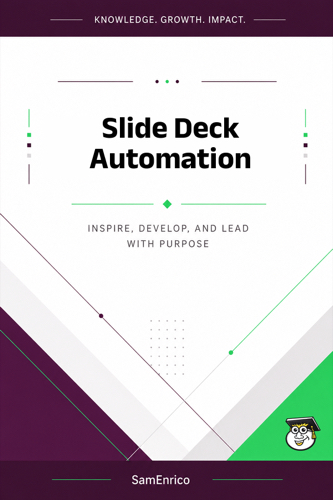
Slide Deck Automation eBook
Connect AI tools to automatically generate slides
Connect AI tools to automatically generate slides from reports and data.
Formats
Free sample
Chapter 1: The Blank Slide Graveyard--–- The email arrived at 11:47 PM on a Tuesday. Subject line: "Urgent – Board Deck v34_FINAL_REALLYFINAL.pptx." Attached was a file that had consumed eighteen hours of someone's life. Inside that file were seventy-two slides, each one a tombstone of manual labor: a chart copied from Excel as an image (because the link broke three versions ago), a table reformatted by hand, arrows drawn with the shape tool because no one had time to learn the alignment features, and a dozen fonts that drifted from Calibri to Arial to something called "Comic Sans MS Emergency." Somewhere in that deck was a single number—$4.2 million in Q3 revenue—that had been retyped fourteen times across different slides. On slide forty-one, it said $4.2 million. On slide fifty-two, it said $4.3 million.
No one noticed until the board meeting, when the CFO pointed at the screen and asked, "Which one is real?"This is not an isolated failure. This is the daily reality of knowledge work in the twenty-first century. The blank slide—that pristine white rectangle with the blinking cursor—has become a graveyard of productivity, swallowing hours, days, and weeks of human attention. And the tragedy is that almost none of that time is spent on strategic thinking. It is spent on logistics: copying, pasting, aligning, reformatting, checking, rechecking, and then copying again because the source data changed.This chapter is about why the blank slide is obsolete.
It is about the hidden cost of context switching, the quiet catastrophe of unstructured data, and a fundamental shift in how we should think about presentation building. The solution is not a better template or a faster mouse. The solution is redefining the role of AI from a passive assistant that suggests the next sentence to an active orchestrator that builds logical slide sequences from source documents. But before we get to the solution, we must understand the full weight of the problem.The Hidden Mathematics of Manual Decks Let us begin with a simple calculation. A mid-level manager at a Fortune 500 company spends, on average, four hours per week building slide decks.
That is two hundred hours per year, or five full workweeks, dedicated exclusively to the mechanical act of moving information from one format to another. When we expand this to a team of ten managers, we lose fifty workweeks per year—an entire person-year of labor that produces no new insights, no strategic decisions, and no competitive advantage.But the raw hour count understates the damage. The real cost is cognitive fragmentation. Every time a human switches between Excel (looking at numbers), Power Point (arranging slides), and email (collecting feedback), there is a cognitive switching penalty. Research in applied psychology pegs this penalty at approximately twenty minutes to fully regain deep focus after an interruption.
A deck that requires forty context switches—which is conservative for a twenty-slide presentation—costs nearly fourteen hours of lost focus beyond the actual working time.This explains why a deck that should take two hours often takes two days. It is not that the work is hard. It is that the work is fractured. And fracture is the natural enemy of quality.Consider what happens inside those fractured hours. A manager pulls data from a CRM export, pastes it into Excel, reformats it, copies the resulting chart into Power Point, resizes it because the aspect ratio is wrong, types a title, sends a draft to a colleague, waits for feedback, receives a comment that says "can we see the regional breakdown?", returns to Excel, filters by region, creates four new charts, pastes them into Power Point, realigns the four charts manually because Power Point's auto-align feature never works on the first try, sends another draft, receives another comment, and so on.
Each cycle adds another layer of manual labor. Each cycle introduces another opportunity for error.And the errors are not hypothetical. A study of corporate presentations found that the average twenty-slide deck contains three factual inconsistencies—contradictory numbers, mislabeled axes, outdated dates—that go undetected until the presentation is delivered. In high-stakes environments like board meetings or investor pitches, those three errors can translate into millions of dollars of lost credibility.The Unstructured Data Catastrophe The root cause of this inefficiency is not laziness or incompetence. It is data entropy.
Most organizations swim in a sea of unstructured information: PDFs from external research firms, Slack threads containing product feedback, CSV exports from analytics platforms, meeting notes stored in a dozen different folders, and email attachments that have been forwarded so many times that their provenance is lost.Structured data lives in databases with schemas and relationships. Unstructured data is everything else. And unstructured data now accounts for approximately eighty to ninety percent of all enterprise data. This means that the raw material for most slide decks—the quotes, charts, numbers, and narratives that ultimately appear on slides—is scattered across dozens of formats and locations. There is no single source of truth.
There is only a patchwork of sources, each with its own update cadence, formatting quirks, and permission model.Let us follow a typical piece of unstructured data on its journey to a slide. A product manager writes a quarterly update in a Google Doc. That doc contains a table of key metrics. The table is manually typed, not linked to any live source. Three weeks later, an analyst copies that table into an internal wiki.
The wiki formatting breaks the table's alignment. A director then copies the broken table into a Power Point deck, realigns it by hand, and changes one of the numbers because the source data updated in the CRM. That changed number is never reflected back in the original Google Doc or the wiki. Now there are three versions of the same data point, and no one knows which one is correct.This is not an edge case. This is the default workflow for thousands of organizations.
The result is that slide decks become repositories of frozen, decaying information. The moment a deck is exported to PDF or presented to an audience, it begins to age. The numbers inside it are already out of date relative to live systems. But because the deck is a static artifact, no one knows which numbers have changed unless they manually re-check every source.The annual cost of this decay is staggering. Enterprise surveys estimate that employees spend an average of six hours per week simply searching for and validating information that should already be trusted.
That is nearly three hundred hours per year per knowledge worker. For a team of fifty, that is fifteen thousand hours of labor spent on trust verification—work that adds no value to the final product.From Assistant to Orchestrator: A Necessary Reorientation The technology industry has spent the last five years building AI assistants. These tools live inside documents, spreadsheets, and slide decks, waiting for a prompt. "Write a title for this slide." "Summarize this paragraph." "Generate an image of a growth chart." These are useful features. They save seconds here and minutes there.
But they do not solve the structural problem. They are bandages on a broken workflow.The reason assistants fail to deliver…
This is the end of the free sample. Get the eBook to keep going. Buy now
About this book
Details
- Author
- Passmore Tamie
- Publisher
- SamEnrico
- Language
- English
- Genre
- Non-Fiction, AI Operator
- Released
- 2026-06-09
- Pages (approx.)
- 125
- Available as
- eBook, Audiobook

Read better in the ZLOADR app
Your eBooks on your phone or tablet. Sign in with your SamEnrico account and start reading.
More by Passmore Tamie
 Postpartum Body EsteemPassmore Tamie$11.99
 Emotional Cheating Self EsteemPassmore Tamie$11.99
 Five Minute Dream Log GuidePassmore Tamie$11.99
 Strength Training For DancersPassmore Tamie$11.99
 Pet Food Recall DatabasePassmore Tamie$11.99Pet Food Recall DatabasePassmore Tamie$11.99
 Pearl Harbor SurvivorPassmore Tamie$11.99
 Serbian Manufacturing ResurgencePassmore Tamie$11.99
 Stacey Abrams VotingPassmore Tamie$11.99
 The Siege of Legation Quarter: China's Boxer Rebellion and the Birth of Modern Naval PowerPassmore Tamie$11.99
 The Oslo Vault Heist: A Million-Dollar Museum MysteryPassmore Tamie$11.99
 Fire and Ice: The Forgotten Volcanologists of AntarcticaPassmore Tamie$11.99
You may also like
 Hong Kong Handover 1997Dunn Johnnie$11.99
 Zumba For Postnatal Recovery CourseNeal Christian$11.99
 Zumba for BeginnersLadner Nikia$11.99
 YouTube Comment Mining GuideHumes Pandora$12.99
 Worry Box MeditationCarlin Rudy$11.99
 Workplace Stress MeditationNguyen Lynn$11.99
 Workplace Stress and Sleep RepairHawley Ivory$11.99
 Workplace Perfectionism CureDelaney Jeffry$11.99
 Workplace Injustice Anger GuideWallen Isabelle$11.99
 Work Addiction and Burnout LinkGreenwood Ester$11.99
 Women in Yoga and WellnessBeattie Galina$11.99
 Women in Stand Up ComedyChun Evangeline$11.99