
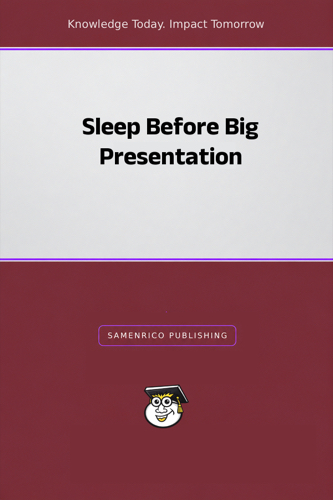
Non-FictionMental WealthSleep Hygiene
Sleep Before Big Presentation eBook
Optimize pre talk sleep with wind down routine and
Optimize pre talk sleep with wind down routine and worry journaling at bedside.
Formats
Free sample
Chapter 1: The 3 AM Grip--–- The clock on your nightstand reads 3:14 AM. You have been staring at it for forty-seven minutes. The presentation is in five hours. Your heart is pounding not with fear, but with a strange, electric alertness that feels exactly like the opposite of sleep. You have tried everything the internet told you to do.
You drank chamomile tea at 9 PM. You put your phone on Do Not Disturb. You repeated “just relax” to yourself so many times that the words lost all meaning. And yet here you are, wide awake, your brain running laps around a track that leads nowhere.This is not a failure of willpower. It is not a sign that you are weak, unprepared, or broken.
It is, in fact, a perfectly predictable biological response to a specific set of circumstances. And once you understand why this is happening, you will stop fighting yourself and start working with the very mechanisms that are currently keeping you awake.This chapter is not another collection of generic sleep tips. It will not tell you to “avoid screens” as if that single piece of advice could undo the cascade of stress hormones flooding your system. Instead, this chapter will show you why the night before a big presentation is fundamentally different from any other night, why your brain has mistaken excitement for danger, and why the most common advice actually makes things worse. By the end, you will understand the real enemies and, more importantly, why they are not your fault.The Cruel Irony of High-Stakes Sleep There is a perverse law of performance that every speaker, athlete, and executive eventually discovers: the more important tomorrow is, the worse you will sleep tonight.
This is not bad luck. It is biology.Consider two scenarios. On an ordinary Tuesday night, with no meetings scheduled until afternoon, you fall asleep within fifteen minutes and sleep through until your alarm. Your brain’s sleep system functions exactly as designed. Now imagine that same Tuesday night, but at 9 AM tomorrow you must deliver a twenty-minute presentation to the senior leadership team.
Your career trajectory, a promotion, or a major client depends on it. Suddenly, the same bed, the same pillow, the same room become a stage for insomnia.What changed? Not the mattress. Not the temperature. Not the number of hours you had to prepare.
What changed was your brain’s threat-detection system, which has now classified tomorrow morning as a survival event.Your brain does not distinguish between a saber-toothed tiger and a Power Point slide deck. Evolution gave you a nervous system that responds to perceived threats with a cascade of hormones designed to keep you alert, focused, and ready to fight or flee. The problem is that this system cannot tell the difference between a physical predator and a social one. And make no mistake: public speaking is processed by your brain as a social threat. Research using functional magnetic resonance imaging has shown that the prospect of giving a speech activates the same neural regions associated with physical pain.So when you lie in bed thinking about tomorrow’s presentation, your brain does not say, “This is a professional opportunity for growth.” It says, “There is a threat.
Stay awake. Stay vigilant. Do not let your guard down.” And then it floods your system with the very chemicals that make sleep impossible.This is the cruel irony. You need sleep to perform well. But the importance of performing well triggers the exact biological response that destroys sleep.
The harder you try to sleep, the more you signal to your brain that something is wrong, which raises your arousal further, which makes sleep even more elusive. You are caught in a loop that no amount of warm milk can break.Why Generic Sleep Advice Fails You Tonight The internet is full of sleep hygiene recommendations. Avoid caffeine after 2 PM. Keep your bedroom cool and dark. Establish a consistent bedtime.
Use white noise. These are excellent pieces of advice for chronic insomnia or for improving your average sleep quality over months and years. But they are almost useless for the specific, acute, high-stakes insomnia that strikes the night before a presentation.Here is why.Generic sleep advice assumes that the primary barrier to sleep is environmental or habitual. It assumes that if you fix the room temperature, block the light, and stop scrolling through your phone, your brain will naturally drift off. This is true on normal nights when your stress levels are low.
But on the night before a big talk, the barrier is not your environment. The barrier is your brain’s interpretation of tomorrow as a threat. You could be lying in a sensory deprivation tank at the perfect temperature, and your mind would still race because the threat is not outside you. It is inside your head.Consider the most common piece of advice: “Just relax.” This is not merely unhelpful. It is actively harmful.
Telling someone with acute anticipatory anxiety to relax is like telling someone drowning to breathe calmly. The instruction itself creates additional pressure. Now, not only are you anxious about the presentation, but you are also anxious about your inability to relax. You begin monitoring your own heart rate, checking whether you feel calm enough, and each moment of wakefulness becomes evidence of failure.The “go to bed early” advice is equally problematic. Most people, when facing an important morning, will attempt to go to bed an hour or two earlier than usual.
This seems logical: if you need more sleep, give yourself more time to sleep. But sleep does not work like a bank account. You cannot deposit extra hours on demand. Forcing yourself into bed earlier than your body’s natural sleep onset time typically results in lying awake, watching the clock, and building frustration. That frustration then becomes associated with the bed itself, creating a conditioned arousal response.
After one or two such experiences, the mere act of getting into bed can trigger alertness.Even the well-intentioned advice to “avoid screens” misses the point. Blue light exposure does suppress melatonin, and reducing screen time before bed is generally good advice. But if your cortisol levels are elevated because your brain perceives tomorrow as a threat, the marginal effect of blue light is negligible. You could wear blue-blocking glasses for three hours and still lie awake because the engine keeping you alert is not external light. It is internal chemistry.The failure of generic sleep advice is not that the advice is wrong.
It is that the advice is mismatched to the problem. You do not need better sleep hygiene tonight. You need a specific set of tools designed for anticipatory stress, cognitive hyperarousal, and performance vigilance. That is what the rest of this book provides. But first, you need to understand exactly what is happening inside your brain.The Biology of Anticipatory Stress To understand why you cannot sleep before a big presentation, you need to meet your brain’s stress response system.
It is called the HPA axis, which stands for hypothalamus-pituitary-adrenal. These three structures work together to manage your body’s reaction to stress, and they…
This is the end of the free sample. Get the eBook to keep going. Buy now
About this book
Details
- Author
- Graham Aubrey
- Publisher
- SamEnrico
- Language
- English
- Genre
- Non-Fiction, Mental Wealth, Sleep Hygiene
- Released
- 2026-06-09
- Pages (approx.)
- 147
- Available as
- eBook, Audiobook

Read better in the ZLOADR app
Your eBooks on your phone or tablet. Sign in with your SamEnrico account and start reading.
More by Graham Aubrey
 Handling Hecklers and DisruptionsGraham Aubrey$11.99
 Body Language Social AnxietyGraham Aubrey$11.99
 Senior Dance FitnessGraham Aubrey$11.99
 The Labyrinth of Tenochtitlan: How Aztec Urban Planners Defied the RenaissanceGraham Aubrey$11.99
 How to Start a Oilseed Processing BusinessGraham Aubrey$11.99
 Value Based Pricing Without Fear HandbookGraham Aubrey$12.99
 How to Produce Cardio MachinesGraham Aubrey$11.99
 Long-Term Control Over Digital AssetsGraham Aubrey$11.99
You may also like
 Hong Kong Handover 1997Dunn Johnnie$11.99
 Zumba For Postnatal Recovery CourseNeal Christian$11.99
 Zumba for BeginnersLadner Nikia$11.99
 YouTube Comment Mining GuideHumes Pandora$12.99
 Worry Box MeditationCarlin Rudy$11.99
 Workplace Stress MeditationNguyen Lynn$11.99
 Workplace Stress and Sleep RepairHawley Ivory$11.99
 Workplace Perfectionism CureDelaney Jeffry$11.99
 Workplace Injustice Anger GuideWallen Isabelle$11.99
 Work Addiction and Burnout LinkGreenwood Ester$11.99
 Women in Yoga and WellnessBeattie Galina$11.99
 Women in Stand Up ComedyChun Evangeline$11.99