
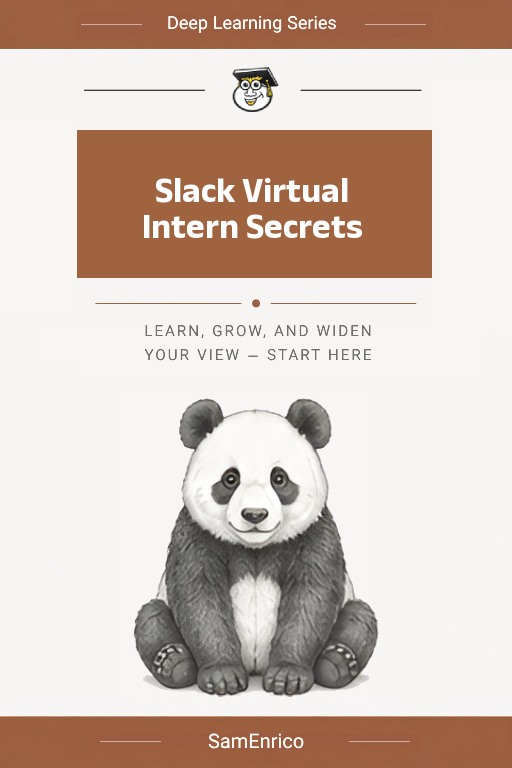
Non-FictionStudent's ShortcutCommunication Tech InternshipSlack Careers
Slack Virtual Intern Secrets eBook
Get a remote internship at Slack focusing on team
by Curtis Irvin
Get a remote internship at Slack focusing on team communication tools workflow automation and bot development.
Formats
Free sample
Chapter 1: The Operating System--–- In the spring of 2021, a college junior named Maya submitted forty-seven internship applications. She heard back from exactly two companies. Both rejected her after the first round. She had a 3.8 GPA, two previous internships, and a portfolio of coding projects. By every traditional metric, she was a strong candidate.
But she was playing the old game while the remote work revolution had already written new rules.Three months later, Maya stumbled into a different kind of opportunity. A friend mentioned that a small tech startup was looking for someone to "help organize their Slack." No formal job posting. No recruiter. Just a desperate plea in a Discord server: "Our Slack is chaos. Channels everywhere.
No one can find anything. If someone can clean this up, we'll pay them." Maya spent a weekend auditing the workspace, renaming channels, setting up workflows for standups, and building a simple form for IT requests. The startup offered her a paid internship on Monday morning.By the end of that summer, Maya had automated so many manual processes that the CEO publicly thanked her in an all-hands meeting. She received a full-time return offer before her senior year even started. Forty-seven applications had failed.
One Slack workspace changed everything.This book exists because Maya's story is not an anomaly. It is the new normal.The Great Misunderstanding Let me tell you what most people get wrong about Slack. They see a chat app. A place where notifications pile up, where GIFs fly back and forth, where conversations disappear into the endless scroll of threads. They see a tool for talking.
And because they see it that way, they use it that way. They send messages. They react with emojis. They maybe—maybe—pin an important link to a channel header.This is like saying a car is a cup holder.Slack is not a chat application. Slack is the operating system for modern remote work.
It is the layer upon which entire companies run their daily operations. It is where decisions get made, where problems get solved, where work actually happens. And just like an operating system on a computer, Slack can be programmed, automated, and extended far beyond its default capabilities.The interns who understand this—the ones who see Slack not as a distraction but as a development platform—are the ones who get hired. They are the ones who receive return offers. They are the ones who, five years into their careers, are leading remote teams and earning salaries that make their college classmates jealous.This chapter is about why that is true.
And more importantly, it is about how you can become one of those interns.The Three Levels of Slack Competency Before we go any further, I need you to be honest with yourself. Where do you currently stand on the spectrum of Slack proficiency? Most people assume they're further along than they actually are. They've been using Slack for years. They know how to format bold text and send a code snippet.
They feel competent.But there is a massive difference between competence and value creation.Let me introduce you to the three levels of Slack competency. I want you to read each description carefully and decide which one describes you today.Level One: The Casual User The Casual User sends messages. They reply in threads—sometimes. They know how to @mention a specific person. They can react with an emoji.
They might even know how to set a status message like "In a meeting" or "Out sick." That is the extent of their capabilities.Here is what the Casual User cannot do: find information from six months ago, organize channels in any meaningful way, reduce notification fatigue, automate repetitive tasks, or integrate Slack with any other tool. The Casual User is a passenger in the Slack workspace, not a driver. They consume attention but do not create efficiency.If this sounds like you, do not be discouraged. Most people are Casual Users. Companies expect this.
They do not expect more. And that is precisely why you have an opportunity.Level Two: The Power User The Power User treats Slack like a productivity system. They use keyboard shortcuts to navigate without touching their mouse. They have mastered search modifiers ( in:#channel , from:@name , after:2024-01-01 ) to find anything instantly. They organize their sidebar with custom sections, mute channels that create noise, and set notification schedules that protect their focus time.The Power User knows about saved replies for common questions.
They use reminders to follow up on important messages. They can create a multi-person DM without accidentally starting a new channel. They understand the difference between @here, @channel, and @everyone—and they use each appropriately.Most importantly, the Power User has begun to notice inefficiencies. They think, "Someone should automate this." But they do not yet know how.If this sounds like you, you are ahead of 80 percent of Slack users. You are efficient.
You are organized. You are not yet indispensable.Level Three: The Automation Developer The Automation Developer sees Slack as a development environment. They build workflows that replace manual processes. They create bots that answer questions, route requests, and collect data. They connect Slack to other tools—Google Sheets, Trello, Git Hub, Salesforce—so that information flows automatically where it needs to go.The Automation Developer does not wait for IT to solve problems.
They solve problems themselves. When their team wastes hours every week copying data from one place to another, they build an integration. When new hires struggle to find answers to common questions, they build a Q&A bot. When managers complain about unclear status updates, they build a standup collection workflow.The Automation Developer is not necessarily a programmer. Many of the most valuable automations require zero lines of code.
Slack's Workflow Builder, Zapier, Make, n8n, and Botpress have democratized automation to the point where a motivated intern with no coding experience can build tools that save their team dozens of hours per week.If this sounds like you—or if it sounds like who you want to become—then you are about to become very valuable to any remote company.The Market Reality That Changes Everything Let me share some data with you. According to Slack's 2022 Platform Report (the most comprehensive publicly available data on Slack's ecosystem), over 1,200 applications are listed in Slack's official App Directory. But that number barely scratches the surface. The vast majority of Slack automations are custom-built for individual companies—internal tools never published to any directory.Here is what that means for you: companies are desperate for people who can build these automations. They cannot hire enough engineers to solve every small inefficiency.
They cannot afford to wait for their IT department to approve every integration. They need people on the ground—interns, junior employees, anyone with initiative—who can identify problems and fix them using the tools already available.I have interviewed hiring managers at dozens of remote companies for this book. Again and again, they told me the same thing: "We will hire anyone who can make our Slack workspace more efficient." Not "anyone with a computer science degree." Not…
This is the end of the free sample. Get the eBook to keep going. Buy now
About this book
Details
- Author
- Curtis Irvin
- Publisher
- SamEnrico
- Language
- English
- Genre
- Non-Fiction, Student's Shortcut, Communication Tech Internship, Slack Careers
- Released
- 2026-05-29
- Pages (approx.)
- 130
- Available as
- eBook, Audiobook

Read better in the ZLOADR app
Your eBooks on your phone or tablet. Sign in with your SamEnrico account and start reading.
More by Curtis Irvin
 One on One Pitch Anxiety ProtocolCurtis Irvin$11.99
 Meth Long Term Recovery GuideCurtis Irvin$11.99
 Kidnapped Aid WorkerCurtis Irvin$11.99
 Hearst Propaganda TechniquesCurtis Irvin$11.99
 AI Color Grading for Video EditorsCurtis Irvin$11.99
 The Frozen Odyssey: The Lost U.S. Air Force Crew Who Mapped the ArcticCurtis Irvin$11.99
 Hiring Remote QA Engineers PolandCurtis Irvin$12.99
 Understanding BotulismCurtis Irvin$17.99
 How to Start a Hobby in Inline SkatingCurtis Irvin$11.99
 Career CounselingCurtis Irvin$11.99
You may also like
 Hong Kong Handover 1997Dunn Johnnie$11.99
 Zumba For Postnatal Recovery CourseNeal Christian$11.99
 Zumba for BeginnersLadner Nikia$11.99
 YouTube Comment Mining GuideHumes Pandora$12.99
 Worry Box MeditationCarlin Rudy$11.99
 Workplace Stress MeditationNguyen Lynn$11.99
 Workplace Stress and Sleep RepairHawley Ivory$11.99
 Workplace Perfectionism CureDelaney Jeffry$11.99
 Workplace Injustice Anger GuideWallen Isabelle$11.99
 Work Addiction and Burnout LinkGreenwood Ester$11.99
 Women in Yoga and WellnessBeattie Galina$11.99
 Women in Stand Up ComedyChun Evangeline$11.99