
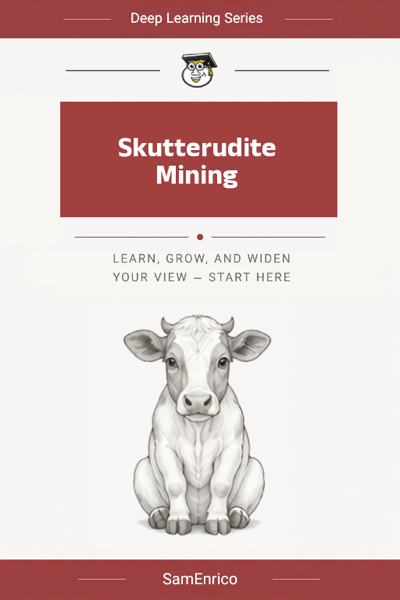
Non-FictionInformativeEducational
Skutterudite Mining eBook
A Coursebook on Skutterudite Mining
by Chu Beaulah
A Coursebook on Skutterudite Mining
Formats
Free sample
Chapter 1: The Cobalt Trap--The skutterudite specimen sat in a glass case at the Royal Swedish Academy of Sciences, labeled simply "Smaltite – 1751." For two and a half centuries, it was a curiosity – a heavy, tin-white mineral that produced a brilliant blue glass when crushed and heated. Mining engineers walked past it without a second glance. It was too rare, too obscure, too complicated to matter.How quickly the world changes.Today, that same mineral is at the center of a geopolitical struggle most people have never heard of. The cobalt inside skutterudite powers the electric vehicle revolution. The arsenic locked in its crystal lattice is a poison that must be tamed.
And the supply chains that move cobalt from mine to battery are the most concentrated, most fragile, most strategically vulnerable of any critical mineral on earth.This book is about skutterudite mining. But before we discuss a single assay result or flotation circuit, we need to understand why this obscure mineral suddenly matters – and why ignoring it could cost nations their energy independence.The Secret Ingredient You've Never Heard Of Cobalt is not a household name. It doesn't have the glamour of lithium or the urgency of copper. Yet without cobalt, the electric vehicle revolution stops dead.Every lithium-ion battery in every Tesla, every Ford Mustang Mach-E, every Volkswagen ID.4 contains cobalt in its cathode. The typical EV battery pack contains 8 to 12 kilograms of cobalt.
That's not a typo – twelve kilograms per vehicle. Multiply that by the 14 million electric vehicles sold globally in 2023, and you're looking at over 150,000 tonnes of cobalt just for passenger cars. Add grid storage batteries, consumer electronics, and aerospace superalloys, and the number climbs toward 200,000 tonnes annually.Cobalt does something no other element can do. It stabilizes the battery's cathode structure, preventing the lithium ions from rearranging the crystal lattice during charging and discharging. Remove cobalt, and battery life plummets.
Safety degrades. Performance suffers. Engineers have spent billions trying to reduce cobalt content – and they have succeeded, lowering it from 33 percent of the cathode in early lithium-cobalt-oxide batteries to around 10 percent in today's nickel-cobalt-manganese chemistries. But they cannot eliminate it entirely. Not yet.
Maybe not ever.This creates a fundamental tension. The energy transition needs cobalt. But cobalt comes from places most Western nations would rather not depend on.The Geography of Dependence Here is the uncomfortable truth that every mining executive, every policy maker, and every investor needs to internalize:Seventy percent of the world's cobalt is mined in the Democratic Republic of Congo.Not Canada. Not Australia. Not the United States.
The DRC – a nation the size of Western Europe with a history of political instability, artisanal mining, child labor allegations, and corruption rankings near the bottom of global indices.But that's only half the problem.Seventy percent of the world's cobalt refining happens in China.Let that sink in. The DRC digs the rock out of the ground. Then that concentrate – often containing 10 to 15 percent cobalt – is shipped thousands of kilometers to Chinese refineries. They turn it into cobalt sulfate, cobalt metal, and cobalt powder. And then they sell it back to the rest of the world at prices they largely control.This is not a supply chain.
It is a chokehold.During the cobalt price spike of 2017-2018, prices reached over $40 per pound. Automakers scrambled. Tesla negotiated direct deals with Glencore. BMW sent teams to the DRC to audit mines. But the underlying vulnerability never went away.
A single coup in Kinshasa, a single trade dispute with Beijing, a single environmental disaster at a key refinery – any of these could send cobalt prices through the roof and EV production grinding to a halt.Western governments have finally noticed. The United States Department of the Interior designated cobalt a "critical mineral" in 2018. The European Union added it to its Critical Raw Materials list in 2020. Canada followed in 2021. But designation is not production.
And production requires deposits that can be mined economically – deposits like skutterudite.Enter Skutterudite: The High-Grade Solution Most cobalt is not mined as cobalt. It is a byproduct.The vast majority of the world's cobalt comes from copper mining in the DRC's Central African Copperbelt or nickel mining in Australia, Canada, and Russia. In these deposits, cobalt is present at low grades – typically 0.1 to 0.3 percent. It is recovered as an afterthought, an impurity that happens to be valuable. The primary metal pays the bills.
Cobalt is gravy.Skutterudite is different.Skutterudite is a primary cobalt mineral. It contains 20 to 30 percent cobalt by weight – not 0.2 percent, not 2 percent, but twenty to thirty percent. A skutterudite mine can be a cobalt mine first, everything else second.But there is a catch. Several catches, in fact.First, skutterudite is an arsenide. Its chemical formula is Co As₃ – one atom of cobalt for every three atoms of arsenic.
That means for every tonne of cobalt you produce, you generate approximately 1.3 tonnes of arsenic as a waste product. Arsenic is not something you can dump in a tailings pond. It is a potent poison, a Group 1 carcinogen, a liability that can bankrupt a mining company if mismanaged.Second, skutterudite deposits are rarely large. They tend to form in narrow hydrothermal veins – think of a crack in the earth's crust, filled with cobalt arsenide and silver and bismuth, often less than a meter wide. These veins are "nuggety," meaning the cobalt grade can jump from 0.5 percent to 20 percent and back to 1 percent over a distance of centimeters.
This makes resource estimation difficult and mining selective.Third, skutterudite is brittle. It over-grinds easily, creating fine particles that are difficult to recover by flotation. The same high specific gravity that makes it amenable to gravity concentration also makes it prone to losses when processing fines.These challenges are real. But they are not insurmountable. And the prize – a secure, high-grade, Western-friendly source of cobalt – is worth the effort.A Brief History: From Smaltite to Strategic Mineral The name "skutterudite" comes from Skutterud, Norway, where the mineral was first described in 1845.
But miners had known the material for centuries under different names.In 16th-century Sweden, miners called it "smaltite" – from "smalt," the blue glass pigment made by heating cobalt arsenides with silica and potash. The pigment was immensely valuable. European ceramics studios paid handsomely for that distinctive cobalt blue. But the mining was brutal. The arsenic fumes sickened workers.
The waste rock piled up, leaching arsenic into streams. It was a hazardous trade, but the color was worth it.The great silver rushes of the 19th century – Cobalt, Ontario; Kongsberg, Norway; Schneeberg, Germany – all produced skutterudite as a byproduct. The silver veins carried cobalt arsenides, and the cobalt was discarded. At the Cobalt mining camp in Ontario, miners threw skutterudite on the waste dumps. They were after silver wires, not heavy gray arsenides.
Today, those waste dumps are being re-mined for their cobalt content. What was trash in 1905 is treasure in 2025.The shift began during World War I, when Germany's blockade of Allied shipping highlighted the vulnerability of imported strategic materials. Cobalt was needed for armor plating, high-speed tool steels, and magnets. The U.S. government stockpiled cobalt.
Canada opened a refinery at Cobalt, Ontario. Skutterudite briefly became a target mineral.After World War II, the bottom fell out.…
This is the end of the free sample. Get the eBook to keep going. Buy now
About this book
Details
- Author
- Chu Beaulah
- Publisher
- SamEnrico
- Language
- English
- Genre
- Non-Fiction, Informative, Educational
- Released
- 2026-05-18
- Pages (approx.)
- 157
- Available as
- eBook, Audiobook

Read better in the ZLOADR app
Your eBooks on your phone or tablet. Sign in with your SamEnrico account and start reading.
More by Chu Beaulah
 Sobriety Without AA GuideChu Beaulah$11.99
 Dialogue with Dream FiguresChu Beaulah$11.99
 Post Hypnotic Suggestion for StressChu Beaulah$11.99
 Invalidation As TriggerChu Beaulah$11.99
 The Owl and the Bard: Shakespeare’s Feathered MuseChu Beaulah$11.99
 A Beginners Guide to Powered hang glider (Volume 1)Chu Beaulah$11.99
 ITIN for Bank Account Opening GuideChu Beaulah$12.99
 How to Produce Clarinet Small PartsChu Beaulah$11.99
You may also like
 Hong Kong Handover 1997Dunn Johnnie$11.99
 Zumba For Postnatal Recovery CourseNeal Christian$11.99
 Zumba for BeginnersLadner Nikia$11.99
 YouTube Comment Mining GuideHumes Pandora$12.99
 Worry Box MeditationCarlin Rudy$11.99
 Workplace Stress MeditationNguyen Lynn$11.99
 Workplace Stress and Sleep RepairHawley Ivory$11.99
 Workplace Perfectionism CureDelaney Jeffry$11.99
 Workplace Injustice Anger GuideWallen Isabelle$11.99
 Work Addiction and Burnout LinkGreenwood Ester$11.99
 Women in Yoga and WellnessBeattie Galina$11.99
 Women in Stand Up ComedyChun Evangeline$11.99