
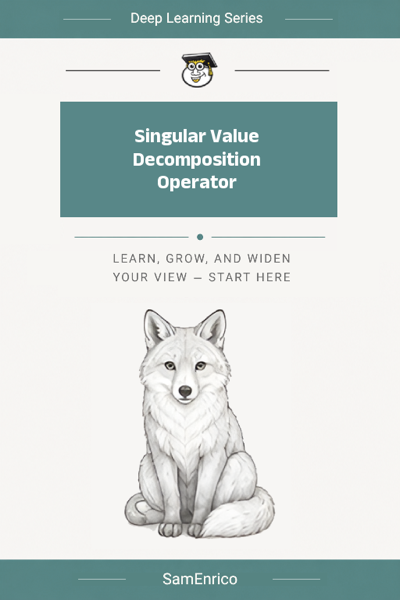
Non-FictionInformativeEducational
Singular Value Decomposition Operator eBook
A Coursebook on Singular Value Decomposition Opera
by Emery Neda
A Coursebook on Singular Value Decomposition Operator
Formats
Free sample
Chapter 1: The Sphere's Secret...–- Imagine holding a perfectly round, crimson rubber ball—a sphere. Now press it firmly between your palms. It does not shatter or crack. Instead, it squishes into an egg-shaped ellipsoid, its smooth surface bulging along one axis and flattening along another. That simple, almost childish act—turning a sphere into an ellipsoid—is the entire secret of the Singular Value Decomposition.
Every linear map, from a humble 2×2 matrix to the infinite-dimensional operators that describe quantum fields, does exactly this: it takes the unit sphere and stretches it into an ellipsoid. The SVD is nothing more than the mathematical grammar that describes this transformation. Master this grammar, and you unlock the language of data science, quantum mechanics, machine learning, and numerical analysis.This statement might strike you as absurdly simple, perhaps even naive. After all, you have likely spent years learning linear algebra through the lens of eigenvalues and eigenvectors. You solved Ax = bx, computed determinants, and traced characteristic polynomials.
Eigenvalues, you were told, reveal the "essential nature" of a matrix. They tell you how much a matrix stretches a vector that happens to point in just the right direction. But eigenvalues have a fatal flaw: they only work for square matrices, and even then, only for those that are diagonalizable. What happens when your matrix isn't square? What happens when it's a 500×1000 data table of customer purchases, or a linear map from a space of images to a space of sounds, or an integral operator that transforms functions?
Eigenvalues simply shrug and walk away.The SVD, however, works for every matrix—every single one. It works for the 2×2 rotation matrix, for the 100×50 matrix of genetic expression data, for the infinite-dimensional operator that blurs a photograph. It works because it asks a different, better question. Eigenvalues ask: "Are there any special vectors that stay in the same direction after the map?" The SVD asks: "What does the map do to the entire geometry of space?" By shifting the question from a few special vectors to the whole sphere, we unlock a tool that is simultaneously the foundation of Google's Page Rank, the engine of Netflix's recommendation system, the heart of medical image compression, the mathematics behind principal component analysis, and a cornerstone of quantum mechanics.This chapter is where we abandon the eigenvalue crutch. We will not compute a single determinant or solve a single characteristic polynomial.
Instead, we will take a journey through geometry—through spheres and ellipsoids, through maximization and orthogonality, through the sheer beauty of seeing linear maps as geometric transformations. By the end of this chapter, you will have derived the existence of singular values and singular vectors using nothing more than calculus, compactness, and orthogonal projections—the same reasoning that extends perfectly to infinite dimensions later in this book. You will see that the SVD is not an algebraic trick or a computational convenience; it is a geometric necessity.The Humiliating Failure of Eigenvalues Let us begin with a concrete problem that exposes the limitations of eigenvalue thinking. Suppose we have a linear map A: R² → R³. This map takes a 2D vector (say, a point on a flat map of a city) and produces a 3D vector (say, a point in physical space, perhaps the location of a drone above that city).
Can we find a non-zero vector v such that Av is parallel to v? The question is nonsense: Av lives in R³, while v lives in R². They cannot be parallel because they are not even in the same space. Eigenvalues are undefined for non-square matrices. Yet the map A is still a real, physical transformation.
It stretches, rotates, and shears. Surely there must be some "characteristic" directions and magnitudes that describe how A stretches space. There are. They are called singular vectors and singular values.Now consider a square but defective matrix, a matrix that refuses to be diagonalizable. Take:text Copy Download A = [[1, 1], [0, 1]]This matrix has a single eigenvalue λ = 1 with algebraic multiplicity 2 but geometric multiplicity 1.
It is not diagonalizable. There is no basis of eigenvectors. Eigenvalues tell you almost nothing useful about how this matrix stretches space. However, A still maps the unit circle to an ellipse (try it: take points (cosθ, sinθ), multiply by A, plot them). The ellipse has semi-axis lengths (singular values) and directions (singular vectors).
Eigenvalues fail. The SVD does not.Consider a rectangular matrix that appears in linear regression:text Copy Download B = [[1, 2], [3, 4], [5, 6]]This 3×2 matrix has no eigenvalues. Yet it represents a perfectly reasonable linear map from R² to R³. The image of the unit circle in R² is an ellipse floating in R³. The SVD will find that ellipse's axes, their lengths, and the pre-images of those axes.
Eigenvalues cannot even begin the conversation.The moral is clear: eigenvalues are a luxury for special maps—square, normal matrices. The SVD is a universal language for all linear maps, regardless of shape or diagonalizability.The Core Geometric Insight Let A: Rⁿ → Rᵐ be a linear map. Consider the unit sphere in the domain: S = { x ∈ Rⁿ : ‖x‖ = 1 }. This is the set of all vectors of length exactly 1. It is a beautiful, symmetric object—smooth, compact, and perfectly round.
Because A is linear, the image A(S) = { Ax : ‖x‖=1 } is also a compact set (continuous image of a compact set) and is symmetric about the origin (if x is in S, then -x is in S, and A(-x) = -Ax). In fact, A(S) is an ellipsoid—a stretched sphere. This is not obvious, but it is true for every linear map. We will prove it constructively.Let us define σ₁ as the maximum of ‖Ax‖ over all unit vectors x. Formally:text Copy Downloadσ₁ = max{ ‖Ax‖ : x ∈ Rⁿ, ‖x‖ = 1 }This maximum exists because the function x → ‖Ax‖ is continuous and the set S is compact (closed and bounded in finite-dimensional space).
This is a crucial point: the compactness of the unit sphere guarantees that the maximum is attained. There is at least one direction in which the map stretches the most. Every linear map has a "longest" stretch factor.Choose a unit vector v₁ that achieves this maximum, i.e., ‖Av₁‖ = σ₁. If σ₁ = 0, then A maps every vector to zero—the zero map—and we are done. So assume σ₁ > 0.
Define u₁ = Av₁ / σ₁. Then u₁ is a unit vector in Rᵐ. This vector points in the direction of the longest axis of the output ellipsoid.Now, consider the orthogonal complement of v₁ in Rⁿ, denoted {v₁}⊥. This is the set of all vectors perpendicular to v₁. It is an (n-1)-dimensional subspace.
Restrict A to this subspace. Look at the image of the unit sphere within that subspace. By the same reasoning, there is a maximum σ₂ achieved at some unit vector v₂ in {v₁}⊥ with ‖Av₂‖ = σ₂. Define u₂ = Av₂ / σ₂. Because v₂ is orthogonal to v₁ and A is linear, u₂ will be orthogonal to u₁?
This orthogonality is not automatic, but we can enforce it by choosing v₂ carefully. In fact, using the method of Lagrange multipliers or the properties of the Rayleigh quotient, one can show that the maximizers naturally yield orthogonal images. For our constructive proof, we simply continue: after finding v₁…
This is the end of the free sample. Get the eBook to keep going. Buy now
About this book
Details
- Author
- Emery Neda
- Publisher
- SamEnrico
- Language
- English
- Genre
- Non-Fiction, Informative, Educational
- Released
- 2026-05-07
- Pages (approx.)
- 144
- Available as
- eBook, Audiobook

Read better in the ZLOADR app
Your eBooks on your phone or tablet. Sign in with your SamEnrico account and start reading.
More by Emery Neda
 Disagreement Small Talk CourseEmery Neda$11.99
 The Nobel And The Nuclear ShellEmery Neda$11.99
 Market Gap Identification MapEmery Neda$11.99
 Leadership Habit GuideEmery Neda$11.99
 Walking Meditation for ChemotherapyEmery Neda$11.99
 The Plague Fighter: Edwin Chadwick and the Sanitation Revolution of the Middle EastEmery Neda$11.99
 The Descent of Inanna: Queen of Heaven’s Forbidden JourneyEmery Neda$11.99
 Understanding Granulomatous Allergic AngiitisEmery Neda$17.99
 Payment Tracking Spreadsheet ManualEmery Neda$12.99
 BPO Pricing Models GuideEmery Neda$12.99
 How to Become a Cleaner And PreparerEmery Neda$11.99
You may also like
 Hong Kong Handover 1997Dunn Johnnie$11.99
 Zumba For Postnatal Recovery CourseNeal Christian$11.99
 Zumba for BeginnersLadner Nikia$11.99
 YouTube Comment Mining GuideHumes Pandora$12.99
 Worry Box MeditationCarlin Rudy$11.99
 Workplace Stress MeditationNguyen Lynn$11.99
 Workplace Stress and Sleep RepairHawley Ivory$11.99
 Workplace Perfectionism CureDelaney Jeffry$11.99
 Workplace Injustice Anger GuideWallen Isabelle$11.99
 Work Addiction and Burnout LinkGreenwood Ester$11.99
 Women in Yoga and WellnessBeattie Galina$11.99
 Women in Stand Up ComedyChun Evangeline$11.99