
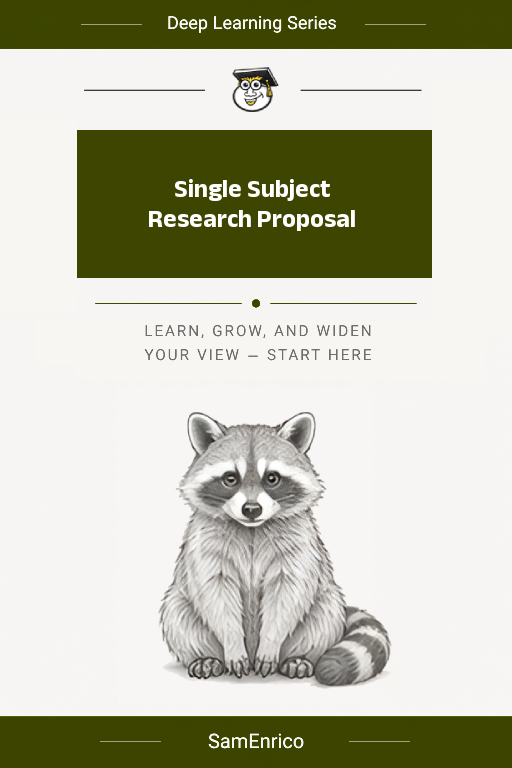
researchStudent's ShortcutSingle Case
Single Subject Research Proposal
Design single case experimental designs for grad p
Design single case experimental designs for grad proposals in education or therapy. Describe baseline, intervention, and withdrawal phases with visual analysis.
Formats
About this book
Free sample
Chapter 1: The n=1 Revolution...--For most of your academic career, you have been taught that bigger is better. Larger sample sizes, more participants, higher statistical power—these are the metrics of "real" science. Your statistics professors drilled t-tests, ANOVAs, and p-values into your thinking. Your research methods textbooks dedicated exactly one paragraph to single-subject designs, usually tucked somewhere between "quasi-experimental designs" and "threats to validity," as if n=1 were a curious footnote rather than a legitimate methodology.That paragraph probably said something like: "Single-subject designs involve repeated measurement of one individual across different conditions. These designs are sometimes used in clinical and educational settings but have limited generalizability."Let me be direct with you: That paragraph is wrong.
Not oversimplified. Not outdated. Wrong.Single-case experimental designs (SCED) are not a consolation prize for researchers who cannot afford large samples. They are not a "lesser" methodology used only when group designs are impossible. They represent a fundamentally different—and in many applied contexts, superior—approach to establishing causal relationships between interventions and behavior change.This chapter dismantles the myth that n=1 is not real science.
By the time you finish reading, you will understand not only when to use SCED but why a well-designed single-case study can provide stronger evidence for your intervention than a flawed group study with fifty participants. You will learn to defend your methodology against skeptical committee members who ask, "Why not just run a t-test with 30 subjects?" And you will walk away with a scripted rationale section that you can drop directly into your proposal.The Fundamental Misunderstanding: Group Thinking vs. Single-Case Thinking To understand why SCED matters, you must first understand the paradigm shift it requires. Most researchers think in what I call group-design thinking: You randomly assign participants to treatment and control groups, measure each participant once (or twice, pre-post), average the scores, and compare group means. If the average treatment group score is higher than the average control group score, and the difference is unlikely to have occurred by chance (p < .05), you conclude the intervention "works."This approach answers a specific question…
This is the end of the free sample. Get the eBook to keep going. Buy now
Contents
- Chapter 1
- Chapter 2
- Chapter 3
- Chapter 4
- Chapter 5
- Chapter 6
- Chapter 7
- Chapter 8
- Chapter 9
- Chapter 10
- Chapter 11
- Chapter 12
Details
- Author
- Sykes Olimpia
- Publisher
- SamEnrico
- Language
- English
- Genre
- research, Student's Shortcut, Single Case
- Released
- 2026-05-30
- Pages (approx.)
- 159
- Available as
- eBook, Audiobook

Read better in the ZLOADR app
Your eBooks on your phone or tablet. Sign in with your SamEnrico account and start reading.
More by Sykes Olimpia
 Harvard Extension School Research OpportunitiesSykes Olimpia$11.99
 NVC For Workplace MediationSykes Olimpia$11.99
 The Hospital Toxin GuideSykes Olimpia$11.99
 Rescuing Dissidents AbroadSykes Olimpia$11.99
 Gwion’s Riddle: The Bard Who Outwitted the OtherworldSykes Olimpia$11.99
 How to Produce Bicycle Hub PartsSykes Olimpia$11.99
 SandblasterSykes Olimpia$11.99
 A Beginners Guide to Kelly pool (Volume 1)Sykes Olimpia$11.99
You may also like
 Scientific Research On TM GuideMartens Nathanial$11.99
 Research Proposal Methodology Section MasteryPauley Debroah$11.99
 Research Proposal Appendix CompilationRaines Tyisha$11.99
 Academic Researcher Distraction GuideFord Virgil$11.99
 TM Research and ScienceCovert Nicki$11.99
 Social Anxiety Research ReviewRoberge Cole$11.99
 Research Proposal Significance Section GuideBock Tory$12.99
 Research Proposal Reviewer PsychologyLugo Tawanda$11.99
 Research Proposal Research Questions DesignLara Robbi$11.99
 Research Proposal References and CitationsPatten Shanice$11.99
 Research Proposal Mixed Methods DesignCameron Omega$11.99
 Research Proposal Data Management PlanAnderson Roberto$12.99