
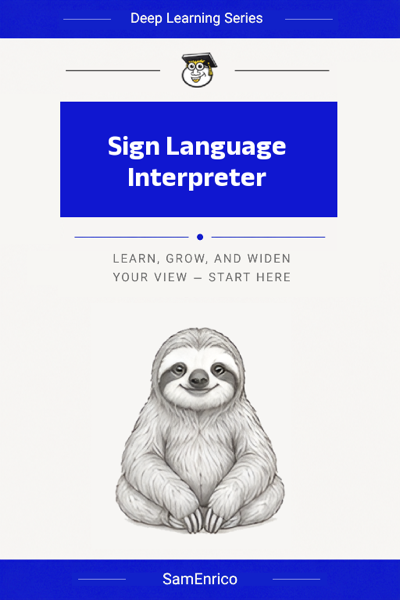
Non-FictionInformativeEducational
Sign Language Interpreter eBook
A Coursebook on Sign Language Interpreter
by Nall Tawnya
A Coursebook on Sign Language Interpreter
Formats
Free sample
Chapter 1: The Mirror Test...--–- The first time you see yourself as an interpreter, you will not recognize the person you thought you were. This is not a metaphor. It is a professional inevitability. The mirror I am referring to is not made of glass but of a Deaf consumer's patient, waiting eyes—eyes that have seen dozens of hearing people fail them before you arrived. In that reflection, you will see your own limitations with brutal clarity: the sign you suddenly forgot, the English phrase that has no clean equivalent in ASL, the fatigue that hits at minute twelve of what should be an easy assignment.
The question is not whether you will experience this moment. Every interpreter does. The question is what you do afterward.This chapter is called "The Mirror Test" because it asks you to look honestly at who you are before you ever step into an assignment—and at who you will need to become. We will dismantle the comfortable myths that attract well-meaning people to this field: that interpreting is simply "helping Deaf people," that fluency in ASL is enough, that neutrality is possible or even desirable. In their place, we will build the foundational frameworks that separate amateurs from professionals: the historical arc of the field, the Demand-Control Schema (DC-S), and a unified definition of "Deaf Heart" that will guide every subsequent chapter.
We will also introduce the Role Continuum Model—a tool that resolves the decades-old debate about interpreter neutrality by replacing a single fixed role with a flexible range of positions from Conduit to Ally.By the end of this chapter, you will have completed a guided self-assessment of your own aptitude and disposition. You will know whether this path is right for you—not because of your ASL fluency (that can be taught) but because of your willingness to confront the mirror.The Myth of the Helper Every interpreter enters this field for reasons that feel noble. Perhaps you had a Deaf family member and grew up bridging conversations at the dinner table. Perhaps you took an ASL class in college and fell in love with the language's visual beauty. Perhaps you watched an interpreter on television during a news conference and thought, I could do that.
I could help. That last phrase—"I could help"—is the most dangerous thought an aspiring interpreter can have, not because helping is wrong but because it places you at the center of the story.The "helper" model of interpreting positions the interpreter as a benevolent figure who bestows access upon grateful Deaf consumers. In this model, the interpreter is the protagonist; the Deaf person is the recipient. This is not merely arrogant—it is historically inaccurate and practically harmful. Before the professionalization of the field, most interpreting was performed by family members, teachers, or well-intentioned volunteers who had no formal training.
They "helped" by summarizing, omitting uncomfortable details, or simplifying complex language "for the Deaf person's own good." The result was systematic linguistic deprivation: Deaf individuals received a fraction of what was said and were rarely consulted about what they wanted.The "helper" model persists because it feels good. It allows the interpreter to leave an assignment feeling virtuous rather than exhausted. But virtue is not the goal. Accuracy is. And accuracy requires the interpreter to subordinate their own desire to be seen as helpful to the harder task of being faithful to the source message—even when that message is ugly, confusing, or emotionally distressing.Consider this scenario: A Deaf patient is being told they have terminal cancer.
The hearing doctor delivers the news with clinical detachment. The "helper" interpreter, wanting to soften the blow, signs "sick" instead of "cancer" and adds a comforting facial expression that the doctor did not provide. The interpreter has just committed malpractice. The Deaf patient now believes they have a treatable illness. The "help" was actually harm.The alternative to the helper model is not cold detachment.
It is a professional stance that prioritizes the Deaf consumer's autonomy—the right to receive the full message, in all its ugliness, and make their own decisions about it. This is the first and most difficult lesson of this chapter: Your feelings about the message do not matter. Your job is not to filter. Your job is to bridge.The Conduit Myth and Its Collapse If the "helper" model is one extreme, the "conduit" model is the other. The conduit views the interpreter as a neutral transmission belt—a pipeline through which language flows unchanged from speaker to listener.
In this model, the interpreter has no agency, no influence, and no responsibility beyond the mechanical transfer of words into signs and signs into words.The conduit model is seductive because it relieves the interpreter of moral weight. If you are merely a pipe, you cannot be blamed for what flows through you. You are not responsible for the doctor's bad news, the lawyer's aggressive questioning, or the family member's hurtful words. You are just the messenger.But the conduit model is a fantasy. No interpreter simply transmits.
Every choice—which synonym to use, how to position your body, whether to sign something literally or paraphrase it, when to interrupt for clarification—shapes the message. Even the decision to remain "neutral" is a choice with consequences. When an interpreter refuses to interrupt a confusing lecture to ask for clarification, they are not being neutral; they are choosing to prioritize the hearing speaker's flow over the Deaf student's comprehension. That is a bias, not a lack of one.The conduit model also collapses under the weight of linguistic reality. ASL and English are not codes of each other.
They are separate languages with different grammars, different pragmatics, and different ways of organizing time and space. A word-for-word "conduit" between them is impossible. The interpreter must constantly make decisions about equivalence, not identity. What is the ASL equivalent of the English phrase "I see what you mean"? It is not the signs "I SEE WHAT YOU MEAN," which would be nonsense in ASL.
It is the sign UNDERSTAND, perhaps with a specific non-manual marker indicating sudden comprehension. The interpreter has just transformed the message—not changed its meaning, but transformed its form. That transformation is an act of authorship, not transmission.The professional literature has largely abandoned both the helper and conduit models. In their place stands the bilingual-bicultural mediator—an interpreter who is actively engaged in negotiating meaning between two languages and two cultures, who accepts responsibility for their decisions, and who centers the Deaf consumer's autonomy rather than their own comfort. This is the identity this book will cultivate.A Brief History of Interpreting: From Altar Boys to Professionals The history of sign language interpreting is the story of a slow, painful march from charity to professionalization.
Understanding this history is not an academic exercise; it explains why the field has the ethical codes, certification requirements, and professional standards it has today—and why those standards remain contested.The Pre-RID Era (Before 1964): Before the Registry of Interpreters for the Deaf (RID) was founded, there were no formal standards for interpreting. Deaf people relied on "interpreters" who were often family…
This is the end of the free sample. Get the eBook to keep going. Buy now
About this book
Details
- Author
- Nall Tawnya
- Publisher
- SamEnrico
- Language
- English
- Genre
- Non-Fiction, Informative, Educational
- Released
- 2026-06-03
- Pages (approx.)
- 159
- Available as
- eBook, Audiobook

Read better in the ZLOADR app
Your eBooks on your phone or tablet. Sign in with your SamEnrico account and start reading.
More by Nall Tawnya
 Chronic Pain Brain RetrainingNall Tawnya$11.99
 IBS Gluten Sensitivity Without Celiac HandbookNall Tawnya$11.99
 The Missing Geocacher CasesNall Tawnya$11.99
 LSE Online English Language CriteriaNall Tawnya$11.99
 The Dragon’s Lament: The Forgotten Ballads of Saint GeorgeNall Tawnya$11.99
 The Velvet Underground: How a Rebel Designer Redefined Rock & Roll FashionNall Tawnya$11.99
 Understanding Hydatidiform MoleNall Tawnya$17.99
 Ultimate Handbook Guide to Tangerang : (Indonesia) Travel GuideNall Tawnya$11.99
 Open Banking Payment OutlookNall Tawnya$12.99
 USSD And Feature Phone PrimerNall Tawnya$12.99
You may also like
 Hong Kong Handover 1997Dunn Johnnie$11.99
 Zumba For Postnatal Recovery CourseNeal Christian$11.99
 Zumba for BeginnersLadner Nikia$11.99
 YouTube Comment Mining GuideHumes Pandora$12.99
 Worry Box MeditationCarlin Rudy$11.99
 Workplace Stress MeditationNguyen Lynn$11.99
 Workplace Stress and Sleep RepairHawley Ivory$11.99
 Workplace Perfectionism CureDelaney Jeffry$11.99
 Workplace Injustice Anger GuideWallen Isabelle$11.99
 Work Addiction and Burnout LinkGreenwood Ester$11.99
 Women in Yoga and WellnessBeattie Galina$11.99
 Women in Stand Up ComedyChun Evangeline$11.99