
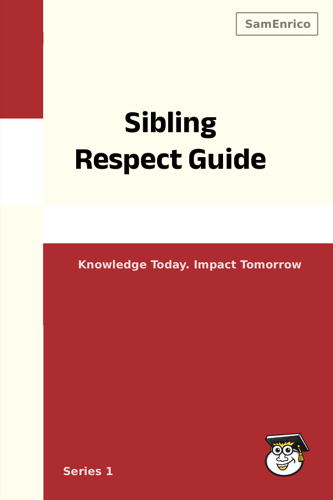
Sibling Respect Guide eBook
Treat adult sibling as equal, not child.
Treat adult sibling as equal, not child.
Formats
Free sample
Chapter 1: The Frozen Narrative...-- You are a 45-year-old accountant with a mortgage, two children, and a reputation for冷静 handling corporate crises. Your older brother calls. He asks how your holiday plans are coming along. You mention you might order the turkey instead of roasting it this year. He laughs and says, "Remember that time you tried to cook Thanksgiving dinner when you were 22?
The smoke alarm went off for three hours. Maybe stick to what you know, little one."Suddenly, you feel 10 years old again. Small. Defensive. A little bit stupid.
You spend the next hour stewing, rehearsing comebacks in your head, and wondering why a single sentence from a man you see four times a year can unravel you completely.This is not a flaw in your character. It is a feature of how sibling relationships are built.By the time you finish this chapter, you will understand why adult siblings trigger each other like no one else on earth. You will learn the concept of the "frozen narrative"—the invisible script written in childhood that continues to dictate your interactions decades later. And you will complete a single, powerful exercise designed to do one thing: separate the ghost of your sibling from the actual human standing in front of you.The Peculiar Cruelty of Sibling Triggers Let us begin with a question that sounds simple but is not: Why do siblings have the power to make us feel like children again?Spouses can wound us. Bosses can infuriate us.
Friends can disappoint us. But only a sibling can transport you across four decades of life experience, professional accomplishment, and emotional growth in the span of a single sentence. A casual remark about your career choice, your parenting style, or even the way you load a dishwasher can reduce a fully functioning adult to a seething, tearful, or paralyzed version of their 12-year-old self.This is not accidental. It is structural.Your sibling knew you before you had a resume, a partner, or a sense of your own competence. They witnessed your most embarrassing moments, your most desperate bids for attention, and your least impressive attempts at maturity.
In the family system, you were not a CEO, a therapist, or a marathon runner. You were the older sister who cried when she lost at Monopoly. You were the younger brother who wet the bed until he was nine. You were the middle child who learned to disappear during arguments.Those versions of you still exist in your sibling's memory. And more importantly, they still exist in your own nervous system.Psychologists call this "state-dependent memory." When you are in a familiar environment with a familiar person, your brain unconsciously retrieves the emotional patterns associated with that person.
Your sibling is not just a relative. They are a living, breathing time machine. And you are not reacting to the person in front of you. You are reacting to the ghost of every interaction you have ever had with them, layered on top of one another like sedimentary rock.What Is the Frozen Narrative?The frozen narrative is the term this book uses for the set of assumptions, roles, and expectations that solidified during your childhood and have not been meaningfully updated since. It is the story your family told about who you were and who your sibling was—a story that was useful for managing chaos in a household of small people but becomes a prison when those small people grow up.Consider the following examples of frozen narratives in action:The Responsible One and the Wild One.
As children, the older sister was tasked with watching the younger brother. She became the "responsible one." He became the "wild one." Thirty years later, she still corrects his life choices. He still resents her interference. Neither notices that she is a burned-out corporate manager and he is a stable electrician with a thriving side business. The narrative has not updated.The Smart One and the Pretty One.
The family praised one child for academic achievement and the other for appearance or charm. Decades later, the "smart one" still discounts her sibling's opinions as shallow. The "pretty one" still assumes her sibling is socially inept. Both have multiple graduate degrees and successful relationships, but the family story has not caught up.The Peacemaker and the Troublemaker. One child learned early that the way to survive family conflict was to smooth things over, apologize preemptively, and never rock the boat.
Another child learned that the only way to be seen was to act out. As adults, the peacemaker still swallows their own needs in every disagreement. The troublemaker still expects to be the center of attention, even when they no longer want to be.These narratives are not neutral observations. They are assignments. And they were assigned before you had any say in the matter.The research on birth order, family systems, and sibling dynamics consistently shows one uncomfortable truth: the roles we play in our families are rarely chosen.
They are negotiated unconsciously between young children and their parents, often before the age of seven. The oldest child is given responsibility whether they want it or not. The youngest is allowed to remain dependent longer. The middle child learns to negotiate or disappears. These patterns become habitual.
Habits become identities. Identities become frozen.The Role Audit: Identifying Your Childhood Assignment Before you can thaw a frozen narrative, you have to name it. This book contains exactly one journaling exercise—this one—because the goal of diagnosis is precision, not endless self-reflection. You will complete the Role Audit now, and then you will refer back to it throughout the remaining chapters.Below are five common childhood roles identified in family systems literature. Read each description carefully.
Do not choose the role you want to have or the role that sounds most flattering. Choose the role that, when you read it, makes your chest tighten slightly because it fits.The Hero The Hero is the child who was praised for achievement, maturity, and reliability. They were the one parents pointed to as an example. "Why can't you be more like your sister?" was a sentence directed at other siblings, never at the Hero. The Hero learned that love is conditional on performance.
As an adult, the Hero over-functions in relationships, takes on too much responsibility, and resents others for not doing their share. The Hero's deepest fear is being seen as ordinary or inadequate.Signs this is you: You were the first to get a job, the first to move out, the first to offer financial help to your parents. Your siblings sometimes say, "Not everyone can be as perfect as you" with a tone that is not entirely complimentary. You have a hard time asking for help because asking feels like failing.The Scapegoat The Scapegoat is the child who absorbed the family's negative projections. When something went wrong, it was usually blamed on the Scapegoat—fairly or not.
The Scapegoat learned that they would be punished regardless of their behavior, so they often stopped trying to please anyone. As an adult, the Scapegoat may struggle with shame, assume blame prematurely, or…
This is the end of the free sample. Get the eBook to keep going. Buy now
About this book
Details
- Author
- Jewell Raelene
- Publisher
- SamEnrico
- Language
- English
- Genre
- Non-Fiction, Biography, Respect
- Released
- 2026-06-07
- Pages (approx.)
- 133
- Available as
- eBook, Audiobook

Read better in the ZLOADR app
Your eBooks on your phone or tablet. Sign in with your SamEnrico account and start reading.
More by Jewell Raelene
 Tinder Dating App AddictionJewell Raelene$11.99
 TCM Autoimmune ManagementJewell Raelene$11.99
 HIIT Science WorkbookJewell Raelene$11.99
 The Iron Spires of Byzantium: A Lost Renaissance of Western EngineeringJewell Raelene$11.99
 How to Become a Hobbing-press OperatorJewell Raelene$11.99
 AI Payroll Processing for Small FirmsJewell Raelene$12.99
 How to Produce Charms and PendantsJewell Raelene$11.99
 PsychologistJewell Raelene$11.99
You may also like
 Hong Kong Handover 1997Dunn Johnnie$11.99
 Zumba For Postnatal Recovery CourseNeal Christian$11.99
 Zumba for BeginnersLadner Nikia$11.99
 YouTube Comment Mining GuideHumes Pandora$12.99
 Worry Box MeditationCarlin Rudy$11.99
 Workplace Stress MeditationNguyen Lynn$11.99
 Workplace Stress and Sleep RepairHawley Ivory$11.99
 Workplace Perfectionism CureDelaney Jeffry$11.99
 Workplace Injustice Anger GuideWallen Isabelle$11.99
 Work Addiction and Burnout LinkGreenwood Ester$11.99
 Women in Yoga and WellnessBeattie Galina$11.99
 Women in Stand Up ComedyChun Evangeline$11.99