
Non-FictionInformativeEducational
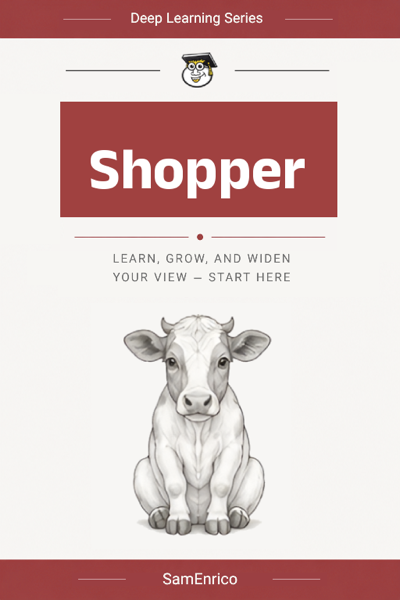
Shopper eBook
A Coursebook on Shopper
A Coursebook on Shopper
Formats
Free sample
Chapter 1: The Autopilot Betrayal--– You are about to discover something unsettling. In the time it takes you to read this sentence, your brain will have already made three purchasing decisions without your permission. Not recommendations. Not suggestions. Decisions.
Your hand will reach for a product before your conscious mind knows why. Your eyes will skip over the best deal and land on the most familiar package. Your wallet will open for reasons you will rationalize later but never truly understand.This is not a flaw in your character. It is not a lack of discipline or a failure of willpower. It is the fundamental architecture of the human brain – and the retail industry has spent billions of dollars learning to exploit it.
They know what you will buy before you do. They know which shelf to put it on, which color to make the package, and which price to write in the largest font. They know because they have stopped studying what shoppers say and started studying what shoppers do. And what shoppers do is betray themselves.Every day, you walk into stores and onto websites believing you are in control. You tell yourself you are comparing prices, reading labels, and making a rational choice.
You are wrong. The vast majority of your purchasing decisions – somewhere between 70 and 90 percent, depending on the category – are made by a part of your brain you cannot directly access, cannot easily override, and barely know exists. Call it the autopilot. Call it the reflex. Call it System 1.
Whatever name you give it, the truth is the same: you are not the pilot of your shopping. You are a passenger who occasionally grabs the controls.This chapter will show you the autopilot in action. It will force you to confront the uncomfortable gap between what you think you do in a store and what you actually do. And it will introduce the single most important distinction in all of shopper psychology – a distinction that, once understood, will change how you see every purchase you will ever make.The Grocery Store Lie Let us begin with an experiment you can conduct yourself. Go to any grocery store.
Any chain, any city, any time of day. Walk to the cereal aisle. Stand at the entrance of the aisle and look at the wall of boxes. There will be dozens of options – perhaps more than a hundred. Now watch the shoppers.What you will see, if you pay close attention, is a pattern of behavior that contradicts everything shoppers claim about themselves.
A woman will walk to the middle of the aisle – not the top or bottom shelf, but the exact middle. She will reach for a box without comparing the options to her left or right. She will put it in her cart and walk away. The entire transaction, from arrival to departure, will take less than eight seconds. She has just chosen a product she will eat repeatedly over the next week, and she spent less time on that choice than you spent reading this paragraph.If you stopped her at the exit and asked why she chose that particular cereal, she would give you a reason.
She might say it was on sale. She might say she likes the taste. She might say she read the ingredients and preferred them. Every single one of these explanations is a lie – not a malicious lie, but a post-hoc fabrication. Her conscious mind did not weigh the options, compare the prices, or evaluate the ingredients.
Her autopilot did. Her conscious mind simply invented a justification after the fact to maintain the illusion of control.This is not speculation. It is the result of decades of research in cognitive psychology and neuroscience, much of it conducted by the Nobel Prize-winning psychologist Daniel Kahneman and his collaborator Amos Tversky. Their work revealed that the human brain operates on two fundamentally different systems, and only one of them is accessible to your conscious awareness.The Two Systems: Pilot and Navigator Imagine you are driving a car on a familiar road. The sun is out, traffic is light, and you have made this drive a hundred times before.
You are not thinking about the mechanics of driving. Your foot moves between pedals automatically. Your hands adjust the wheel without conscious instruction. You arrive at your destination and realize you remember almost nothing about the drive. You were on autopilot.Now imagine you are driving the same car on an unfamiliar road in heavy rain at night.
You grip the wheel. You watch every curve. You check your speed constantly. You are fully engaged, fully conscious, fully in control. The drive exhausts you because you are doing work your brain normally offloads.This is the difference between System 1 and System 2.System 1 – The Pilot (Autopilot): Fast, automatic, emotional, unconscious, and effortless.
System 1 recognizes faces, feels fear, reads simple sentences, and – most importantly for our purposes – makes routine purchasing decisions. When you grab your usual brand of toothpaste without looking at the other options, that is System 1. When you reach for the cereal at eye level because your brain has learned that "eye level = best value," that is System 1. When you buy something because "it just feels right," that is System 1.System 1 is not stupid. It is extraordinarily sophisticated – but its sophistication comes from pattern recognition, not logical analysis.
System 1 has learned, through thousands of repetitions, that certain visual cues predict desirable outcomes. A familiar logo predicts safety. A yellow price tag predicts a deal. A box with more space between the text and the edge of the package predicts premium quality. System 1 does not reason its way to these conclusions.
It simply reacts. And it reacts faster than your conscious mind can intervene.System 2 – The Navigator (Conscious Controller): Slow, deliberate, analytical, energy-intensive, and conscious. System 2 solves math problems, compares complex options, evaluates risk, and overrides impulses. When you compare the unit price of two detergent bottles to find the better value, that is System 2. When you read the fine print on a warranty, that is System 2.
When you force yourself to put down an impulse purchase and walk away, that is System 2.Here is the crucial insight that most books get wrong: System 2 is not the default. It is not even the most common. System 2 activates only when System 1 encounters something it cannot handle – an unfamiliar product, a surprising price, a confusing label, or a high-stakes decision. The moment System 1 feels confident, it resumes control. The navigator hands the wheel back to the pilot as quickly as possible, because conscious thinking is exhausting.
Your brain is wired to avoid thinking whenever it can.The marketing industry has known this for decades. The most successful retailers do not try to convince your System 2 that their product is superior. They try to make your System 1 feel comfortable, familiar, and safe. They design their packaging, their shelf placement, and their pricing to trigger automatic responses. They want you to grab and go.
They want you to stop thinking.The Handoff: When the Navigator Gives Up The most important moment in any shopping journey is not the moment of purchase. It is the moment just before – the handoff…
This is the end of the free sample. Get the eBook to keep going. Buy now
About this book
Details
- Author
- Walrath Cathern
- Publisher
- SamEnrico
- Language
- English
- Genre
- Non-Fiction, Informative, Educational
- Released
- 2026-05-09
- Pages (approx.)
- 144
- Available as
- eBook, Audiobook

Read better in the ZLOADR app
Your eBooks on your phone or tablet. Sign in with your SamEnrico account and start reading.
More by Walrath Cathern
 Loneliness for FreelancersWalrath Cathern$11.99
 Venture Capital SentimentWalrath Cathern$11.99
 The Fulfillment First Career PathWalrath Cathern$11.99
 College Freshman Stress GuideWalrath Cathern$11.99
 The Arsenic Widows: Poison, Deception, and the Kidnapping Plot of Colonial AustraliaWalrath Cathern$11.99
 Product Owner Survival StartupWalrath Cathern$12.99
 How to Produce Baby One-pieces (Clothing)Walrath Cathern$11.99
You may also like
 Hong Kong Handover 1997Dunn Johnnie$11.99
 Zumba For Postnatal Recovery CourseNeal Christian$11.99
 Zumba for BeginnersLadner Nikia$11.99
 YouTube Comment Mining GuideHumes Pandora$12.99
 Worry Box MeditationCarlin Rudy$11.99
 Workplace Stress MeditationNguyen Lynn$11.99
 Workplace Stress and Sleep RepairHawley Ivory$11.99
 Workplace Perfectionism CureDelaney Jeffry$11.99
 Workplace Injustice Anger GuideWallen Isabelle$11.99
 Work Addiction and Burnout LinkGreenwood Ester$11.99
 Women in Yoga and WellnessBeattie Galina$11.99
 Women in Stand Up ComedyChun Evangeline$11.99