
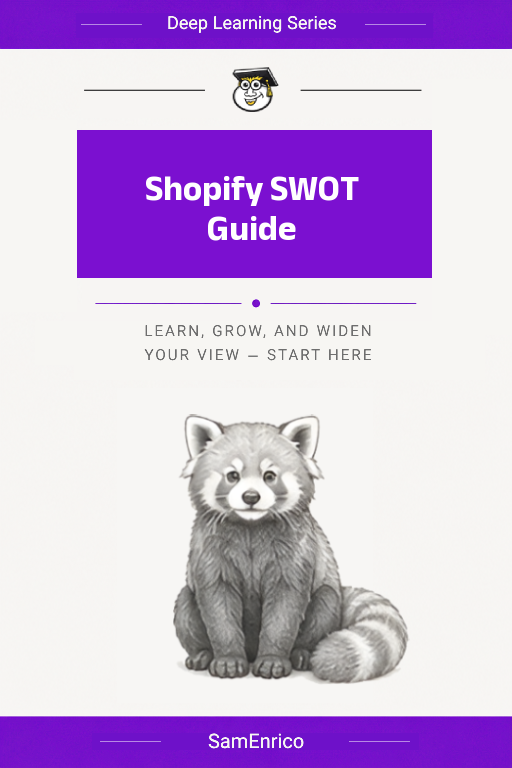
Non-FictionStrategic AtlasEcommerce Platform
Shopify SWOT Guide Audiobook
Analyze e-commerce platform leadership, payments a
Analyze e-commerce platform leadership, payments adoption, competition from Amazon and Salesforce, and revenue slowdown.
Formats
Free sample
Chapter 1: The Great Debate...–- In the summer of 2026, a mid-sized footwear retailer faced an existential question. The company had grown from a single brick-and-mortar location to a $50 million omnichannel operation. Its founder, a pragmatic woman named Sarah, had built her business on Shopify. She loved the platform's simplicity, its predictable pricing, and the way it put her brand front and center. But now her investors were pressuring her to list on Amazon.
Their argument was simple: Amazon has 300 million active buyers. Amazon handles logistics. Amazon drives discovery. Sarah's counterargument was just as simple: Amazon owns the customer. You become a supplier, not a brand.
The boardroom debate that followed is playing out in thousands of companies right now, from solopreneurs to Fortune 500 retailers. It is the central strategic tension of modern commerce, and it cannot be resolved by spreadsheets or conversion rate optimization alone. It requires understanding two fundamentally different philosophies about how commerce should work: the Aggregator model and the Platform model.This chapter establishes the foundational framework for understanding Shopify's position in the global commerce ecosystem. It explains why Shopify exists, what it does differently from Amazon, and why that difference matters more today than at any point in the company's history. By the end of this chapter, you will understand not just what Shopify does, but why its strategic choices create both extraordinary strengths and surprising vulnerabilities—a tension that echoes through every subsequent chapter of this book.The Two Philosophies of Commerce Every e-commerce business ultimately faces a choice between two distinct models.
The first is the Aggregator model, perfected by Amazon. The second is the Platform model, championed by Shopify. These are not just different business strategies; they are different theories of value creation and capture.The Aggregator Model: Own the Customer In the Aggregator model, a single company controls the customer relationship. The marketplace—Amazon, in this case—owns the storefront, sets the rules, captures the data, and decides which products appear in front of which customers. Merchants are suppliers, not brand owners.
They compete in an auction for visibility, paying for ads to reach customers who believe they are shopping on "Amazon," not on the merchant's own store.The Aggregator model has undeniable advantages. Customer acquisition costs are low because traffic is already present. Logistics are simplified because the Aggregator provides fulfillment. Discovery is built-in because the marketplace algorithm serves as the primary…
This is the end of the free sample. Get the Audiobook to keep going. Buy now
About this book
Details
- Author
- Coward Kimberlee
- Publisher
- SamEnrico
- Language
- English
- Genre
- Non-Fiction, Strategic Atlas, Ecommerce Platform
- Released
- 2026-05-30
- Pages (approx.)
- 139
- Available as
- eBook, Audiobook

Listen in the VoxFlicks app
Audiobooks and audio dramas wherever you go. Sign in with your SamEnrico account and press play.
More by Coward Kimberlee
 Poverty and AddictionCoward Kimberlee$11.99
 The Joy of Growing OldCoward Kimberlee$11.99
 Imposter Syndrome Gifted AdultsCoward Kimberlee$11.99
 Assertive Communication for ExecutivesCoward Kimberlee$11.99
 Mindfulness for Perfectionists GuideCoward Kimberlee$11.99
 The Phantom of Westminster: The Haunting of Edward the ConfessorCoward Kimberlee$11.99
 Client Service AdministratorCoward Kimberlee$11.99
 How to Become a Dog GroomerCoward Kimberlee$11.99
 Citation Rules for College PapersCoward Kimberlee$12.99
 Understanding Myopathy, MyotubularCoward Kimberlee$17.99
You may also like
 Hong Kong Handover 1997Dunn Johnnie$11.99
 Zumba For Postnatal Recovery CourseNeal Christian$11.99
 Zumba for BeginnersLadner Nikia$11.99
 YouTube Comment Mining GuideHumes Pandora$12.99
 Worry Box MeditationCarlin Rudy$11.99
 Workplace Stress MeditationNguyen Lynn$11.99
 Workplace Stress and Sleep RepairHawley Ivory$11.99
 Workplace Perfectionism CureDelaney Jeffry$11.99
 Workplace Injustice Anger GuideWallen Isabelle$11.99
 Work Addiction and Burnout LinkGreenwood Ester$11.99
 Women in Yoga and WellnessBeattie Galina$11.99
 Women in Stand Up ComedyChun Evangeline$11.99