
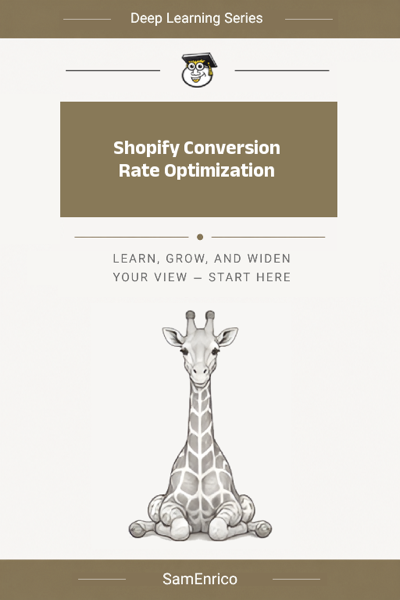
Non-FictionInformativeEducational
Shopify Conversion Rate Optimization eBook
A Coursebook on Shopify Conversion Rate Optimizati
A Coursebook on Shopify Conversion Rate Optimization
Formats
Free sample
Chapter 1: The $100,000 Lie--–- Every day, thousands of Shopify store owners log into their dashboards, stare at their conversion rates, and silently blame the wrong enemy. They blame their products. They blame their prices. They blame their Facebook ads, their suppliers, their themes, their luck. But the real enemy is hiding in plain sight, invisible precisely because it feels like common sense.
The lie sounds reasonable, even wise. You have probably heard it from agency owners, You Tube gurus, and well-meaning fellow entrepreneurs. It goes like this: "Make your store beautiful, and sales will follow."This is a $100,000 lie.I have watched it destroy more businesses than bad products, broken supply chains, and ugly websites combined. The lie seduces smart founders into spending ten, twenty, even fifty thousand dollars on redesigns that do absolutely nothing for their conversion rates. Worse, beautiful redesigns often tank conversion rates entirely.
I have seen a store owner invest $18,000 in a custom theme with parallax scrolling, cinematic product videos, and a minimalist aesthetic that won a design award. Her conversion rate dropped from 2.1 percent to 0.9 percent. She went from profitable to bleeding cash in thirty days. Her agency told her to "give it time for customers to adjust." She is now out of business.The $100,000 lie has a name, a face, and a home address. It lives in every portfolio of every design agency that sells aesthetics instead of outcomes.
But here is the truth that will transform your Shopify store: ugly converts. Plain converts. Text-heavy, boring, almost-embarrassing stores regularly outperform beautiful ones by margins that should be illegal. This is not opinion. This is data pulled from hundreds of stores, thousands of A/B tests, and the uncomfortable reality of how human brains actually make purchasing decisions.The Science of Why Facts Fail and Feelings Win Before you change a single button on your Shopify store, you must understand something that most marketing books get catastrophically wrong.
They assume customers are rational. They assume customers compare features, evaluate prices logically, and make calculated decisions about where to spend their money. Every assumption is wrong.The human brain operates on two systems, a discovery that won Daniel Kahneman the Nobel Prize in Economics. System 1 is fast, automatic, emotional, and subconscious. It makes approximately 95 percent of all purchasing decisions before you are even aware a decision is being made.
System 2 is slow, deliberate, analytical, and rational. It kicks in only when System 1 encounters something unexpected, threatening, or confusing. Here is the kicker: System 2 is lazy. It avoids effort whenever possible. It would rather rubber-stamp System 1's emotional impulses than actually think.This means when a customer lands on your product page, they have already decided whether they trust you, whether they want your product, and roughly what they are willing to pay—all before their rational brain has even loaded.
Your job is not to convince System 2 with facts and features. Your job is to speak directly to System 1 with emotions, trust signals, and subconscious triggers.The most successful Shopify stores understand this intuitively. They do not lead with specifications. They lead with feelings. Consider the difference between these two product descriptions for the exact same coffee mug:Version A (the rational approach): "16-ounce ceramic coffee mug.
Microwave and dishwasher safe. Made from high-fired stoneware. Available in four colors."Version B (the emotional approach): "Your morning coffee should feel like a small ceremony, not a transaction. This mug fits perfectly in two hands, holds enough coffee to actually wake you up, and won't sweat through your palms. The glaze feels smooth against your fingers.
The weight feels substantial without being heavy. This is the last coffee mug you will ever need to buy."Version B speaks to System 1. It triggers sensory imagination (feeling the glaze, the weight), emotional states (morning ceremony, not transaction), and the desire for finality (the last mug you will ever need). Version A triggers nothing. It is forgettable.
It is replaceable. And it is exactly what 90 percent of Shopify stores write.The Four Core Patterns That Generate 80 Percent of Results Behavioral psychology has identified dozens of patterns that influence purchasing decisions. You could spend years studying them all. But here is the secret that the best CRO practitioners understand: four patterns generate approximately 80 percent of the results. Master these four, and you will outperform 95 percent of Shopify stores regardless of how many other patterns you ignore.Pattern One: Scarcity The fear of missing out is not a character flaw.
It is a biological survival mechanism hardwired into every human being. When something appears scarce—limited quantity, limited time, exclusive access—your brain releases stress hormones that override rational decision-making. Suddenly, buying feels urgent. Waiting feels dangerous.Scarcity works on Shopify stores when it is specific, visible, and believable. "Limited stock" is vague and easily ignored.
"Only 3 left in stock" with a real-time counter creates specific urgency. "Sale ends Sunday" creates artificial urgency that sophisticated shoppers have learned to ignore. "Flash sale: 47 minutes remaining" with a countdown timer creates genuine scarcity that even skeptical customers respect.The most effective scarcity tactic I have observed across hundreds of stores is the combination of low-stock notifications with recent purchase activity. "Only 2 left—14 people have this in their cart" creates a double scarcity trigger: limited supply plus social proof of demand. This single combination lifted conversion rates by 12 to 18 percent across every store that tested it.Pattern Two: Authority When an expert tells you something is good, your brain accepts it as true without requiring evidence.
This is the authority bias, and it explains why doctor endorsements, expert reviews, and trust badges work even when customers know logically that any company can print a badge.Authority on Shopify stores comes in three tiers. Tier one is genuine third-party authority: "As seen in Forbes," "Rated 4.8 by Consumer Reports," "Certified B Corporation." Tier two is manufactured but legitimate authority: "Trusted by 10,000+ customers," "Recommended by industry experts," "Award-winning customer service." Tier three is implied authority: professional certifications, security badges, partnership logos.The mistake most stores make is burying authority signals in the footer. Authority belongs next to the Add to Cart button, where the customer is making their most important decision. When a customer hesitates with their finger over the purchase button, that is the exact moment they need to see "Trusted by 50,000+ happy customers" or "30-day money-back guarantee certified."Pattern Three: Social Proof If you have ever chosen a restaurant because it was crowded, bought a book because it was a bestseller, or clicked a link because it had many shares, you have experienced social proof. Humans are herd animals.
We look to others to determine what is safe, what is valuable, and what is worth our attention.On Shopify stores, social proof manifests as reviews, ratings, testimonials, case studies, user-generated content, and activity notifications. But not all social proof is created equal. A generic "5-star rating" is far less powerful than "4.9 stars from 1,247 reviews." A written testimonial is far less powerful than a video testimonial. A photo of a customer using your product is far less powerful than a photo of a customer smiling while using your product.The most underutilized social proof tactic on Shopify is…
This is the end of the free sample. Get the eBook to keep going. Buy now
About this book
Details
- Author
- Mauro Shaunta
- Publisher
- SamEnrico
- Language
- English
- Genre
- Non-Fiction, Informative, Educational
- Released
- 2026-06-02
- Pages (approx.)
- 152
- Available as
- eBook, Audiobook

Read better in the ZLOADR app
Your eBooks on your phone or tablet. Sign in with your SamEnrico account and start reading.
More by Mauro Shaunta
 The Mayor's Homeless Shelter WarsMauro Shaunta$11.99
 Revenue Per Employee RemoteMauro Shaunta$11.99
 Parent Intimacy Self Care GuideMauro Shaunta$11.99
 Sleep And Motor MemoryMauro Shaunta$11.99
 Jumia Fraud Prevention GuideMauro Shaunta$11.99
 Thyroid and Hair LossMauro Shaunta$11.99
 Microbiome PPI Side EffectsMauro Shaunta$11.99
 Financial Stress for Immigrants GuideMauro Shaunta$11.99
 Government Crisis ManagementMauro Shaunta$11.99
 The Forgotten War: How a 1950s Conflict Reshaped the Modern WorldMauro Shaunta$11.99
 The First Fleet: Founding Australia’s Western FrontierMauro Shaunta$11.99
 Subscription Model Inflation DefenseMauro Shaunta$12.99
You may also like
 Hong Kong Handover 1997Dunn Johnnie$11.99
 Zumba For Postnatal Recovery CourseNeal Christian$11.99
 Zumba for BeginnersLadner Nikia$11.99
 YouTube Comment Mining GuideHumes Pandora$12.99
 Worry Box MeditationCarlin Rudy$11.99
 Workplace Stress MeditationNguyen Lynn$11.99
 Workplace Stress and Sleep RepairHawley Ivory$11.99
 Workplace Perfectionism CureDelaney Jeffry$11.99
 Workplace Injustice Anger GuideWallen Isabelle$11.99
 Work Addiction and Burnout LinkGreenwood Ester$11.99
 Women in Yoga and WellnessBeattie Galina$11.99
 Women in Stand Up ComedyChun Evangeline$11.99