
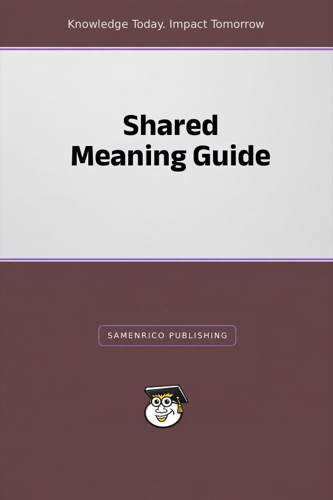
Shared Meaning Guide eBook
Create rituals and inside jokes as couple.
by Storey Abbie
Create rituals and inside jokes as couple.
Formats
Free sample
Chapter 1: The Cognitive Glue...--–- Every couple I have ever worked with believes they have a communication problem. They sit in my office, shoulders slumped, and say the same thing: "We just can't seem to talk anymore." Or "We fight about the same things over and over." Or "I don't feel heard." These are real pains, and I do not dismiss them. But after twenty years of studying couples, I have arrived at an uncomfortable conclusion that most therapists are afraid to say out loud: Communication is overrated.Not unnecessary. Overrated.The difference is crucial. Communication skills—active listening, "I feel" statements, paraphrasing back what you heard—are useful tools.
They can prevent a fight from becoming a disaster. But here is the secret that the happiest couples know intuitively and the rest of us learn too late: Communication does not create connection. Shared meaning creates connection. And shared meaning is not built through talk. It is built through ritual, repetition, and inside jokes.Let me prove this to you with a simple experiment.
Think back to the best moment you have ever had with your partner. Not the most dramatic. Not the most romantic in a movie sense. The moment when you felt the most deeply known—when you looked at each other and thought, "This is us. This is our private world."Now answer this: Was that moment primarily defined by talking?
Or was it defined by something else—a shared laugh, a synchronized action, a ritual you didn't even realize you had created?I have asked this question to thousands of couples. The answers are remarkably consistent. The moments of deepest connection are almost never the moments of deepest conversation. They are the moments when:You both burst out laughing at something that no one else in the room found funny You performed a secret handshake before a stressful event You said a single code word that contained an entire story You touched each other in a specific way that meant "I've got you"You followed an unspoken routine that felt like coming home These are not communication skills. These are rituals and inside jokes—what I call the cognitive glue of intimate relationships.The Myth of the Talking Cure For the past fifty years, the relationship advice industry has been built on a single premise: if you can just learn to communicate better, your relationship will improve.
This premise has generated thousands of books, millions of therapy hours, and an entire vocabulary of "active listening" techniques. It has also generated a great deal of frustration.Because here is what the research actually shows: couples who report the highest relationship satisfaction do not have fewer disagreements than unhappy couples. They do not use more "I feel" statements. They are not better at paraphrasing. What they have is something far more fundamental and far less talked about: they have built a private culture.John Gottman, the world's leading relationship researcher, discovered this after decades of studying thousands of couples.
His most famous finding is often misquoted. People think he said that happy couples fight less. What he actually found is that happy couples have a ratio of five positive interactions for every one negative interaction—not because they avoid conflict, but because they have so many positive rituals that the negative moments are diluted.Think about that. The solution is not to eliminate the bad moments. It is to overwhelm them with good ones.
And the most efficient way to generate good moments is not through lengthy conversations about feelings—it is through small, repeated, shared actions that become automatic.This is what I call the Cognitive Glue. It is the neurological and emotional bonding that happens when two people perform a ritual together or share a private joke. The glue is not made of words. It is made of repetition, anticipation, and belonging.The Emotional Bank Account Let me introduce you to a concept that will appear throughout this book: the Emotional Bank Account. Every interaction you have with your partner is either a deposit or a withdrawal.
Deposits build trust, safety, and goodwill. Withdrawals erode them.Here is what most people get wrong: they think that resolving a conflict is a deposit. It is not. Resolving a conflict is simply stopping a withdrawal. It returns you to neutral.
A deposit is something extra—a moment of connection that is not required, not negotiated, not part of the transaction of daily life.Rituals and inside jokes are the highest-yield deposits you can make. They are small in time commitment but massive in emotional return.Consider the difference between these two scenarios:Scenario A: You and your partner have a disagreement about money. You talk it through for forty-five minutes. You reach a compromise. You feel okay.
Neutral.Scenario B: You and your partner have a disagreement about money. You talk it through for forty-five minutes. You reach a compromise. Then, as you are both exhaling, you look at each other and say, in unison, the secret code word you invented six years ago after a ridiculous argument about a grocery bill. You both laugh.
The tension evaporates. You feel closer than before the fight started.In Scenario A, you stopped the bleeding. In Scenario B, you built something. The difference is the ritual—the inside joke that acts as a circuit breaker and a reminder that you are on the same team.The Neuroscience of Repetition Why do rituals work? The answer lies in your brain.Every time you perform a ritual with your partner—making coffee the same way, saying the same phrase when you reunite, touching in a specific pattern—your brain releases a small amount of oxytocin.
Oxytocin is often called the "bonding hormone," but that undersells it. Oxytocin is the chemical that tells your nervous system: You are safe. This person is familiar. You belong here.Here is the crucial part: oxytocin release is amplified by repetition. The first time you perform a ritual, you might get a small boost.
The tenth time, the boost is larger. The hundredth time, your brain has created a neural pathway so efficient that the ritual itself becomes a conditioned trigger for relaxation. You don't have to think about feeling safe. You just feel safe.This is limbic resonance—the technical term for what happens when two nervous systems learn to sync with each other. Your heart rates begin to match.
Your breathing patterns align. Your brain waves coordinate. This is not poetry. This is measurable physiology.And here is the counterintuitive finding: limbic resonance is strengthened more by low-stakes repetition than by high-stakes communication. A daily five-second ritual—a specific goodbye wave, a shared sigh before sleep—does more to sync your nervous systems than a weekly two-hour "relationship check-in" ever could.
This is because the daily ritual is predictable. Your brain can anticipate it. And anticipation is the key to safety.Chores vs. Rituals: The Critical Distinction Not every repeated action is a ritual. Sometimes, a repeated action is just a chore.The difference is emotional valence.
A chore is something you do because you have to. A ritual is something you do because it means something.…
This is the end of the free sample. Get the eBook to keep going. Buy now
About this book
Details
- Author
- Storey Abbie
- Publisher
- SamEnrico
- Language
- English
- Genre
- Non-Fiction, Self-Help, Shared Meaning
- Released
- 2026-06-09
- Pages (approx.)
- 144
- Available as
- eBook, Audiobook

Read better in the ZLOADR app
Your eBooks on your phone or tablet. Sign in with your SamEnrico account and start reading.
More by Storey Abbie
 Self Esteem After StillbirthStorey Abbie$11.99
 Jiddu Krishnamurti GuideStorey Abbie$11.99
 Ethiopian Jewish AliyahStorey Abbie$11.99
 PAWS Symptom Management ManualStorey Abbie$11.99
 Emotional Memory ReconsolidationStorey Abbie$11.99
 Acquisition Accounting For SellersStorey Abbie$11.99
 Worlds Biggest Diamond HeistStorey Abbie$11.99
 The Phantom of the Catacombs: The Unsolved Mystery of the Parisian BonesStorey Abbie$11.99
 The Titan of the Skies: Lindbergh and the Spirit of St. LouisStorey Abbie$11.99
 How to Produce StencilingStorey Abbie$11.99
 How to Produce Hair Bun and Volume ShapersStorey Abbie$11.99
 VA Veteran Minority GuideStorey Abbie$12.99