
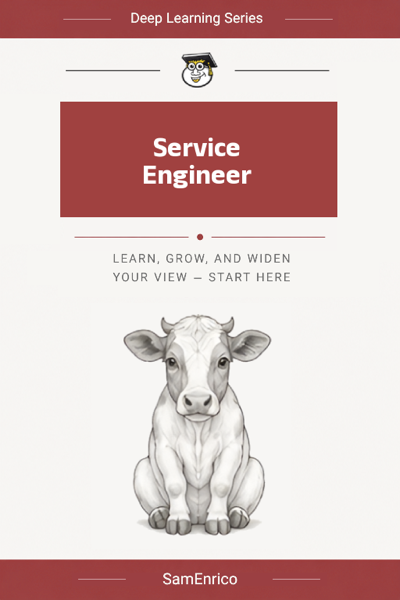
Non-FictionInformativeEducational
Service Engineer eBook
A Coursebook on Service Engineer
A Coursebook on Service Engineer
Formats
Free sample
Chapter 1: The Unspoken Revolution...--– In a noisy workshop outside Birmingham, England, a fifty-three-year-old diesel mechanic named Colin has just diagnosed a recurring injector failure using nothing but his ears, a vibration gauge, and thirty years of pattern recognition. Four thousand miles away, a twenty-six-year-old site reliability engineer named Priya sits in a silent San Francisco apartment, staring at a dashboard of cascading red alerts. She has just diagnosed a database deadlock caused by a malformed configuration push. Colin and Priya have never met. They work with different tools, different vocabularies, and entirely different technologies.
Yet both are service engineers. And both are fighting the same war—the war against failure, downtime, and the slow erosion of customer trust.The modern service engineer is the most misunderstood, underestimated, and urgently needed professional of the twenty-first century. Ask a stranger to describe an engineer, and they will likely picture a bridge builder, a software developer hunched over code, or perhaps a mechanic covered in grease. All of those images are partially correct. None of them captures the full truth.
The service engineer does not simply build things or fix things. The service engineer ensures that promises—the invisible contracts between a provider and a user—are kept, minute by minute, often across continents, often in the face of chaos that no single person can fully control.This book argues a radical proposition: that the discipline of service engineering has outgrown its origins as a trade, a technical specialty, or an IT support function. It has become a distinct, mature field of knowledge that sits at the intersection of three foundational domains: technical architecture (the machines, the code, the pipes), business strategy (the economics, the value streams, the trade-offs), and human psychology (the trust, the communication, the shared understanding of what "working" actually means). To master service engineering is to become, in the ideal, what this book will call a Full-Stack Operator—not a person who does everything, but a professional who understands how these three domains interact and who can move deliberately between them.But let us be honest from the first page. No single human being can be a world-class diesel mechanic, a cloud infrastructure wizard, a financial analyst, and a crisis communicator all at once.
That is not the argument. The argument is that the profession requires all of these capabilities, and that individual practitioners grow into the role over time, specializing where their talents lie while maintaining enough fluency in the other domains to collaborate effectively. Colin does not need to write Kubernetes manifests. Priya does not need to rebuild a fuel injector. But both need to understand that root-cause analysis follows the same pattern regardless of the medium.
Both need to speak the language of uptime, cost, and customer impact. Both need to know when to escalate, when to document, and when to say "I don't know yet" without destroying confidence.This chapter will dismantle three persistent myths about service engineering. The first myth is that it is merely a reactive trade—that service engineers are firefighters who only show up when something breaks. The second myth is that service engineering is an entry-level or "lower status" role compared to design or development. The third myth is that digital and physical service engineering are fundamentally different disciplines requiring completely separate training.
Each of these myths is not just wrong but dangerously wrong, because each leads organizations to underinvest in the capabilities that ultimately determine whether customers stay or leave.To understand why, we must go back. Not too far—only a few decades. But far enough to see how the role has been quietly, relentlessly transformed.The pre-digital service engineer was largely a mechanical or electrical tradesperson. If you bought a printing press, a tractor, or an elevator, you also bought a maintenance contract. The engineer arrived with a toolbox, a paper manual, and a list of scheduled inspections.
The dominant model was break-fix: wait for something to fail, then repair it. The most valuable skill was diagnostic intuition—the ability to listen to an engine and know, by the quality of its knock, which cylinder was misfiring. The relationship between customer and engineer was local, often personal, and built over years. The engineer knew the machine, knew the operator, and knew the building. That intimacy was the foundation of trust.The first disruption came with the digitization of machines.
Programmable logic controllers, embedded systems, and eventually network-connected sensors meant that machines could report their own status. The engineer no longer had to be physically present to know that a temperature threshold had been crossed. Remote monitoring was born. This shift, which began in the 1980s and accelerated through the 2000s, changed the economics of service radically. Suddenly one engineer could monitor dozens or hundreds of machines from a single screen.
The role began to split: some engineers stayed in the field, others moved into monitoring centers, and a new kind of hybrid emerged—the engineer who could read data, interpret alerts, and dispatch physical help when needed.The second disruption was the internet itself. When services became digital—websites, APIs, cloud storage, streaming platforms—the entire model of "break and fix" collapsed. A software bug could affect millions of users simultaneously. There was no physical part to replace. The fix might be a single line of code, but finding that line meant navigating a labyrinth of distributed systems, each with its own logs, its own failure modes, and its own team of owners.
The field of Site Reliability Engineering emerged from Google in the early 2000s, codifying practices that had previously been tribal knowledge. The SRE did not wait for things to break. The SRE designed systems that could tolerate failure, measured everything, and used error budgets to decide when to stop deploying new features and start fixing stability. The resemblance to preventive maintenance was not accidental—but the tools were unrecognizable.Today we stand at the convergence of these two histories. The diesel mechanic and the cloud SRE are not separate species.
They are branches of the same evolutionary tree, separated by technology but united by function. Both detect anomalies. Both isolate causes. Both verify fixes. Both communicate with distressed customers.
Both keep records that inform future improvements. The vocabulary differs—"vibration analysis" versus "latency spike," "injector timing" versus "query execution plan"—but the underlying cognitive workflow is identical. This is not a metaphor. Cognitive task analysis studies have repeatedly shown that expert diagnosticians in medicine, aviation, automotive repair, and software engineering follow the same mental model: generate hypotheses, test the most likely first, gather evidence, revise, act, and verify. The domain changes.
The structure of expertise does not.This insight is the foundation of everything that follows in this book. If you accept that service engineering is a unified discipline—not two disciplines wearing similar name tags—then the implications are profound. Training programs can stop pretending that physical and digital service engineers need entirely separate curricula. They share systems thinking, incident management, customer communication, economic reasoning, and root-cause analysis. They diverge only in the technical specifics, and those specifics can be taught as specializations atop a common base.
Organizations can stop career-path segregation that traps field engineers in one silo and software engineers in another. The best service…
This is the end of the free sample. Get the eBook to keep going. Buy now
About this book
Details
- Author
- Kunkel Roberto
- Publisher
- SamEnrico
- Language
- English
- Genre
- Non-Fiction, Informative, Educational
- Released
- 2026-05-06
- Pages (approx.)
- 158
- Available as
- eBook, Audiobook

Read better in the ZLOADR app
Your eBooks on your phone or tablet. Sign in with your SamEnrico account and start reading.
More by Kunkel Roberto
 Family Guide To DysthymiaKunkel Roberto$11.99
 Section 232 Steel Tariff GuideKunkel Roberto$11.99
 Async Project Management GuideKunkel Roberto$11.99
 Executive Security Culture Training ManualKunkel Roberto$11.99
 Hypnotic Post Op Pain ControlKunkel Roberto$11.99
 The Vanishing of Flight 571: The Bermuda Triangle's Last MysteryKunkel Roberto$11.99
 The Billionaire Who Bought a CountryKunkel Roberto$11.99
 How to Become a Cell TenderKunkel Roberto$11.99
 Supply Chain Insurance GuideKunkel Roberto$12.99
 Dubai After Graduation VisaKunkel Roberto$12.99
 Understanding Congenital RubellaKunkel Roberto$17.99
You may also like
 Hong Kong Handover 1997Dunn Johnnie$11.99
 Zumba For Postnatal Recovery CourseNeal Christian$11.99
 Zumba for BeginnersLadner Nikia$11.99
 YouTube Comment Mining GuideHumes Pandora$12.99
 Worry Box MeditationCarlin Rudy$11.99
 Workplace Stress MeditationNguyen Lynn$11.99
 Workplace Stress and Sleep RepairHawley Ivory$11.99
 Workplace Perfectionism CureDelaney Jeffry$11.99
 Workplace Injustice Anger GuideWallen Isabelle$11.99
 Work Addiction and Burnout LinkGreenwood Ester$11.99
 Women in Yoga and WellnessBeattie Galina$11.99
 Women in Stand Up ComedyChun Evangeline$11.99