
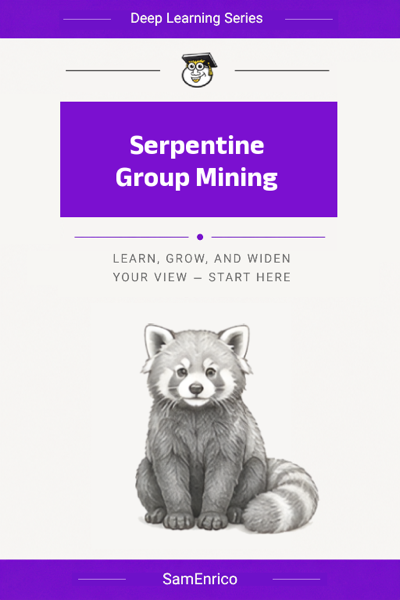
Non-FictionInformativeEducational
Serpentine Group Mining eBook
A Coursebook on Serpentine Group Mining
A Coursebook on Serpentine Group Mining
Formats
Free sample
Chapter 1: The Green Menace--–- The rock arrived at the assay lab in a plain cardboard box, no different from the thousands of other samples that passed through the facility each week. The geologist who collected it had been looking for copper, chasing a faint electromagnetic anomaly through the bush of northern Quebec. What he found instead was a slippery, greenish-gray boulder that felt heavier than it looked and left a chalky residue on his hands. He labeled it "serpentinite, possible nickel showings" and thought nothing more of it. Three weeks later, the lab called him back.
The sample had crushed their jaw crusher—not because it was hard, but because it was soft and fibrous and had wrapped itself around the moving parts like wet carpet. Then it had clogged their screens. Then it had contaminated their flotation cell with a layer of fine, talc-like slime that took two days to clean. The lab manager, a man with thirty years of experience in hard rock mining, told the geologist something he had never said about any other rock type: "I don't want to see another one of these. Ever."That rock was serpentine.
And that lab manager's frustration captures, in miniature, the central problem of serpentine group mining. This is not a rock that yields its wealth easily. It does not crush cleanly, like granite. It does not support tunnels reliably, like basalt. It does not process predictably, like most other nickel ores.
Instead, it fights back at every stage of the mining value chain—from the first drill core to the final tailings pond. And yet, despite all of this—perhaps because of all of this—serpentine has become one of the most strategically important rock types of the twenty-first century. The nickel and cobalt locked inside serpentine deposits are essential components of the lithium-ion batteries that power electric vehicles. The magnesium in serpentine waste rock can capture carbon dioxide from the atmosphere, potentially turning a mining liability into a climate solution. And the sheer abundance of serpentine—outcrops are found on every continent, marking the sutures where ancient oceans closed and continents collided—means that it will be mined, somewhere, by someone, whether the industry is ready or not.This book is about that contradiction.
It is about a rock that is simultaneously valuable and treacherous, abundant and inaccessible, environmentally hazardous and potentially climate-saving. It is about the engineers who have learned, through trial and catastrophic error, how to stabilize ground that wants to collapse, how to process ore that wants to clog, and how to protect workers from dust that can kill them decades after they breathe it. And it is about the future—a future in which the demand for battery metals will push mining companies into serpentine deposits that have been ignored for generations, forcing them to solve problems that the mining industry has long preferred to avoid.The Serpentine Family: Three Minerals, One Headache Before we can understand why serpentine is so difficult to mine, we must understand what it actually is. The serpentine group consists of three principal minerals, each with its own crystal structure, its own mechanical properties, and its own implications for mining and processing. They share the same chemical formula—(Mg,Fe,Ni)₃Si₂O₅(OH)₄—but they arrange their atoms differently, and those differences matter enormously.Antigorite is the most common serpentine polymorph and the one that causes the fewest problems for mining, though "fewest" is a relative term.
It forms at high temperatures, typically above 300 degrees Celsius, and its crystal structure consists of wavy, corrugated sheets that give it a relatively massive, non-fibrous habit. Antigorite is still weak by hard rock standards—its uniaxial compressive strength rarely exceeds 40 megapascals, compared to 150 megapascals or more for granite—but it is at least predictable. It does not spontaneously disaggregate into fibers. It does not produce the same hazardous dust as its cousin chrysotile. When geologists see antigorite in drill core, they breathe a cautious sigh of relief.
The ground will still be difficult, but it will not try to kill them in the same insidious way.Lizardite is the low-temperature serpentine polymorph, forming below 300 degrees Celsius, typically near the surface or in the outer rims of serpentinized bodies. Its crystal structure is platy—think of a stack of extremely thin, slippery sheets—and those plates have a tendency to separate under stress. Lizardite-rich serpentinite is the worst of the three for ground stability. It is soft, often with a hardness below 3 on the Mohs scale, meaning it can be scratched with a copper coin. It is highly deformable, with Young's modulus values often below 20 gigapascals.
And it has a distressing habit of undergoing what geotechnical engineers call "spontaneous liquefaction" when saturated and vibrated—a phenomenon more commonly associated with unconsolidated sands than with rock. When lizardite-rich serpentinite fails, it does not fracture like hard rock. It flows like a viscous fluid, squeezing through the smallest openings and exerting pressures that can buckle steel sets and snap rock bolts.Chrysotile is the polymorph that everyone has heard of, though usually under a different name: white asbestos. Chrysotile forms flexible, curved fibers that can be woven into textiles, mixed into cement, or sprayed onto boiler pipes as insulation. Those same fibers, when inhaled, become lodged in the lungs, where they trigger chronic inflammation, scarring, and eventually cancer.
The latency period for chrysotile-related diseases is typically twenty to forty years, meaning that a miner who breathed asbestos dust in his twenties might not develop mesothelioma until his fifties or sixties—long after the mine has closed, long after the safety records have been filed away, long after any lawsuit has been settled or statute of limitations expired. Chrysotile is classified as a Group 1 carcinogen by the International Agency for Research on Cancer, alongside tobacco smoke and plutonium.A critical clarification is needed here, and it will save lives if understood correctly. Antigorite and lizardite are not asbestos. Their crystal habits are massive or platy, not fibrous, and they are not classified as carcinogens under IARC Group 1. However—and this is a crucial however—antigorite can contain fibrous intergrowths of chrysotile in some geologic settings.
The two minerals form under different temperature conditions, but those conditions can overlap, and when they do, chrysotile fibers can grow within an antigorite matrix. This means that no serpentine deposit can be assumed safe without testing. A mine that appears to be antigorite-dominated on bulk mineralogy might still contain localized zones of chrysotile that pose serious respiratory hazards to anyone who disturbs them. The only responsible approach is to test every serpentine exposure for asbestos content, using a combination of phase contrast microscopy for regulatory compliance and transmission electron microscopy for definitive identification.The Chemistry of Trouble: Why Serpentine Behaves So Strangely The chemical formula of serpentine—(Mg,Fe,Ni)₃Si₂O₅(OH)₄—contains several clues about why this rock group behaves so differently from other silicate minerals. First, note the high magnesium content.
Typical serpentine contains 35 to 40 percent magnesium oxide (Mg O) by weight, making it one of the most magnesium-rich rock types on Earth. This high magnesium content is responsible for serpentine's distinctive…
This is the end of the free sample. Get the eBook to keep going. Buy now
About this book
Details
- Author
- Fitzpatrick Merrilee
- Publisher
- SamEnrico
- Language
- English
- Genre
- Non-Fiction, Informative, Educational
- Released
- 2026-06-03
- Pages (approx.)
- 148
- Available as
- eBook, Audiobook

Read better in the ZLOADR app
Your eBooks on your phone or tablet. Sign in with your SamEnrico account and start reading.
More by Fitzpatrick Merrilee
 Reading List Priority MethodFitzpatrick Merrilee$11.99
 Senior Grandparent Self Esteem GuideFitzpatrick Merrilee$11.99
 Networking ScorecardFitzpatrick Merrilee$11.99
 Hair Loss Due to Anabolic SteroidsFitzpatrick Merrilee$11.99
 Dark Souls Death Loop FixFitzpatrick Merrilee$11.99
 The Crown’s Wild Child: How Prince Harry’s Vegas Night Almost Toppled the MonarchyFitzpatrick Merrilee$11.99
 Understanding Mental Retardation Mietens–Weber TypeFitzpatrick Merrilee$17.99
 Promotion Business Case Review ProcessFitzpatrick Merrilee$12.99
 World Bank Social Protection CareersFitzpatrick Merrilee$12.99
 How to Become a Sponge BufferFitzpatrick Merrilee$11.99
You may also like
 Hong Kong Handover 1997Dunn Johnnie$11.99
 Zumba For Postnatal Recovery CourseNeal Christian$11.99
 Zumba for BeginnersLadner Nikia$11.99
 YouTube Comment Mining GuideHumes Pandora$12.99
 Worry Box MeditationCarlin Rudy$11.99
 Workplace Stress MeditationNguyen Lynn$11.99
 Workplace Stress and Sleep RepairHawley Ivory$11.99
 Workplace Perfectionism CureDelaney Jeffry$11.99
 Workplace Injustice Anger GuideWallen Isabelle$11.99
 Work Addiction and Burnout LinkGreenwood Ester$11.99
 Women in Yoga and WellnessBeattie Galina$11.99
 Women in Stand Up ComedyChun Evangeline$11.99