
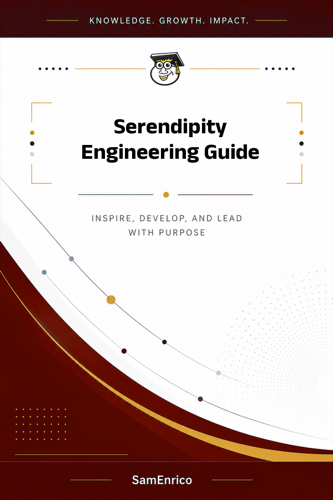
Non-FictionSelf-HelpSerendipityChance
Serendipity Engineering Guide
Design conditions that increase chances of acciden
by Fay Trent
Design conditions that increase chances of accidental discoveries and lucky breaks.
Formats
About this book
Free sample
Chapter 1: The Luck Illusion...--Most people believe that luck is a lottery ticket—random, impersonal, and utterly beyond their control. They think that breakthrough discoveries, chance encounters, and lucky breaks are cosmic gifts bestowed upon a fortunate few who happen to be in the right place at the right time. This belief is comforting in its simplicity, but it is also profoundly wrong. And it is costing you opportunities you cannot even see.Let me tell you about a discovery that changed the world, not because it was random, but because someone was paying attention in a way almost no one else would have.In September 1928, a Scottish bacteriologist named Alexander Fleming returned to his chaotic, cluttered laboratory after a two-week vacation. He had been working on influenza, but like many scientists of his era, he was also cultivating colonies of Staphylococcus bacteria in glass Petri dishes.
Before leaving, Fleming had stacked a pile of these dishes on a bench near a window. When he returned, he began sorting through them to discard the contaminated ones—a routine cleanup task he had performed thousands of times.One dish caught his eye. It had been left open by accident, and a blue-green mold had begun growing on it. This was not unusual; airborne contaminants regularly ruined experiments. Most researchers would have cursed, scraped the mold into a biohazard bin, and moved on.
But Fleming noticed something strange. Around the mold colony, the Staphylococcus bacteria had been dissolved. There was a clear ring—a zone of death—surrounding the mold. The bacteria had not simply failed to grow; they had been killed.Fleming did not throw the dish away. He isolated the mold, identified it as Penicillium notatum, and spent months testing its properties.
Ten years later, his accidental discovery was refined into penicillin, the first antibiotic. It has since saved an estimated 200 million lives.Here is what most people miss about this story: Fleming had seen mold-contaminated dishes before. Hundreds of them. Every microbiologist had. The difference was not the mold.
The difference was the prepared mind that recognized the mold as a signal, not noise. Fleming was not lucky in…
This is the end of the free sample. Get the eBook to keep going. Buy now
Contents
- Chapter 1
- Chapter 2
- Chapter 3
- Chapter 4
- Chapter 5
- Chapter 6
- Chapter 7
- Chapter 8
- Chapter 9
- Chapter 10
- Chapter 11
- Chapter 12
Details
- Author
- Fay Trent
- Publisher
- SamEnrico
- Language
- English
- Genre
- Non-Fiction, Self-Help, Serendipity, Chance
- Released
- 2026-06-10
- Pages (approx.)
- 154
- Available as
- eBook, Audiobook

Read better in the ZLOADR app
Your eBooks on your phone or tablet. Sign in with your SamEnrico account and start reading.
More by Fay Trent
 Ballot Counting Supervisor StressFay Trent$11.99
 Pablo Escobar Prison EscapeFay Trent$11.99
 Arts Nonprofit Social Enterprise StoryFay Trent$11.99
 Bridge Loan for DownsizeFay Trent$11.99
 Nefertiti's Lost Legacy: The Queen Who VanishedFay Trent$11.99
 The Forgotten Mariners of the Monsoon: Ancient Spice Routes and the Birth of Global TradeFay Trent$11.99
 Real Estate Development ManagerFay Trent$11.99
 Understanding Familial Opposable Triphalangeal Thumbs DuplicationFay Trent$17.99
 Presenting Data for Annual Strategic PlanningFay Trent$12.99
 Ghana Email Marketing GuideFay Trent$12.99
 How to Become a Case-loader OperatorFay Trent$11.99
You may also like
 Hong Kong Handover 1997Dunn Johnnie$11.99
 Zumba For Postnatal Recovery CourseNeal Christian$11.99
 Zumba for BeginnersLadner Nikia$11.99
 YouTube Comment Mining GuideHumes Pandora$12.99
 Worry Box MeditationCarlin Rudy$11.99
 Workplace Stress MeditationNguyen Lynn$11.99
 Workplace Stress and Sleep RepairHawley Ivory$11.99
 Workplace Perfectionism CureDelaney Jeffry$11.99
 Workplace Injustice Anger GuideWallen Isabelle$11.99
 Work Addiction and Burnout LinkGreenwood Ester$11.99
 Women in Yoga and WellnessBeattie Galina$11.99
 Women in Stand Up ComedyChun Evangeline$11.99