
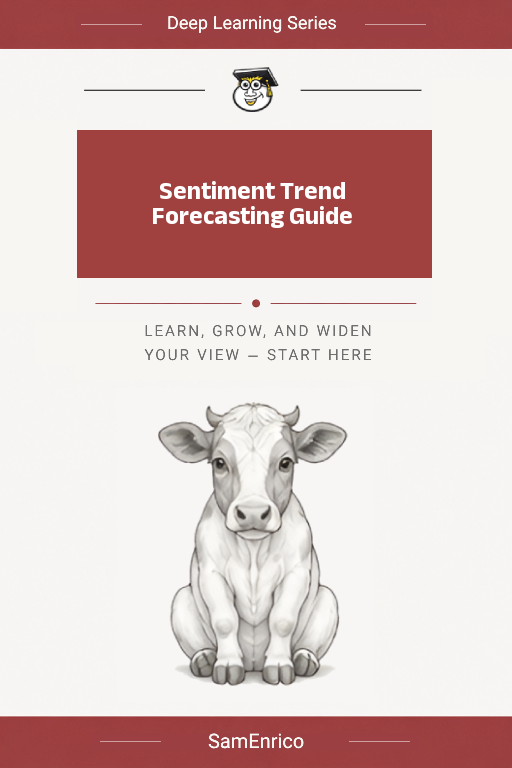
Non-FictionAI OperatorPredictive AnalyticsTrend Forecasting
Sentiment Trend Forecasting Guide eBook
Predict brand sentiment direction from historical
Predict brand sentiment direction from historical patterns and events. Detect emerging issues before they go viral and model campaign impact.
Formats
Free sample
Chapter 1: The Rearview Fallacy--The average brand leader today operates like a driver speeding down a foggy highway at midnight, headlights off, navigating solely by glancing in the rearview mirror every few seconds. The road behind is perfectly visible—every turn taken, every pothole hit, every patch of ice that caused a spinout three months ago is clearly illuminated. But the road ahead? A complete mystery. And somewhere in the darkness, just a few hundred yards ahead, a bridge has washed out.This is not merely a metaphor.
It is the literal operational reality of most marketing, product, and communications teams in the twenty-twenty-twenties. They make decisions based on quarterly brand trackers, NPS surveys circulated twice per year, and sales data that arrives in spreadsheets labeled with last quarter’s dates. By the time these numbers land in an inbox, the customer has already moved on—angry, delighted, or indifferent—and the brand is simply the last to know.The J.C. Penney disaster of twenty-thirteen serves as a canonical warning, though not for the reasons most retail post-mortems cite. When CEO Ron Johnson eliminated coupons and everyday low pricing in favor of a “fair and square” model, the decision seemed rational on paper.
Traditional metrics—same-store sales, average transaction value, inventory turnover—remained stable for two full quarters. The board saw no immediate cause for concern. But beneath the surface, something was already burning.Within forty-eight hours of the announcement, digital chatter had turned vicious. Customers who had built decades of shopping habits around clipping coupons felt betrayed. The phrase “no more coupons” became synonymous with “no more J.C.
Penney” across thousands of social media posts, blog comments, and forum threads. This was not a slow, gradual decline in goodwill. It was a sudden, violent repudiation of the brand’s new identity. And yet, because traditional metrics measure what has already been bought—not what is currently being felt—the warning lights never flashed.By the time sales data finally caught up to the sentiment reality, the damage was irreversible. Revenue dropped twenty-five percent.
Johnson was ousted. And the brand entered a death spiral from which it has never fully recovered. The tragedy is not that J.C. Penney made a bad pricing decision. The tragedy is that the company had all the data it needed to avoid the catastrophe—it was just looking at the wrong data, at the wrong time, in the wrong way.This book exists to solve that exact problem.
It is a guide to shifting from descriptive analytics—what happened—to predictive analytics—what will happen. It is a playbook for building a sentiment forecasting system that detects the subtle, low-magnitude emotional shifts that precede either a viral crisis or a brand breakthrough. And it is a call to arms for every leader who is tired of being surprised by problems their own customers saw coming days or weeks earlier.The premise is simple but profound: Traditional brand tracking is a lagging indicator. It tells you where you have been, not where you are going. In an era where a brand crisis can go viral in three hours, relying on three-month-old data is not just ineffective—it is actively dangerous.
The brands that survive and thrive in the coming decade will be those that learn to forecast sentiment direction with the same rigor and reliability that they currently apply to sales forecasting.This chapter lays the foundation for everything that follows. It begins by dissecting why traditional metrics fail so spectacularly in the viral age. It then introduces the core conceptual shift that animates the entire book: moving from reaction to anticipation. And it establishes the unifying metaphor that will guide our journey—the distinction between the weather vane and the meteorologist—while acknowledging that different forecasting time horizons require different tools and mindsets.The Weather Vane Problem Consider the traditional brand tracker. It is typically deployed quarterly, sometimes semi-annually.
A sample of customers—often self-selected, often biased toward the extremely satisfied or extremely dissatisfied—answers a series of questions about their perception of the brand. The results are aggregated, sliced by demographic, and presented in a Power Point deck approximately six to eight weeks after the survey was fielded. By the time the C-suite reviews the findings, the data is already three to four months old relative to when customer sentiment actually shifted.This is the weather vane problem. A weather vane tells you which direction the wind is blowing right now. It is useful for knowing what jacket to grab on your way out the door.
But it is useless for planning a weekend picnic, a shipping logistics route, or a product launch. It reacts to the present moment without any capacity to anticipate the future.Most brand measurement tools are weather vanes. NPS scores tell you how likely customers were to recommend you last quarter. Sales data tells you what customers bought last month. Social listening dashboards, even when real-time, only tell you what people are saying right this second—not what they will be saying tomorrow, next week, or next month.
They describe the present and the past. They do not predict the future.The problem is not that these metrics are wrong. They are accurate measurements of what has already occurred. The problem is that they are incomplete. They answer the question “What just happened?” but they are utterly silent on the question “What is about to happen?” And in the viral age, the gap between these two questions has collapsed from months to hours.A brand crisis in two thousand ten might have taken weeks to build momentum.
A customer complaint on a forum would be picked up by a blogger, then another blogger, then perhaps a small news outlet, and finally—if the story had legs—it might reach the mainstream press. Brands had days to respond. In two thousand twenty-five, the same sequence unfolds in hours. A single Tik Tok video can generate ten million views overnight. A single Reddit thread can trigger a coordinated boycott by morning.
The velocity of information has outpaced the velocity of traditional measurement by several orders of magnitude.The Meteorologist’s Mindset If the weather vane represents reactive measurement, the meteorologist represents predictive intelligence. A meteorologist does not simply look out the window and report on the current conditions. She studies historical pressure maps, satellite imagery, ocean temperature data, wind shear patterns, and dozens of other variables. She runs complex simulation models that predict how these variables will interact over the next twenty-four, forty-eight, and seventy-two hours. She does not claim perfect certainty—weather forecasting remains probabilistic, not deterministic—but she can tell you with useful confidence whether to expect sunshine or a thunderstorm.This book argues that brands must become meteorologists.
They must build systems that ingest historical sentiment patterns, real-time social signals, and contextual event data to forecast the direction of brand sentiment over multiple time horizons. They must distinguish between short-term weather patterns (a sudden spike of outrage that will blow over in hours) and long-term climate shifts (a slow, cumulative decline in trust that will permanently damage the brand). And they must learn to act on…
This is the end of the free sample. Get the eBook to keep going. Buy now
About this book
Details
- Author
- Knudson Renate
- Publisher
- SamEnrico
- Language
- English
- Genre
- Non-Fiction, AI Operator, Predictive Analytics, Trend Forecasting
- Released
- 2026-06-01
- Pages (approx.)
- 152
- Available as
- eBook, Audiobook

Read better in the ZLOADR app
Your eBooks on your phone or tablet. Sign in with your SamEnrico account and start reading.
More by Knudson Renate
 Social Media and AnxietyKnudson Renate$11.99
 Koi Pond MeditationKnudson Renate$11.99
 Following the BreathKnudson Renate$11.99
 The Surprise Adoption DiscoveryKnudson Renate$11.99
 The Chickenpox Vaccine ImpactKnudson Renate$11.99
 Holocaust Survivor DreamsKnudson Renate$11.99
 Standard Oil MonopolyKnudson Renate$11.99
 Imposter Syndrome For Late BloomersKnudson Renate$11.99
 Diplomat Crisis NegotiationKnudson Renate$11.99
 The Druids of Anglesey: The Last Stand of Celtic WisdomKnudson Renate$11.99
 Hippocrates & Theas: Love in the Birthplace of MedicineKnudson Renate$11.99
 Ethical AI Prompting in HealthcareKnudson Renate$11.99
You may also like
 Hong Kong Handover 1997Dunn Johnnie$11.99
 Zumba For Postnatal Recovery CourseNeal Christian$11.99
 Zumba for BeginnersLadner Nikia$11.99
 YouTube Comment Mining GuideHumes Pandora$12.99
 Worry Box MeditationCarlin Rudy$11.99
 Workplace Stress MeditationNguyen Lynn$11.99
 Workplace Stress and Sleep RepairHawley Ivory$11.99
 Workplace Perfectionism CureDelaney Jeffry$11.99
 Workplace Injustice Anger GuideWallen Isabelle$11.99
 Work Addiction and Burnout LinkGreenwood Ester$11.99
 Women in Yoga and WellnessBeattie Galina$11.99
 Women in Stand Up ComedyChun Evangeline$11.99