
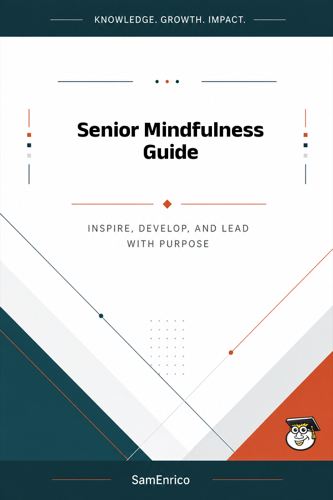
Non-FictionSelf-HelpMindfulness
Senior Mindfulness Guide eBook
Reduces anxiety through present-moment awareness.
Reduces anxiety through present-moment awareness.
Formats
Free sample
Chapter 1: The Time Travel Trap...--The first time Margaret forgot her grandson’s name—just for a second, just a flicker of white static where “Jacob” used to live—she didn’t feel old. She felt terrified. Not because the name mattered that much, but because her mind immediately leaped to the worst possible destination: This is how it starts. First the name, then the car keys, then the nursing home, then the end. In the space of one breath, Margaret had traveled from her kitchen to a future she could not survive.
That is the time travel trap. And if you are reading this book, you know exactly what it feels like.Margaret is not real. But her story is. It is the story of every senior who has ever woken up at 3 AM calculating how many good years remain, or replayed an argument from 1987 as if it happened yesterday, or lay perfectly still after a minor chest twitch, waiting for the heart attack that never came. You have done this.
I have done this. The human brain, especially the aging human brain, is a time machine that runs constantly—and most of the time, it travels to places that hurt.This chapter is about why that happens, how it creates the specific flavor of anxiety that plagues seniors, and what you can do about it in less than ten seconds. We are going to build a single, powerful tool—the 4-6 breath anchor—that will serve as your home base throughout this entire book. Every other chapter will refer back to this one. Master this, and you have already won more than half the battle.The Unique Anxiety of Aging Let us name what is actually happening, because naming is the first form of taming.
Younger people experience anxiety differently. A thirty-year-old might worry about a job interview or a first date. Those anxieties are real, but they are anchored in a future that feels infinite. There is always another job, another date, another chance. The senior mind operates under a different gravitational pull.
The future is no longer a vast ocean. It is a shrinking pond. Every loss feels like the last loss. Every health scare feels like the final one.Researchers have a name for this. They call it “future time perspective”—the subjective sense of how much time remains.
When time feels open, people take risks and delay gratification. When time feels limited, people focus on emotional regulation and meaning. That sounds nice in a textbook. In real life, it means you lie awake thinking, If I lose my independence now, I will never get it back. And that thought is not entirely wrong.
That is what makes senior anxiety so brutal. Unlike the thirty-year-old’s worry about a presentation, your worries often have legitimate foundations. You could fall. You could outlive your savings. You could be forgotten by family.The problem is not that these possibilities are unrealistic.
The problem is that you are living inside them before they happen. You are not preparing for the fall. You are already on the ground, broken, alone—except you are actually sitting in a perfectly safe chair with a cup of tea going cold beside you. The catastrophe exists only in the mind. But the mind’s catastrophe feels real because the brain does not distinguish between vividly imagined danger and actual danger.
The same stress hormones flood your system either way.This is the fundamental mechanism of senior anxiety, and you need to understand it clearly because everything else in this book builds on this single insight. Ready? Here it is:Anxiety is not caused by what is happening to you right now. It is caused by mental time travel—leaving the present moment to live in a past that cannot be changed or a future that has not arrived.That is layer one of our three-layer model. We will add layer two and layer three later in this chapter.
But for now, just sit with that idea. Read it again: Anxiety is mental time travel. You cannot be anxious about this exact moment, this breath, this sensation of the page under your fingers. You can only be anxious about what already happened or what might happen next.Why Seniors Are Especially Vulnerable to Time Travel Let us be specific. The thirty-year-old time travels too, but their destinations are different: “What if I never get promoted?” “What if my partner leaves me?” “What if I am not good enough?” These are real anxieties.
But notice the difference. The thirty-year-old’s time travel is usually about achievement and identity formation. The senior’s time travel is usually about loss and survival.There are three primary destinations for senior time travel, and you will recognize every one of them.Destination One: The Past’s Regret Room This is where you replay old decisions. I should have saved more money. I should have been a better parent.
I should have told my wife I loved her that last morning instead of rushing out the door. The regret room has no windows and no exit. You can stay there for hours, decades, a lifetime. The strange thing is that rehearsing regret does nothing to change the past, but your brain keeps doing it as if repetition might somehow rewrite history. This is the brain’s cruelty: it confuses thinking about a problem with solving a problem.
Regret cannot be solved. It can only be visited. And you have been visiting too often.Destination Two: The Future’s Fear Factory This is where you manufacture catastrophes. What if this cough is cancer? What if I fall in the shower and no one finds me for days?
What if my mind goes before my body? What if my children put me in a home and never visit? The fear factory runs twenty-four hours a day, seven days a week, and it never pays overtime. Each fear is presented to you as a urgent warning that requires immediate action. But there is no action to take.
The cough is just a cough until a doctor says otherwise. The shower is just a shower. Your mind is still intact right now. The fear factory sells you products that do not exist yet.Destination Three: The Present’s Disappearing Platform This is the most subtle destination. It is not regret or fear.
It is the quiet habit of not being here. You eat breakfast while thinking about a doctor’s appointment next week. You watch television while mentally composing a list of things you should have done differently. You sit with a grandchild while worrying about whether you will be alive for their graduation. The present moment becomes a platform you are always about to leave.
You are never fully on it. You are always halfway to somewhere else.These three destinations are the landscape of senior anxiety. And here is the good news: they are all made of the same substance. Thought. Just thought.
Not reality. Not even close to reality. Thought.The Three Layers of Anxiety (Resolving the Apparent Contradiction)If you have read other mindfulness books, you might have noticed that different teachers…
This is the end of the free sample. Get the eBook to keep going. Buy now
About this book
Details
- Author
- Barrera Trula
- Publisher
- SamEnrico
- Language
- English
- Genre
- Non-Fiction, Self-Help, Mindfulness
- Released
- 2026-06-07
- Pages (approx.)
- 144
- Available as
- eBook, Audiobook

Read better in the ZLOADR app
Your eBooks on your phone or tablet. Sign in with your SamEnrico account and start reading.
More by Barrera Trula
 Neurodivergent Anger at WorkBarrera Trula$11.99
 Thieves Law Criminal CodeBarrera Trula$11.99
 Paramedic Emergency Stress GuideBarrera Trula$11.99
 Worst Possible Idea Warm UpBarrera Trula$11.99
 TM for PregnancyBarrera Trula$11.99
 Adult CPR Certification PrepBarrera Trula$11.99
 Action Planning for Fitness GoalsBarrera Trula$11.99
 The General Who Built an Empire: William McGregor and the Birth of Football's First LeagueBarrera Trula$11.99
 Divine Strings: The Cosmic Lute of NaradaBarrera Trula$11.99
 How to Start a Plant Parts Preserving In Sugar Business (Beginners Guide)Barrera Trula$11.99
 How to Produce a PreservativeBarrera Trula$11.99
 Lucerne: Alfalfa HayBarrera Trula$11.99
You may also like
 Hong Kong Handover 1997Dunn Johnnie$11.99
 Zumba For Postnatal Recovery CourseNeal Christian$11.99
 Zumba for BeginnersLadner Nikia$11.99
 YouTube Comment Mining GuideHumes Pandora$12.99
 Worry Box MeditationCarlin Rudy$11.99
 Workplace Stress MeditationNguyen Lynn$11.99
 Workplace Stress and Sleep RepairHawley Ivory$11.99
 Workplace Perfectionism CureDelaney Jeffry$11.99
 Workplace Injustice Anger GuideWallen Isabelle$11.99
 Work Addiction and Burnout LinkGreenwood Ester$11.99
 Women in Yoga and WellnessBeattie Galina$11.99
 Women in Stand Up ComedyChun Evangeline$11.99