
Non-FictionBiographyLegislative Process
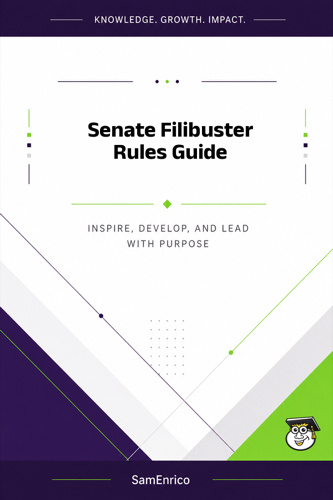
Senate Filibuster Rules Guide
Navigate the 60 vote threshold and cloture motions
by Leahy Twanna
Navigate the 60 vote threshold and cloture motions for legislative strategy.
Formats
About this book
Free sample
Chapter 1: The Accidental Supermajority--–- In the beginning, there was no filibuster. The United States Senate, as designed by the Founders in 1789, operated on a simple principle: debate would continue until a majority of senators present wished to end it and vote. The mechanism for ending debate was called the "previous question" motion, a parliamentary tool inherited from English practice that allowed a simple majority to cut off discussion and proceed to a final vote. Had this mechanism remained in place, the modern concept of a 60-vote threshold would likely never have existed. The Senate would function much like the House of Representatives, where majority rule is the undisputed law of the floor.
But in 1806, a seemingly minor housekeeping change—the removal of the previous question motion from the Senate's rulebook—opened a door that no one intended to unlock. That door led to the accidental creation of the supermajority Senate, a procedural labyrinth that now defines American governance.The Founders' Unspoken Assumption To understand how the filibuster was born by accident, we must first understand what the Founders actually intended. The Constitutional Convention of 1787 produced a document remarkably silent on the specific procedures for ending debate. Article I, Section 5, Clause 2 provides that "Each House may determine the Rules of its Proceedings." That was it. The Founders gave Congress broad authority to govern itself, trusting that elected representatives would design fair and efficient systems for deliberation.
In the earliest Congresses, both the House and Senate adopted versions of the previous question motion—a rule that allowed a majority to force an immediate vote on whatever matter was before the chamber.The previous question motion worked simply. A senator would rise and move "the previous question." If a majority agreed, debate ended instantly, and the Senate voted on the underlying bill or amendment. No senator could speak indefinitely. No minority could block action through endless talk. The majority governed, just as democratic theory would predict.
This was not controversial. In fact, it was so uncontroversial that when the Senate revised its rules in 1806, the previous question motion was quietly removed.…
This is the end of the free sample. Get the eBook to keep going. Buy now
Contents
- Chapter 1
- Chapter 2
- Chapter 3
- Chapter 4
- Chapter 5
- Chapter 6
- Chapter 7
- Chapter 8
- Chapter 9
- Chapter 10
- Chapter 11
- Chapter 12
Details
- Author
- Leahy Twanna
- Publisher
- SamEnrico
- Language
- English
- Genre
- Non-Fiction, Biography, Legislative Process
- Released
- 2026-06-08
- Pages (approx.)
- 136
- Available as
- eBook, Audiobook

Read better in the ZLOADR app
Your eBooks on your phone or tablet. Sign in with your SamEnrico account and start reading.
More by Leahy Twanna
 The Cloud Cost Optimization TrendLeahy Twanna$11.99
 International Franchise Operations ManualLeahy Twanna$11.99
 Improv for Problem SolvingLeahy Twanna$11.99
 Forest Bathing Visualization MethodLeahy Twanna$11.99
 Automobile Purchase GuideLeahy Twanna$12.99
 US Tax for Non Resident LLCLeahy Twanna$12.99
 Understanding Ramos-arroyo SyndromeLeahy Twanna$17.99
 Health Technology AssessmentLeahy Twanna$11.99
 How to Become a Pneumatic-hoist OperatorLeahy Twanna$11.99
You may also like
 Hong Kong Handover 1997Dunn Johnnie$11.99
 Zumba For Postnatal Recovery CourseNeal Christian$11.99
 Zumba for BeginnersLadner Nikia$11.99
 YouTube Comment Mining GuideHumes Pandora$12.99
 Worry Box MeditationCarlin Rudy$11.99
 Workplace Stress MeditationNguyen Lynn$11.99
 Workplace Stress and Sleep RepairHawley Ivory$11.99
 Workplace Perfectionism CureDelaney Jeffry$11.99
 Workplace Injustice Anger GuideWallen Isabelle$11.99
 Work Addiction and Burnout LinkGreenwood Ester$11.99
 Women in Yoga and WellnessBeattie Galina$11.99
 Women in Stand Up ComedyChun Evangeline$11.99