
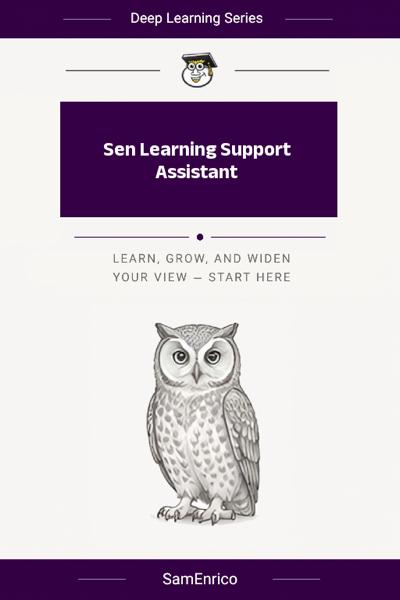
Non-FictionInformativeEducational
Sen Learning Support Assistant eBook
A Coursebook on Sen Learning Support Assistant
A Coursebook on Sen Learning Support Assistant
Formats
Free sample
Chapter 1: The Velcro Trap...--–- Sarah arrived at her new post as a Learning Support Assistant with a heart full of purpose and a lanyard that still felt stiff around her neck. She had been assigned to support Leo, a seven-year-old with a diagnosis of autism, and she took her position seriously. Every time Leo's hand hovered over his pencil, Sarah placed it in his grip. Every time Leo looked away from his worksheet, she gently turned his face back toward the page. Every time Leo hesitated before writing a word, she whispered the answer.
By the end of the second week, Leo would not start any task unless Sarah was sitting beside him. He would not pick up a pencil unless she handed it to him. He would not attempt a single math problem unless she had already read it aloud three times. Sarah felt indispensable. Leo's teacher felt relieved that someone was managing him.
But Leo himself had stopped trying.This is the Velcro trap, and it is the single most common mistake new Learning Support Assistants make. It is not born of laziness or cruelty. It is born of kindness, of a genuine desire to help, and of a fundamental misunderstanding of what the role of an SEN LSA is supposed to be. The Velcro trap is the act of attaching yourself so completely to one student that they cannot function without you. You become their external executive function, their scribe, their prompter, their emotional regulator, and their proxy brain.
And in doing so, you inadvertently rob them of the very thing they need most: the opportunity to struggle productively, to problem-solve, to fail safely, and to build independence.This chapter will tear open the Velcro trap, examine its origins, and provide you with a completely different framework for understanding your role. You are not a shadow. You are not a crutch. You are not a minder. You are a facilitator of inclusion, a scaffold builder, and a fading artist.
Your ultimate goal is not to be needed forever. Your ultimate goal is to work yourself out of a job with every single student you support.The Supervisor Fallacy: A Brief History of the LSA Role To understand where we are, we must understand where we came from. Thirty years ago, the role now known as the Learning Support Assistant barely existed in its current form. Children with special educational needs were often educated in separate units, special schools, or, in the worst cases, excluded entirely from mainstream education. When inclusion policies began to take hold in the 1990s and early 2000s, schools faced a practical problem: they had teachers trained to deliver curriculum content but no infrastructure to support children who could not access that content in the traditional way.The solution was swift and pragmatic.
Schools hired classroom assistants, sometimes called "special needs assistants" or "learning support assistants," and assigned them to individual children. The implicit job description was simple: keep this child safe, keep this child quiet, keep this child from disrupting the learning of others, and make sure they complete the work. This was the supervisor model. The LSA was a pair of eyes and a pair of hands. They supervised behavior, redirected attention, and helped finish worksheets.
There was no sophisticated training requirement. There was no pedagogical framework. There was just a well-intentioned adult and a child who needed more than the teacher could give alone.This model persisted for years because it seemed to work. Classrooms became calmer. Teachers felt supported.
Parents saw that their child was receiving one-to-one attention. But beneath the surface, a quiet disaster was unfolding. Research began to accumulate showing that students with high levels of LSA support often made less academic progress than similar students with less support. They developed learned helplessness. They became socially isolated from peers because they were always attached to an adult.
And they failed to develop the self-regulation skills that their peers were quietly building through daily frustrations and recoveries.The supervisor model produced compliant children, not capable young people. It valued order over independence, and it confused proximity with progress. This book rejects the supervisor model entirely. In its place, we offer the facilitator model.The Facilitator Model: Your True Job Description If you are not a supervisor, what are you? You are a facilitator of inclusion.
That phrase is not a buzzword. It has a precise meaning. Inclusion is not the physical placement of a child with SEN into a mainstream classroom. That is mere integration, and it means nothing. Inclusion means that the child genuinely belongs, genuinely participates, and genuinely progresses alongside their peers, with supports that are proportionate, temporary, and designed to fade.Your job as a facilitator is to build bridges between the student and three things:The curriculum: You make the content accessible through differentiation, scaffolding, and assistive technology.The social environment: You teach social scripts, mediate peer interactions, and help the student navigate the hidden curriculum of the classroom.The student's own capacity: You teach self-advocacy, self-regulation, and metacognitive strategies so that the student needs you less over time.Notice what is missing from that list.
Nowhere does it say that you will complete tasks for the student. Nowhere does it say that you will sit beside them for the entire day. Nowhere does it say that you will speak for them, think for them, or prevent them from ever experiencing frustration. Frustration, when managed appropriately, is not the enemy of learning. Frustration is the signal that learning is about to happen.
If you remove all frustration, you remove all growth.The facilitator model requires a fundamental shift in your mindset. You are not there to make the student's work easier. You are there to make the student's work possible. Those are very different things. Making work easier might mean simplifying every sentence, giving hints for every problem, and correcting every mistake before the student has a chance to self-correct.
Making work possible means ensuring that the student has the tools, the environment, and the prerequisite skills to attempt the work themselves. They still have to do the heavy lifting. You just hold the ladder, and only as long as they need it.The Difference Between Support Staff and Teaching Staff One of the most common sources of confusion for new LSAs is the boundary between their role and the teacher's role. This confusion leads to either overstepping (making pedagogical decisions that should belong to the teacher) or under-functioning (refusing to do anything that feels like teaching). Both are problems.Let us be absolutely clear.
The teacher is responsible for:Curriculum design and long-term planning Leading whole-class instruction Assessing student progress against learning objectives Making final decisions about interventions Communicating with parents about academic progress Holding legal responsibility for the classroom The LSA is responsible for:Adapting the teacher's planned materials to meet individual student needs Providing targeted support during independent work time Collecting observational data on student responses to interventions Implementing the specific strategies outlined in the student's EHCP or support plan Feeding back to the teacher about what worked and what did not Fostering independence so that the student needs less support over…
This is the end of the free sample. Get the eBook to keep going. Buy now
About this book
Details
- Author
- Bankston Numbers
- Publisher
- SamEnrico
- Language
- English
- Genre
- Non-Fiction, Informative, Educational
- Released
- 2026-05-11
- Pages (approx.)
- 157
- Available as
- eBook, Audiobook

Read better in the ZLOADR app
Your eBooks on your phone or tablet. Sign in with your SamEnrico account and start reading.
More by Bankston Numbers
 Remote Company Retreats For HR TeamsBankston Numbers$11.99
 Mercedes Status Comparison GuideBankston Numbers$11.99
 Lefty Frizzell Saginaw MichiganBankston Numbers$11.99
 The Memory Notebook SystemBankston Numbers$11.99
 Burnout Recovery Guided ImageryBankston Numbers$11.99
 The Tunnels of Kingston: Canada’s Most Audacious Prison BreaksBankston Numbers$11.99
 Japanese Embassy Scholarship GuideBankston Numbers$12.99
 Coffee Export Success StoriesBankston Numbers$12.99
 How to Become a Polisher And Buffer IiBankston Numbers$11.99
 Understanding Short Limb Dwarf Lethal Mcalister–crane TypeBankston Numbers$17.99
You may also like
 Hong Kong Handover 1997Dunn Johnnie$11.99
 Zumba For Postnatal Recovery CourseNeal Christian$11.99
 Zumba for BeginnersLadner Nikia$11.99
 YouTube Comment Mining GuideHumes Pandora$12.99
 Worry Box MeditationCarlin Rudy$11.99
 Workplace Stress MeditationNguyen Lynn$11.99
 Workplace Stress and Sleep RepairHawley Ivory$11.99
 Workplace Perfectionism CureDelaney Jeffry$11.99
 Workplace Injustice Anger GuideWallen Isabelle$11.99
 Work Addiction and Burnout LinkGreenwood Ester$11.99
 Women in Yoga and WellnessBeattie Galina$11.99
 Women in Stand Up ComedyChun Evangeline$11.99