
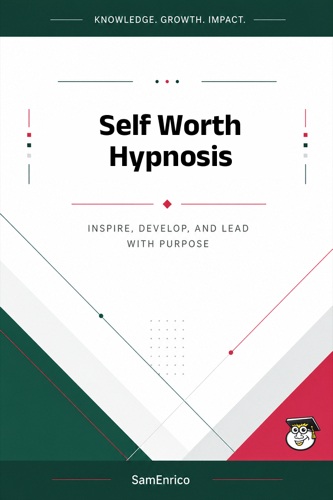
Non-FictionSelf-HelpSelf Worth
Self Worth Hypnosis eBook
Unconditional value regardless of achievements.
Unconditional value regardless of achievements.
Formats
Free sample
Chapter 1: The Blueprint Within--–- Imagine, for a moment, that you are a ship at sea. Not just any ship, but a magnificent vessel built for long voyages. Your hull is sound. Your engines are powerful. Your navigation system is state-of-the-art.
You have every reason to believe you are destined for open waters, for adventure, for distant shores you have only dreamed of reaching.But every time you leave the harbor, something strange happens.Without you touching the wheel, the ship turns. Not toward the horizon, but back toward the familiar dock. You fight the helm. You apply more power. You call in experts who adjust your sails and polish your instruments.
And still, every time, the ship returns to where it started.After months—years—of this, you begin to believe something is wrong with the ship itself. Perhaps it is broken. Perhaps you are a terrible captain. Perhaps the sea is simply not meant for you.But here is the truth the experts missed: Your ship is not broken. It is following a course set by an invisible autopilot.
And that autopilot was programmed long ago, by someone who believed the safest place for you was always in the harbor.That autopilot is your Self-Image Blueprint. And until you change it, no amount of effort, achievement, or positive thinking will ever take you where you truly want to go.This chapter is about discovering that blueprint for the first time. Not to judge it. Not to blame whoever wrote it. But simply to see it clearly—because you cannot change a program you refuse to acknowledge.The Invisible Autopilot Let us begin with a question that may feel uncomfortable, even unsettling: Why do you unconsciously sabotage your own success just as you are about to reach it?Consider the evidence.
You study for an important exam, know the material cold, and then the night before, you cannot sleep. You perform poorly. You are offered a promotion that would double your income, and suddenly you find reasons to turn it down. You meet someone who genuinely cares for you, and within weeks, you pick a fight or withdraw emotionally. You are on the verge of achieving something you have wanted for years, and your body finds a way to get sick, to procrastinate, to make a critical error at the last possible moment.If this has happened to you—and if you are human, it almost certainly has—you have likely blamed yourself.
You called it laziness. Self-sabotage. A lack of discipline. Perhaps even a character flaw. You may have concluded that something is fundamentally wrong with you, that you are broken in a way that other people are not.But what if none of those explanations are true?Drawing from the pioneering work of Maxwell Maltz, a plastic surgeon who became one of the most influential psychologists of the twentieth century, this chapter introduces a radically different explanation.
Maltz noticed something strange in his practice. When he performed surgery to correct a physical feature—a nose that a patient believed was too large, a scar that a patient believed was disfiguring—the patient's self-image often did not change. Even after the physical flaw was gone, the patient continued to act as if it were still there. They continued to hide their face, to avoid photographs, to feel ashamed.Maltz realized that the physical feature was not the real problem. The real problem was the patient's internal self-image—the blueprint they carried in their mind of who they were and what they deserved.
And that blueprint, he discovered, operated like a cybernetic mechanism.The word cybernetics comes from the Greek word for "steersman." A cybernetic system is any system that automatically corrects its course to reach a target. Your home thermostat is a cybernetic system: it senses the temperature and turns the heat on or off to match your setting. A cruise missile is a cybernetic system: it constantly adjusts its trajectory to hit its target. Your subconscious mind is the most sophisticated cybernetic system in existence.Here is the critical point: Your subconscious does not judge. It does not evaluate whether your blueprint is good for you or bad for you.
It does not care if your blueprint says "I am worthy of love" or "I am fundamentally flawed." Its only job is to make your thoughts, feelings, and behaviors align with whatever blueprint you have installed. It is a servo-mechanism, not a philosopher.If your blueprint says "I am unworthy of success," your subconscious will find a way to fail at the last moment—not because it wants you to suffer, but because success would create a mismatch with your internal model. The discomfort of that mismatch is so profound, so disorienting, that your subconscious will choose failure over the unbearable feeling of being out of alignment with who you believe yourself to be.This is not a metaphor. This is how your nervous system actually works. The reticular activating system in your brainstem filters incoming information to match your existing beliefs.
Your hippocampus prioritizes memories that confirm what you already think about yourself. Your autonomic nervous system prepares your body for the future your blueprint predicts. Even your perception of other people's facial expressions is filtered through your self-image.You are not sabotaging yourself because you are weak, lazy, or broken. You are sabotaging yourself because your subconscious is doing exactly what it was designed to do—and it was designed using faulty specifications. The autopilot is working perfectly.
The destination it is steering toward is the problem.Where Blueprints Come From If your blueprint is running your life without your conscious permission, the next question is unavoidable: Where did this blueprint come from? Who wrote the code? And more importantly, can it be rewritten?The answer to the first question is both liberating and humbling: You did not write your blueprint. You were not old enough, wise enough, or conscious enough to choose the beliefs that now govern your life. Your blueprint was written for you, before you had the capacity to say yes or no.Between birth and approximately the age of seven, your brain was operating primarily in theta wave states—the same brainwave frequency associated with deep hypnosis, meditation, and the moments just before sleep.
During these years, you were in a natural, continuous trance state. Every word you heard, every facial expression you witnessed, every tone of voice that surrounded you was being absorbed directly into your subconscious without the filter of critical evaluation.This was not a design flaw. It was an evolutionary necessity. A newborn cannot survive by critically evaluating every piece of information. The brain must absorb massive amounts of data quickly and efficiently, trusting the environment to provide accurate programming.
For most of human history, in stable tribal environments, this was a reliable system. Parents and caregivers generally told the truth. The tribe generally wanted the child to succeed.But modern childhood is not a stable tribal environment. Parents are stressed, exhausted, and carrying their own unhealed blueprints. Teachers are overworked and under-resourced.
Peers are navigating their own confusion. And the child absorbs everything.A parent said, "Why can't you be more like your…
This is the end of the free sample. Get the eBook to keep going. Buy now
About this book
Details
- Author
- Kurtz Herschel
- Publisher
- SamEnrico
- Language
- English
- Genre
- Non-Fiction, Self-Help, Self Worth
- Released
- 2026-06-08
- Pages (approx.)
- 132
- Available as
- eBook, Audiobook

Read better in the ZLOADR app
Your eBooks on your phone or tablet. Sign in with your SamEnrico account and start reading.
More by Kurtz Herschel
 Menopause Partner CommunicationKurtz Herschel$11.99
 Task Batching Scheduling GuideKurtz Herschel$11.99
 Overcoming Addiction After FiftyKurtz Herschel$11.99
 Household Chore Stress GuideKurtz Herschel$11.99
 The Personal Brand Testimonial GuideKurtz Herschel$11.99
 Meeting Rhythm StandardizationKurtz Herschel$11.99
 Virgil's Aeneid: The Epic That Shaped Rome's SoulKurtz Herschel$11.99
 Buffer Time Scheduling GuideKurtz Herschel$11.99
 The Last Empress: The Fall of Empress Eugénie and the Exile of a DynastyKurtz Herschel$11.99
 Mastering Tithe: Religious Agricultural TaxKurtz Herschel$11.99
 Feedback Collection SheetKurtz Herschel$12.99
 Ghana Customer Service WorkbookKurtz Herschel$12.99
You may also like
 Hong Kong Handover 1997Dunn Johnnie$11.99
 Zumba For Postnatal Recovery CourseNeal Christian$11.99
 Zumba for BeginnersLadner Nikia$11.99
 YouTube Comment Mining GuideHumes Pandora$12.99
 Worry Box MeditationCarlin Rudy$11.99
 Workplace Stress MeditationNguyen Lynn$11.99
 Workplace Stress and Sleep RepairHawley Ivory$11.99
 Workplace Perfectionism CureDelaney Jeffry$11.99
 Workplace Injustice Anger GuideWallen Isabelle$11.99
 Work Addiction and Burnout LinkGreenwood Ester$11.99
 Women in Yoga and WellnessBeattie Galina$11.99
 Women in Stand Up ComedyChun Evangeline$11.99