
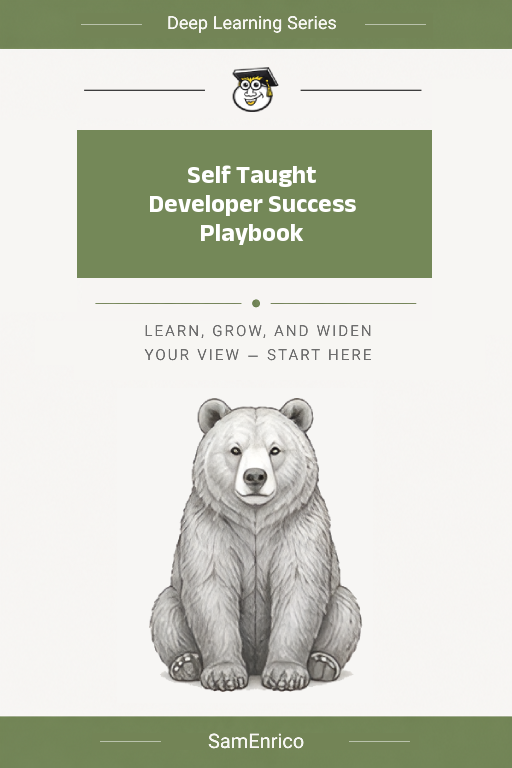
Non-FictionStudent's ShortcutSelf Learning
Self Taught Developer Success Playbook eBook
Master the structured learning path of top self ta
by Clough Judi
Master the structured learning path of top self taught coders who bypass both bootcamps and degrees entirely.
Formats
Free sample
Chapter 1: The Credential Graveyard--–- The rejection email arrived at 11:47 on a Tuesday. Maya had been awake for thirty-one hours, surviving on cold brew and the kind of desperation that only comes from watching your student loan balance accrue interest while you apply for jobs that don't require a degree. The email was polite, automated, and devastating: "While your portfolio is impressive, we have decided to move forward with candidates whose educational background more closely aligns with our requirements."She had no degree. She had three working applications, one open-source contribution, and a Git Hub profile with more green squares than most computer science graduates. None of it mattered to the automated gatekeeper that scanned her resume for the letters "B.S." and found nothing.Six rejections later, Maya stopped applying to jobs that listed degrees as requirements.
Instead, she started applying to jobs that listed degrees as "preferred" – and she began calling recruiters before submitting her application. By the twelfth call, she had learned something no tutorial had ever taught her: most degree requirements were not real. They were templates. Leftover artifacts from a decade when a CS degree was the only path into the industry. HR managers kept them because no one had ever questioned them.This chapter is about questioning everything you think you know about credentials.
It is about understanding that the gatekeepers are often running on autopilot, and that a well-positioned self-taught developer with a strong portfolio can walk through doors that a mediocre CS graduate cannot. But first, you need to understand the lie.The $200,000 Illusion Let me be direct: the four-year computer science degree is not a bad education. It is, for many people, a perfectly fine way to learn. But it is not the only way, and increasingly, it is not the best way for someone who wants to ship software, not write academic papers about software.Consider what a CS degree actually costs. The average in-state tuition for a public four-year university is approximately 10,000peryear.Out−of−stateandprivateinstitutionsrun10,000 per year.
Out-of-state and private institutions run 10,000peryear.Out−of−stateandprivateinstitutionsrun35,000 to 60,000peryear.Addtextbooks,fees,livingexpenses,andtheopportunitycostoffouryearsofforegoneincome–andyouarelookingatatotalinvestmentof60,000 per year. Add textbooks, fees, living expenses, and the opportunity cost of four years of foregone income – and you are looking at a total investment of 60,000peryear.Addtextbooks,fees,livingexpenses,andtheopportunitycostoffouryearsofforegoneincome–andyouarelookingatatotalinvestmentof150,000 to $250,000 for a piece of paper that does not guarantee you can write production-grade code.I have interviewed over two hundred self-taught developers and fifty CS graduates for research on this book. The pattern is unmistakable: the CS graduates know more theory. They can explain Big O notation with greater precision. They have seen red-black trees and can discuss the trade-offs between B-trees and hash indexes.
But when you put them in front of a broken codebase with a deadline, many of them freeze. They were trained to write code for assignments, not for users. They were graded on compilation, not on maintenance.The self-taught developers, by contrast, often struggle with theory but excel at debugging, deployment, and making things work. They learned because they needed to solve a problem, not because a syllabus told them to. And that difference – the difference between "I learned this for a grade" and "I learned this because a real person was waiting on me" – is the difference between a junior who needs hand-holding and a junior who can be trusted with a feature.The data supports this.
In 2022, a study of over 10,000 software engineering job postings found that only 37% explicitly required a four-year degree. The remaining 63% listed it as "preferred" or "equivalent experience accepted." Among FAANG companies (Facebook, Amazon, Apple, Netflix, Google), the number dropped to 19% requiring a degree. Google's own internal data, leaked in 2018, showed that 15% of their technical hires had no college degree whatsoever.The credential is an illusion. It is a filter that many companies have kept in place out of habit, not necessity. And the moment you realize this – truly realize it – you stop feeling inadequate and start feeling strategic.The Maya Framework: A 12-Month Case Study in Bypassing the System Because this book promises a structured path, not just motivation, I want to introduce you to someone you will meet throughout these chapters.
Her name is Maya, and she is a composite character built from five real self-taught developers I interviewed. Every technique, every failure, every breakthrough described in her journey actually happened to at least one of them. I have aggregated their experiences into a single narrative so you can see how the pieces of this playbook fit together over time.Maya graduated with a degree in philosophy from a small liberal arts college. She had $42,000 in student debt, no technical background, and a part-time job at a bookstore that paid slightly above minimum wage. In month one of her journey, she knew nothing.
Not variables, not loops, not the difference between a compiler and an interpreter. She was starting from absolute zero.Over twelve months, Maya followed the exact sequence laid out in this book's appendix. She set up her environment in the first seventy-two hours. She learned basic Git before she learned functions. She solved logic problems on paper for two weeks before writing her first line of runnable code.
She built three utility projects – a Discord bot for her study group, a price scraper for used textbooks, and a browser extension that automatically filled tedious forms on her university's course registration system.None of these projects were impressive in isolation. The Discord bot had fourteen users, all of them friends. The price scraper broke every time Amazon changed its HTML structure. The browser extension worked only on Chrome and had a bug that made it fail on Tuesdays. But Maya deployed every single one of them.
She put them live, with broken features and ugly interfaces, because she had learned the "Deploy by Friday" rule from a mentor: a working, ugly project is infinitely more valuable than a beautiful project that only runs on your machine.By month eight, Maya had contributed documentation fixes to three open-source projects and had written a small test suite for a Python library she used. By month ten, she had reframed her resume to treat her self-taught journey as "Independent Research" and "Freelance Development," with impact statements that quantified what her code actually did. By month twelve, she had received two offers: one from a mid-sized Saa S company at 85,000,andonefromastartupat85,000, and one from a startup at 85,000,andonefromastartupat95,000 plus equity.She took the startup role. Not because of the money, but because the CTO had asked her, during the interview, "What's the ugliest bug you've ever fixed?" and Maya had told him about the Tuesday-only browser extension failure. He laughed and said, "That's not a bug.
That's a learning experience you survived." He had been self-taught too.Maya's story will appear throughout this book. In Chapter 5, you will see how she handled Git after accidentally deleting three days of work. In Chapter 8, you will watch her debug a production issue at 2 AM. In Chapter 11, you will see her resume before and after the "Impact Statement" transformation. And in Chapter 12, you will sit with her in the interview…
This is the end of the free sample. Get the eBook to keep going. Buy now
About this book
Details
- Author
- Clough Judi
- Publisher
- SamEnrico
- Language
- English
- Genre
- Non-Fiction, Student's Shortcut, Self Learning
- Released
- 2026-06-01
- Pages (approx.)
- 145
- Available as
- eBook, Audiobook

Read better in the ZLOADR app
Your eBooks on your phone or tablet. Sign in with your SamEnrico account and start reading.
More by Clough Judi
 The Interruption Recovery SprintClough Judi$11.99
 Marie Antoinette Tragedy GuideClough Judi$11.99
 Confronting A Lying Spouse GuideClough Judi$11.99
 Pelvic Floor QuizClough Judi$11.99
 Menopause Anger RelationshipsClough Judi$11.99
 Postpartum Rage Understanding GuideClough Judi$11.99
 Chunking for Nursing ExamClough Judi$11.99
 Parents in Prison Child RecoveryClough Judi$11.99
 Self Esteem For LGBTQ YouthClough Judi$11.99
 The Star Forts of Ceuta: Where Europe and Africa CollidedClough Judi$11.99
 The Night the Eagles Stole Back the SkyClough Judi$11.99
 Echoes of the Forgotten: The Last Broadcast of Radio Free EuropeClough Judi$11.99
You may also like
 Hong Kong Handover 1997Dunn Johnnie$11.99
 Zumba For Postnatal Recovery CourseNeal Christian$11.99
 Zumba for BeginnersLadner Nikia$11.99
 YouTube Comment Mining GuideHumes Pandora$12.99
 Worry Box MeditationCarlin Rudy$11.99
 Workplace Stress MeditationNguyen Lynn$11.99
 Workplace Stress and Sleep RepairHawley Ivory$11.99
 Workplace Perfectionism CureDelaney Jeffry$11.99
 Workplace Injustice Anger GuideWallen Isabelle$11.99
 Work Addiction and Burnout LinkGreenwood Ester$11.99
 Women in Yoga and WellnessBeattie Galina$11.99
 Women in Stand Up ComedyChun Evangeline$11.99