
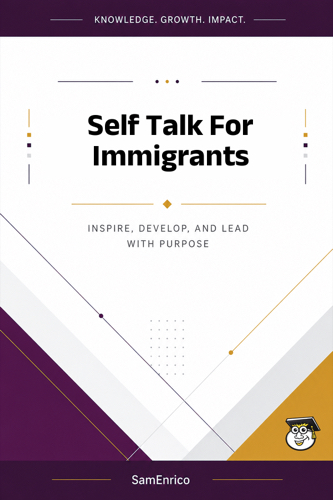
Self Talk For Immigrants
Navigate cultural adaptation with resilient and be
by Sipes Freida
Navigate cultural adaptation with resilient and belonging affirming internal dialogue.
Formats
About this book
Free sample
FIXED BOOK: "Self-Talk for Immigrants: The Home Within"Revised Chapter Summaries (Minimum 250 Words Each)PART I: THE DIAGNOSIS (Chapters 1-3)Structure: Problem → Concept → Shift (no worksheet formula yet)Chapter 1: The Core Split — Loyalty vs. Autonomy Opening Bridge from Preface: "This book begins with a single question: Who is the 'you' that speaks when no one else is listening?"This chapter establishes the book's unifying framework: all immigrant self-talk ultimately reduces to a tension between Loyalty (to heritage, family, the past, collective duty) and Autonomy (to the new country, the self, the future, individual freedom). Rather than introducing multiple competing frameworks (two voices, should language, third culture, etc.), the book names this single axis once and for all.The chapter opens with a composite story: Diego, a Mexican software engineer in Toronto, who experiences whiplash between his mother's voice ("You owe us. You left. You must succeed.") and his own ambition ("I want to travel.
I want to date outside my culture. I want to rest."). Most immigrants, the chapter argues, assume this war means they are broken. In fact, it is the signature psychological signature of migration.The chapter introduces the "Cultural Tightrope" — not as a place of paralysis, but as a conscious practice of balance. The goal of this book is not to kill either voice (Loyalty or Autonomy), nor to merge them prematurely, but to learn to recognize when each is speaking and to choose responses instead of being ruled.Ending Note (The First Shift): "I don't have to pick a side.
I have to learn who is speaking."Transition to Chapter 2: "Before you can balance the voices, you must learn to recognize the most destructive form each voice takes: the Language of Should."Chapter 2: The Language of Should — Identifying the Inner Critic Opening Hook: "Say the word 'should' out loud. Notice how your chest tightens. That is not a value. That is a command wearing a mask."This chapter provides a precise vocabulary for identifying toxic self-talk. Building on Chapter 1's Loyalty/Autonomy framework, the chapter demonstrates that the inner critic is not one voice but a ventriloquist…
This is the end of the free sample. Get the eBook to keep going. Buy now
Contents
- Chapter 1
- Chapter 2
- Chapter 3
- Chapter 4
- Chapter 5
- Chapter 6
- Chapter 7
- Chapter 8
- Chapter 9
- Chapter 10
- Chapter 11
- Chapter 12
Details
- Author
- Sipes Freida
- Publisher
- SamEnrico
- Language
- English
- Genre
- Non-Fiction, Self-Help, Immigrant
- Released
- 2026-06-09
- Pages (approx.)
- 147
- Available as
- eBook, Audiobook

Read better in the ZLOADR app
Your eBooks on your phone or tablet. Sign in with your SamEnrico account and start reading.
More by Sipes Freida
 Walking Meditation For GuiltSipes Freida$11.99
 Pomodoro for Graphic DesignSipes Freida$11.99
 Assertiveness for Recovering CodependentsSipes Freida$11.99
 The Opium Wars of the Levant: Smugglers, Spies, and the Birth of Organized CrimeSipes Freida$11.99
 Understanding Ophthalmo Acromelic SyndromeSipes Freida$17.99
 Intake SpecialistSipes Freida$11.99
 University Degree AdvantageSipes Freida$12.99
 Pricing Strategy for Ecommerce InflationSipes Freida$12.99
 How to Become a Shaker RepairerSipes Freida$11.99
You may also like
 Hong Kong Handover 1997Dunn Johnnie$11.99
 Zumba For Postnatal Recovery CourseNeal Christian$11.99
 Zumba for BeginnersLadner Nikia$11.99
 YouTube Comment Mining GuideHumes Pandora$12.99
 Worry Box MeditationCarlin Rudy$11.99
 Workplace Stress MeditationNguyen Lynn$11.99
 Workplace Stress and Sleep RepairHawley Ivory$11.99
 Workplace Perfectionism CureDelaney Jeffry$11.99
 Workplace Injustice Anger GuideWallen Isabelle$11.99
 Work Addiction and Burnout LinkGreenwood Ester$11.99
 Women in Yoga and WellnessBeattie Galina$11.99
 Women in Stand Up ComedyChun Evangeline$11.99