
Non-FictionSelf-HelpCreative Block
Self Talk for Creatives eBook
Rewire the inner critic that blocks artistic flow
Rewire the inner critic that blocks artistic flow and innovation.
Formats
Free sample
Chapter 1: The Safety Trap--–- Every creative I have ever met shares a secret shame. It lives beneath the surface of their Instagram feeds, their gallery openings, their published pages, their finished films. The shame is this: they believe their suffering is the source of their talent. They worry that if they were truly happy, truly at peace, truly kind to themselves—they would lose the edge that makes their work matter. The painter who cannot sleep because the critic in her head screams that every brushstroke is wrong believes that sleeplessness is the price of vision.
The writer who revises a single sentence forty times believes that obsession is the cost of craft. The musician who hates everything he plays until the tenth take believes that self-contempt is the fuel of genius.This is the myth of the tortured artist. And it is not merely incorrect. It is destructive.I have spent the last decade working with creatives across every discipline—novelists and neuroscientists, potters and product designers, choreographers and coders. I have sat across from Academy Award winners who cannot look at their own films without flinching.
I have held space for first-time poets who cannot share a single stanza without apologizing. And across every level of success, the same story repeats: the inner critic is not a drill sergeant shaping raw talent into excellence. It is a malfunctioning alarm system that mistakes creative vulnerability for physical danger.This book is about rewiring that alarm. Not destroying it—you cannot delete a part of your own psyche without collateral damage—but retraining it. Teaching it to distinguish between actual threats (a predator, a falling object, a hostile crowd) and creative risks (a blank page, a new medium, an unfinished idea).
When that retraining happens, something remarkable emerges. Not a gentle, complacent artist who has lost their edge. But a creative who works faster, plays harder, recovers more quickly, and produces more original work because fear no longer blocks the neural pathways required for innovation.Before we rewire, we must diagnose. And the first and most urgent diagnosis is this: your suffering is not your strength.The Resistance: How Shame Masquerades as Discipline Steven Pressfield, in his seminal work The War of Art, named the force that blocks creative work "The Resistance." He described it as the invisible enemy that rises up whenever we attempt to do anything difficult, meaningful, or new. Procrastination.
Self-doubt. Perfectionism. Distraction. Addiction. The Resistance wears a thousand masks, but its single goal is to keep us from doing our work.Pressfield is right about the phenomenon but, I believe, incomplete about its nature.
He frames Resistance as an external enemy to be conquered through discipline and willpower. This framing works for many readers. It turns creative work into a battlefield, and the artist into a warrior. There is power in that metaphor.But there is also danger.When you treat your inner critic as an enemy to be defeated, you enter into a war with a part of yourself. Wars are exhausting.
Wars produce casualties. And wars against internal enemies rarely end—they simply shift from active combat to cold war, with the critic retreating only to ambush you later when you are tired, sick, or vulnerable.What if the critic is not your enemy? What if it is a protection system?Consider the amygdala. This almond-shaped cluster of neurons in your brain is responsible for detecting threats. It is fast—much faster than your conscious mind.
When you see a shape that might be a snake on a hiking trail, your amygdala triggers a fear response before your prefrontal cortex has even finished processing the visual information. Your heart races. Your muscles tense. You pull back. This happens in milliseconds.The amygdala does not care whether the snake is real or a stick.
It errs on the side of survival. Better to flee from a false alarm than to ignore a real threat.Now consider the creative process. When you sit down to paint, to write, to compose, to design, you are entering a domain of uncertainty. Will the work be good? Will people judge it?
Will they judge you? Your brain, which cannot distinguish between social rejection and physical danger (neuroscience has shown that the same neural regions activate for both), treats creative vulnerability as a threat. The amygdala fires. The critic speaks: "This is stupid." "You're not ready." "Someone else already did it better." "Wait until you have more time."The critic is not trying to sabotage you. It is trying to protect you from the perceived danger of social rejection, shame, and exile.
It is a smoke alarm that has learned, over years of conditioning, that creative expression leads to pain. Perhaps you were mocked for a drawing in third grade. Perhaps a teacher dismissed your poem. Perhaps a parent said, "That's nice, but what are you going to do for a real job?" Perhaps you simply absorbed the cultural message that artists starve and that serious people pursue practical careers.The alarm learned its lessons well. It is trying to keep you safe.The problem is not the alarm's intent.
The problem is its calibration. You are not in physical danger. A bad painting will not kill you. A rejected manuscript will not exile you from the tribe. But your nervous system does not know this automatically.
It must be taught.The Neuroscience of Shame: Why Self-Criticism Kills Creativity Let us get specific about what happens in your brain when the critic speaks. This is not abstract psychology. This is biology.When you experience shame or harsh self-criticism, your brain activates the same stress response system that evolved to help you escape predators. The hypothalamic-pituitary-adrenal (HPA) axis releases cortisol. Your sympathetic nervous system prepares you for fight, flight, or freeze.
Blood flows away from your prefrontal cortex—the region responsible for executive function, abstract thinking, planning, and creative problem-solving—and toward your limbs and core.This is a problem for creativity. The prefrontal cortex is not optional for creative work. It is where you hold multiple possibilities in mind simultaneously. It is where you inhibit automatic responses to generate novel ones. It is where you evaluate aesthetic choices, imagine alternative solutions, and sustain attention over time.
When the critic triggers a stress response, you are literally robbing your brain of the resources it needs to create.This is not a metaphor. This is a measurable physiological phenomenon.The research is clear: people who report higher levels of self-criticism show lower levels of creative performance across multiple domains. In one study, participants who were primed with self-critical statements ("You are not creative enough," "Your ideas are ordinary") produced solutions that were rated as significantly less original than participants who were primed with neutral or self-compassionate statements. The self-critical group did not try less hard. They tried harder.
They generated more ideas. But the ideas were less innovative because their prefrontal cortex was operating under a stress burden.This is the cruel irony of the tortured artist myth. The belief that self-criticism fuels excellence is not just wrong. It is backward. Self-criticism impairs the very neural mechanisms required for excellence.
The artists who produce their best work are not the ones who hate themselves the most. They are the ones…
This is the end of the free sample. Get the eBook to keep going. Buy now
About this book
Details
- Author
- Stanley Shannon
- Publisher
- SamEnrico
- Language
- English
- Genre
- Non-Fiction, Self-Help, Creative Block
- Released
- 2026-06-09
- Pages (approx.)
- 154
- Available as
- eBook, Audiobook

Read better in the ZLOADR app
Your eBooks on your phone or tablet. Sign in with your SamEnrico account and start reading.
More by Stanley Shannon
 The Grocery Store Impulse TrapStanley Shannon$11.99
 Louis Bacon MooreStanley Shannon$11.99
 The Nobel Medicine ImmunologyStanley Shannon$11.99
 Physics Nobel Genius Stories GuideStanley Shannon$11.99
 Mouth Covering Gesture GuideStanley Shannon$11.99
 Anapanasati After WakingStanley Shannon$11.99
 Mindfulness For OverthinkingStanley Shannon$11.99
 The Maid of the Dardanelles: A Heroine’s Stand in the War of Austrian SuccessionStanley Shannon$11.99
 The Falklands: Blood and Ice in the South AtlanticStanley Shannon$11.99
 The Unseen Hand: How Frida Kahlo Painted Her PainStanley Shannon$11.99
 Growing ConandronStanley Shannon$11.99
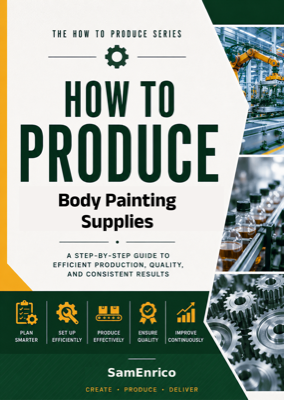 How to Produce Body Painting SuppliesStanley Shannon$11.99
You may also like
 Hong Kong Handover 1997Dunn Johnnie$11.99
 Zumba For Postnatal Recovery CourseNeal Christian$11.99
 Zumba for BeginnersLadner Nikia$11.99
 YouTube Comment Mining GuideHumes Pandora$12.99
 Worry Box MeditationCarlin Rudy$11.99
 Workplace Stress MeditationNguyen Lynn$11.99
 Workplace Stress and Sleep RepairHawley Ivory$11.99
 Workplace Perfectionism CureDelaney Jeffry$11.99
 Workplace Injustice Anger GuideWallen Isabelle$11.99
 Work Addiction and Burnout LinkGreenwood Ester$11.99
 Women in Yoga and WellnessBeattie Galina$11.99
 Women in Stand Up ComedyChun Evangeline$11.99