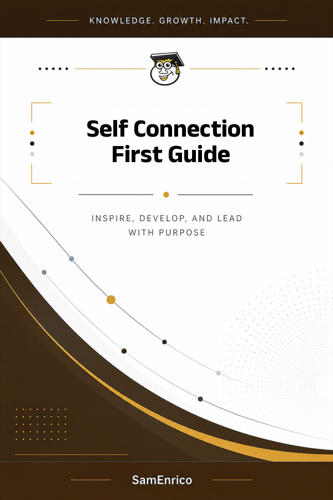
Self Connection First Guide eBook
Learn to enjoy your own company before seeking oth
Learn to enjoy your own company before seeking others.
Formats
Free sample
Chapter 1: The Uncomfortable Twenty...--The moment you wake up, before your eyes are fully open, your hand reaches for it. The phone. Not because anyone has called – the screen is dark, no notifications glowing. Not because there’s an emergency. Simply because the silence between you and yourself feels unbearable.
You scroll. You check email that hasn’t arrived. You open an app, close it, open another. You have been awake for ninety seconds, and you have already left yourself.This is not a moral failure. This is not laziness or weakness.
This is the distraction epidemic, and you are not alone in it. The average adult checks their phone ninety-six times per day. That’s once every ten waking minutes. But the number itself isn’t the story. The story is what happens in the spaces between those checks.
The story is the growing inability to sit in a room with nothing but your own thoughts for company. The story is that you have forgotten how to be alone with yourself – and worse, you have begun to fear it.Welcome to the first chapter of Self Connection First. Before we can build a practice of enjoying your own company, we must first understand why you avoid it. This chapter is a diagnosis. It will name the enemy, map its terrain, and give you the first honest glimpse of your own self-abandonment.
It will not fix you. It will show you what needs fixing.The Quiet That Screams Think of the last time you had ten minutes with nothing to do. Perhaps you arrived early to an appointment. Perhaps you were waiting for water to boil. Perhaps you finished a task at work and had a small gap before the next one.
What did you do? If you are like most people, you reached for your phone. You opened social media. You checked the news. You sent a message to someone, anyone, to fill the space.Now ask yourself a harder question: What were you afraid would happen if you simply sat there?The answer, for most people, is discomfort.
Not pain, not danger – just ordinary, human discomfort. The kind that comes from being alone with your own mind. The kind that feels like restlessness, like a low-grade itch, like a voice whispering that you should be doing something, seeing someone, proving something.This discomfort has a name. It is called the escape reflex – the automatic, unconscious reach for a phone, snack, task, or conversation whenever there is a gap in stimulation. It is not a choice.
It is a learned response, wired into your nervous system over years of practice. And like any learned response, it can be unlearned. But first, you have to see it.The escape reflex is the primary symptom of a deeper condition: self-abandonment. Let’s define that term clearly, because it will appear throughout this book.Self-abandonment is the act of ignoring your own feelings, needs, or desires in favor of external stimulation, approval, or escape.When you scroll instead of sitting with boredom, you abandon yourself. When you overwork to avoid quiet, you abandon yourself.
When you stay in a noisy relationship because being alone feels worse, you abandon yourself. When you binge-watch four episodes in a row because the silence in your apartment feels like a judgment, you abandon yourself.Self-abandonment is not a character flaw. It is a survival strategy that outlived its usefulness. And it is running your life.The Neuroscience of Escape Why does silence feel so uncomfortable? The answer lies in your brain’s default mode network (DMN) – a collection of brain regions that become active when you are not focused on an external task.
The DMN is responsible for self-referential thought: reflecting on your past, imagining your future, considering how others see you, and, crucially, noticing discrepancies between who you are and who you think you should be.When the DMN activates in a person with high self-compassion, it produces gentle reflection. But when it activates in a person with a harsh inner critic – which we will explore in Chapter 6 – it produces rumination, self-judgment, and anxiety. Your brain has learned that quiet equals danger, because quiet allows the DMN to bring up everything you’ve been avoiding.Enter dopamine. Your brain’s reward system craves novelty and predictability – a strange combination. Scrolling provides both.
Each swipe is a tiny gamble: will this next post be interesting? Each notification is a small reward. Over time, your brain rewires itself to prefer the small, predictable dopamine hits of distraction over the unpredictable, sometimes uncomfortable terrain of your own mind.This is not a metaphor. Neuroimaging studies show that the same brain regions activated by physical pain are activated by social rejection – and also by prolonged periods of unstructured alone time in people with high self-abandonment patterns. Your brain has literally learned that being alone with yourself hurts.
Distraction is not a bad habit. It is self-medication.But here is what the studies also show: the discomfort of solitude decreases with practice. The brain is plastic. The neural pathways that scream “danger” when you are alone can be rewired into pathways that whisper “home.” It takes time. It takes repetition.
And it starts with a single, uncomfortable choice: to stay.The Many Faces of Self-Abandonment The escape reflex shows up differently in different lives. Read the following list not as a checklist of failures but as a mirror. Which of these sound familiar?The Scroller. You reach for your phone whenever you have a free moment. In line at the grocery store, you scroll.
Waiting for the bus, you scroll. In the bathroom, you scroll. You have not looked at a stranger’s face in public in years because your eyes are glued to a screen. The thought of standing in line without your phone makes your chest tighten.The Overworker. You fill every hour with tasks.
You answer emails at 10 p.m. You volunteer for projects no one else wants. You tell yourself you are ambitious, dedicated, driven. And you are – but you are also terrified of what might surface if you stopped. Your job is not just your career.
It is your escape.The Binge-Watcher. You cannot watch just one episode. You cannot sit through a movie without your phone in your hand. The moment the credits roll, you are searching for the next thing. You have watched entire seasons of shows you didn’t even like, simply because the alternative was silence.The Overeater.
You eat when you are not hungry. You snack while scrolling, while working, while watching. The food is not about hunger – it is about filling the space. The act of chewing, tasting, swallowing keeps your body busy so your mind doesn’t have to be.The Relationship Jumper. You have not been single for more than a few weeks since you started dating.
You end one relationship and immediately begin another. You tell yourself you are a romantic, a lover, someone who thrives on connection. But beneath that story is a simpler truth: you do not know how to be alone. The thought of an empty bed, a quiet Sunday, a phone that…
This is the end of the free sample. Get the eBook to keep going. Buy now
About this book
Details
- Author
- Rouse Horacio
- Publisher
- SamEnrico
- Language
- English
- Genre
- Non-Fiction, Self-Help, Self Acceptance
- Released
- 2026-06-11
- Pages (approx.)
- 113
- Available as
- eBook, Audiobook

Read better in the ZLOADR app
Your eBooks on your phone or tablet. Sign in with your SamEnrico account and start reading.
More by Rouse Horacio
 Countdown Sleep MeditationRouse Horacio$11.99
 Strength Training for SkiingRouse Horacio$11.99
 Values And Mission Alignment Rituals GuideRouse Horacio$11.99
 The Crown and the Codebreaker: How a Future Queen Mastered the Art of EspionageRouse Horacio$11.99
 Silent Waves: The Unseen War of the TelegraphRouse Horacio$11.99
 How to Become a Christian Science NurseRouse Horacio$11.99
 Understanding Hypogonadism Male Mental Retardation Skeletal AnomalyRouse Horacio$17.99
 Internet of Things Cargo TrackingRouse Horacio$12.99
 Ransomware Trend Report PrimerRouse Horacio$12.99
 Visual Operations ManagerRouse Horacio$11.99