
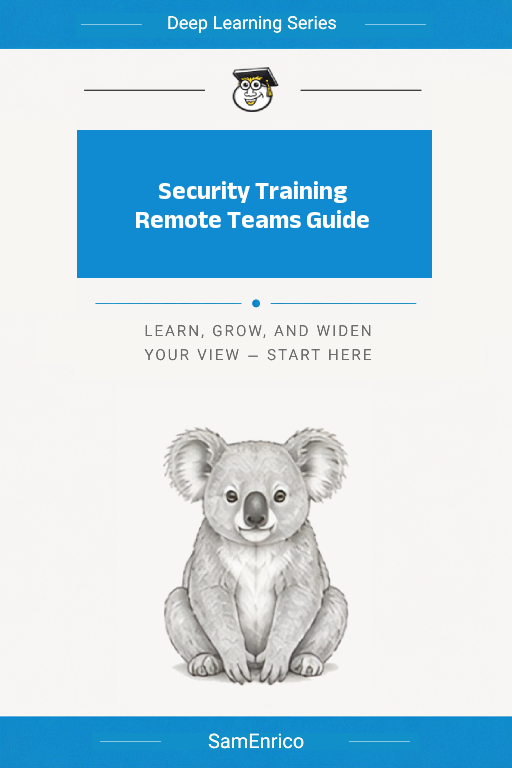
Non-FictionBusiness BriefSecurity Training
Security Training Remote Teams Guide eBook
Implement cybersecurity awareness programs tailore
Implement cybersecurity awareness programs tailored to remote workers in each country's threat landscape.
Formats
Free sample
Chapter 1: The Wall Is Gone--The breach started with a smart fridge.Not a sophisticated piece of malware. Not a nation-state actor with unlimited resources. Not even a particularly clever phishing email. A smart fridge. A $400 internet-connected appliance that a remote employee in Chicago had bought to keep his family’s groceries cold.The attacker scanned the internet for vulnerable Io T devices, found the fridge’s open port, brute-forced its default password – “123456” – and used it as a beachhead.
From the fridge, the attacker pivoted to the employee’s laptop, which was on the same home Wi-Fi network. From the laptop, the attacker moved laterally into the corporate VPN. From the VPN, the attacker accessed customer records, source code, and financial data. Total time from fridge to breach: forty-seven minutes. Total cost to the company: four point two million dollars.The employee had completed all required security training.
He had passed the annual quiz with a ninety-four percent score. He had never clicked a known phishing link. He had done everything “right” by the standards of traditional office-based security. And yet, because his training assumed a corporate perimeter that no longer existed, his smart fridge became the front door to his employer’s most sensitive assets.This chapter dismantles the obsolete “castle-and-moat” model of security and establishes the operational reality that every remote-first organization must accept: the physical perimeter is dead. The office firewall no longer protects you.
The corporate network is now distributed across millions of living rooms, coffee shops, and co-working spaces. And the security training that worked in 2019 will fail catastrophically in 2026 unless you fundamentally rethink what “awareness” means for a workforce that never comes into the building.The Myth of the Corporate Fortress For thirty years, corporate security operated on a simple, defensible assumption: keep the bad guys outside the network, and everything inside is safe. This was the “castle-and-moat” model. Build a high wall (the firewall). Dig a deep trench (the intrusion detection system).
Guard the single drawbridge (the VPN). And train employees to watch for threats only at that single point of entry.The model worked reasonably well when every employee worked inside the castle. Security training, in that world, was about teaching people not to open the drawbridge to strangers. You learned to spot a suspicious email. You learned not to share your badge.
You learned to report anything unusual to the guards. Simple, linear, and largely effective.Then 2020 happened.Within weeks, the castle emptied. Millions of employees took their laptops, their credentials, and their access to sensitive data and went home. The wall didn’t move with them. The moat didn’t follow.
The drawbridge suddenly had fifty thousand identical copies, each controlled by a different person in a different location with a different level of security awareness.The perimeter didn’t just expand. It dissolved.Today, in 2026, the majority of knowledge workers spend at least part of their week working remotely. For many organizations, remote work is no longer an emergency measure or a temporary accommodation. It is the default state. The office, when it exists at all, is a collaboration hub, not a security boundary.
And yet, most security training is still designed for the castle-and-moat world.This mismatch is the single largest vulnerability in modern cybersecurity.The Data That Changes Everything Let me show you the numbers that forced me to write this book.In a global survey of eleven hundred IT security professionals across eleven countries, seventy-eight percent reported that attack volumes rose directly as a result of the shift to remote work. Not because attackers became more sophisticated overnight. Not because security budgets were cut. But because the attack surface expanded faster than training could adapt.Consider the Verizon Data Breach Investigations Report, the most authoritative annual study of breaches worldwide. For years, the headline statistic has been that roughly sixty percent of breaches involve a human element.
A click. A mistake. A moment of inattention. That statistic has remained stubbornly consistent.But here is what the statistic hides: remote workers make fundamentally different errors than office workers.When you are in an office, your errors are social. You hold the door for someone who forgot their badge.
You trust the person at the next desk who asks for your password to “help with a ticket.” You assume that the internal email from “IT Support” is legitimate because it came from an internal address.When you are working from home, your errors are environmental. You leave your work laptop on the kitchen table where a houseguest can see it. You connect to an unsecured home router whose default password is still “admin.” You share your network with a dozen smart devices that have never received a security update. You let your teenager use your work computer for online gaming because “it’s faster than their school laptop.”These are not the same risks. They cannot be addressed by the same training.Yet the vast majority of security awareness programs today are still built around the office environment.
They teach you how to recognize a phishing email – good. They teach you not to share your password – necessary. But they do not teach you how to segment your Io T devices from your work laptop. They do not teach you how to recognize when your home router has been compromised. They do not teach you how to handle the fact that your family members share your network and your devices.This is the gap that this book exists to close.Why Generic Training Fails Across Borders The problem is worse than a simple office-to-home mismatch.
Because remote work is global in a way that office work never was.When you worked in an office, your threat landscape was local. The attackers targeting your company were likely in the same country or a neighboring one. They spoke the same language. They understood the same cultural cues. Your security team could tailor training to the specific threats that actually mattered to your region.Remote work has shattered that localization.
Today, your remote workers may be distributed across a dozen countries, each with its own threat landscape, each with its own regulatory environment, each with its own attacker behaviors.A remote worker in the United States faces a threat landscape dominated by ransomware and data leakage. US-based attackers are aggressive, financially motivated, and highly sophisticated. They deploy ransomware that encrypts entire networks, exfiltrates data for double-extortion, and demands payments in cryptocurrency. US cyber-insurance requirements have become so stringent that many companies cannot get coverage unless they implement specific controls – yet most training programs do not mention these requirements.A remote worker in France or Germany faces different threats. European attackers increasingly target cloud services directly, bypassing traditional perimeter defenses entirely.
Saa S compromise – where an attacker gains access to a company’s Google Workspace or Microsoft 365 tenant – is now a leading attack vector. And the regulatory consequences of a breach are catastrophic under GDPR, with fines up to twenty million euros or four percent of global revenue. A French employee needs training on cloud security and data protection that a US employee does not.A remote worker in the UAE or Saudi…
This is the end of the free sample. Get the eBook to keep going. Buy now
About this book
Details
- Author
- Broussard Marx
- Publisher
- SamEnrico
- Language
- English
- Genre
- Non-Fiction, Business Brief, Security Training
- Released
- 2026-05-30
- Pages (approx.)
- 158
- Available as
- eBook, Audiobook

Read better in the ZLOADR app
Your eBooks on your phone or tablet. Sign in with your SamEnrico account and start reading.
More by Broussard Marx
 Confrontation Phobia Assertive GuideBroussard Marx$11.99
 Email Overload SolutionBroussard Marx$11.99
 YouTube Child Star PhenomBroussard Marx$11.99
 Uber Driver Bonuses GuideBroussard Marx$11.99
 Indian GST E Way Bill Generation GuideBroussard Marx$11.99
 Scott Neighbor InterviewBroussard Marx$11.99
 Citation Rules for Books and Journals GuideBroussard Marx$11.99
 C130 Hercules PilotBroussard Marx$11.99
 Carnegie MellonBroussard Marx$11.99
 Rommel's Ghost Division: The Desert Fox's Western Front GambitBroussard Marx$11.99
 The Algorithm That Broke the InternetBroussard Marx$11.99
 Red Dust Rising: The Untold Story of Mars' First Human FootprintBroussard Marx$11.99
You may also like
 Hong Kong Handover 1997Dunn Johnnie$11.99
 Zumba For Postnatal Recovery CourseNeal Christian$11.99
 Zumba for BeginnersLadner Nikia$11.99
 YouTube Comment Mining GuideHumes Pandora$12.99
 Worry Box MeditationCarlin Rudy$11.99
 Workplace Stress MeditationNguyen Lynn$11.99
 Workplace Stress and Sleep RepairHawley Ivory$11.99
 Workplace Perfectionism CureDelaney Jeffry$11.99
 Workplace Injustice Anger GuideWallen Isabelle$11.99
 Work Addiction and Burnout LinkGreenwood Ester$11.99
 Women in Yoga and WellnessBeattie Galina$11.99
 Women in Stand Up ComedyChun Evangeline$11.99