
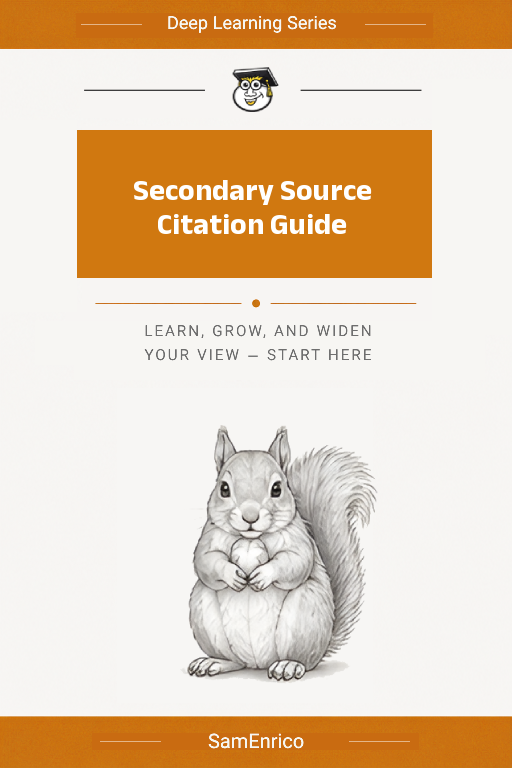
Non-FictionStudent's ShortcutIndirect Sources
Secondary Source Citation Guide Audiobook
Cite a source quoted in another source without pla
Cite a source quoted in another source without plagiarism using both in text and reference rules.
Formats
Free sample
Chapter 1: The Scholarly Lie...--–- Every academic writer has told it. Not with malice, not with intent to deceive, but told it nonetheless. The lie sounds something like this: “As Freud (1935) argued, the unconscious mind operates beyond the reach of direct observation.” The sentence appears innocent enough. It flows smoothly. It cites a famous thinker and a specific year.
It positions the writer as knowledgeable, well-read, and credible. There is only one problem: the writer never opened Freud’s 1935 work. They found Freud’s idea quoted in a textbook by Smith (1983), and they cited Freud directly as if they had read him. That is the scholarly lie.You are not alone if your stomach just tightened. Perhaps you have written a sentence like that.
Perhaps you are writing one right now for a term paper or a journal article. Perhaps no one ever told you there was anything wrong with it. After all, the idea is Freud’s. The year is correct. You are giving credit to the right person.
What difference does it make whether you actually held Freud’s book in your hands?The difference, as this chapter will show, is the difference between integrity and misrepresentation, between scholarship and performance, between building knowledge and borrowing borrowed light. The scholarly lie is not a lie of commission in most cases—it is a lie of omission, a lie born of convenience, a lie that feels like a shortcut but often becomes a trap. This chapter exists to make sure you never tell that lie again, not because you fear punishment, but because you understand why it matters.The Scenario That Launched a Thousand Citation Errors Let us begin with a concrete example that will follow us throughout this book. Imagine you are writing a research paper on the history of dream interpretation. You are deep in the library databases, scrolling through articles, when you stumble upon a 2018 book by a sociologist named Beaujot.
The book is fascinating, but one passage in particular catches your attention. Beaujot writes: “As Trost (1995) noted in his seminal study of nocturnal cognition, dreams are not random neural firings but structured narratives that reflect the dreamer’s waking concerns.”You have never heard of Trost. You have never read his 1995 study. But the idea is perfect for your paper. So you write: “Trost (1995) argued that dreams are structured narratives reflecting waking concerns.”…
This is the end of the free sample. Get the Audiobook to keep going. Buy now
About this book
Details
- Author
- Holloman Karin
- Publisher
- SamEnrico
- Language
- English
- Genre
- Non-Fiction, Student's Shortcut, Indirect Sources
- Released
- 2026-06-01
- Pages (approx.)
- 158
- Available as
- eBook, Audiobook

Listen in the VoxFlicks app
Audiobooks and audio dramas wherever you go. Sign in with your SamEnrico account and press play.
More by Holloman Karin
 Bedtime Release MeditationHolloman Karin$11.99
 Weekly Goal Review RoutineHolloman Karin$11.99
 Jimmy Hoffa Disappearance Timeline ManualHolloman Karin$11.99
 Asana Goal and OKR TrackingHolloman Karin$11.99
 School Strike For Gaza MemoirHolloman Karin$11.99
 Job Loss for Gig WorkersHolloman Karin$11.99
 Mortgage Payment StressHolloman Karin$11.99
 Facebook Social Comparison EffectsHolloman Karin$11.99
 The Cleveland Torso Murderer: America's First Serial Killer in the ShadowsHolloman Karin$11.99
 The Boy General: Marlborough's Triumph at BlenheimHolloman Karin$11.99
 A Collector's Handbook to the Rolls-royce Silver Shadow I LwbHolloman Karin$11.99
 Growing BoragoHolloman Karin$11.99
You may also like
 Hong Kong Handover 1997Dunn Johnnie$11.99
 Zumba For Postnatal Recovery CourseNeal Christian$11.99
 Zumba for BeginnersLadner Nikia$11.99
 YouTube Comment Mining GuideHumes Pandora$12.99
 Worry Box MeditationCarlin Rudy$11.99
 Workplace Stress MeditationNguyen Lynn$11.99
 Workplace Stress and Sleep RepairHawley Ivory$11.99
 Workplace Perfectionism CureDelaney Jeffry$11.99
 Workplace Injustice Anger GuideWallen Isabelle$11.99
 Work Addiction and Burnout LinkGreenwood Ester$11.99
 Women in Yoga and WellnessBeattie Galina$11.99
 Women in Stand Up ComedyChun Evangeline$11.99