
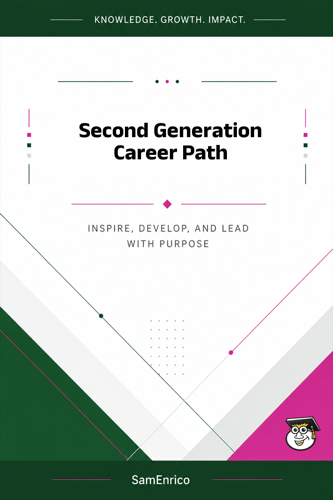
Second Generation Career Path eBook
Choose between parental expectations and your own
by Owens Linda
Choose between parental expectations and your own professional passion.
Formats
Free sample
Chapter 1: The Unspoken Contract--Every second-generation professional remembers the exact moment they realized their career was not entirely their own. For Mira, a 28-year-old daughter of Indian immigrants in Chicago, it happened in a hospital break room at 2 a.m., halfway through her third year of medical residency. She was not saving a life. She was not solving a diagnostic mystery. She was crying over a spilled cup of coffee while wearing scrubs that smelled like antiseptic and regret.
The coffee mattered because it was the third thing that had gone wrong that shift, and the tears mattered because she could not remember the last time she had cried over something that was actually about her. Her parents, back in Illinois, told everyone at the temple that their daughter was a doctor. She was, technically. But she had not wanted to be a doctor since the night she dissected a fetal pig in pre-med and realized she found anatomy interesting but not sacred. That was seven years ago.
Seven years of tuition, applications, exams, rotations, and a slow, creeping numbness that she had learned to call "being practical." The coffee cup broke, and so did something else. Mira looked at her reflection in the dark window of the break room and whispered a sentence she had never said out loud: "I don't want to be here." Then she washed her face, took a deep breath, and walked back to her patients. She told no one.Mira is not unusual. She is the rule. This chapter is about the invisible agreement that people like Mira sign before they are old enough to read the fine print.
It is called the unspoken contract, and it governs more career decisions than talent, ambition, or even money. The unspoken contract is the set of expectations, obligations, and silent debts that children of high-expectation families inherit along with their last names. It is not written down. No one signs it. But everyone feels its weight.
For children of immigrants, the contract says: They sacrificed everything so you could have this. Do not waste it. For children in family businesses, the contract says: This company fed you, clothed you, and paid for your education. You owe it your future. For children of professionals—doctors, lawyers, engineers—the contract says: We built this ladder.
You climb it. Do not ask why. These contracts are not malevolent. Most parents genuinely believe they are offering love and protection. But love wrapped in fear still suffocates.
And protection that does not ask what you actually want is not protection—it is a cage with gold-plated bars.The Three Pillars of the Unspoken Contract To understand the contract, you must first understand what parents are actually asking for. Most second-generation children hear specific career demands: "Be a doctor." "Take over the business." "Don't be an artist." But these demands are translations of deeper, unspoken priorities. Through analyzing hundreds of interviews and survey responses for this book, a consistent pattern emerged. Parents are not actually attached to specific jobs. They are attached to three underlying values: security, status, and stability.
Call them the Three Pillars.Security is first because it is oldest. Most parents who push their children toward conventional careers have lived through or inherited memories of scarcity. Immigrant parents remember what it means to have nothing. Family business parents remember the year the market crashed. Professional-class parents remember the recession that wiped out their colleagues' retirement accounts.
When they say "get a real job," they are not attacking your dream. They are trying to protect you from a nightmare they have already seen. The problem is that their definition of security is frozen in time. A pension and a corner office meant security in 1985. In 2026, security might mean a portable skill set, a diversified income stream, or the ability to work remotely from anywhere.
But parents operate on the data they have, not the data you need.Status is second. This one is harder to talk about because it sounds shallow, but it is not shallow to the people who feel it. Status is about belonging. For many parents, especially those who have experienced discrimination, poverty, or social marginalization, a high-status career is proof that their family has "made it." It is a visible marker of success that cannot be taken away. When a parent brags that their child is a lawyer, they are not just bragging about the child.
They are bragging about their own sacrifice, their own survival, their own upward mobility. To reject the status career can feel to them like rejecting their entire life's work. This is not fair, but it is real.Stability is third, and it is the most deceptive pillar. Stability sounds reasonable. Everyone wants a stable life.
But stability, as defined by the unspoken contract, often means predictable monotony. It means the same commute, the same desk, the same tasks, the same salary trajectory, for forty years. Parents equate stability with safety because they lived through eras when the greatest risk was losing a job you hated. But for many second-generation professionals, the greatest risk is not unemployment. It is slow death by repetition.
The contract's version of stability does not account for the mental health cost of doing something you do not care about for twenty thousand hours.Why Parents Oppose Passion (It Is Not What You Think)Here is a revelation that changes everything: Most parents do not actually oppose passion. They oppose risk without a plan. When a parent says "don't be a musician," they are not saying music has no value. They are saying that the specific version of music you are describing—touring in a van, sleeping on floors, earning nothing for years—terrifies them. If you came to them with a detailed business plan for a sustainable music career that included teaching, session work, licensing, and a retirement account, their resistance would drop significantly.
Not to zero, perhaps, but significantly. The proof of this is everywhere. In the book's survey, parents were presented with hypothetical scenarios. When a child said "I want to quit my job and pursue art with no savings," only 12 percent of parents expressed support. But when the same child said "I want to spend two years building an art business while keeping my part-time job and maintaining a six-month emergency fund," support jumped to 67 percent.
The passion did not change. The plan did.This means that many second-generation children are fighting the wrong battle. They think they are fighting for the right to pursue their passion. In reality, they are fighting for the right to pursue their passion without a safety net. And their parents, reasonably or not, are saying no to the safety net, not to the passion.
The distinction is crucial because it changes the negotiation. You do not need to convince your parents that your passion is valid. You need to convince them that you have thought through the contingencies. You need to show them that you are not a reckless teenager but an adult who has done the math. This is not betrayal of your creative soul.
It is maturity. And it is the only thing that has ever consistently worked to transform parental opposition into grudging…
This is the end of the free sample. Get the eBook to keep going. Buy now
About this book
Details
- Author
- Owens Linda
- Publisher
- SamEnrico
- Language
- English
- Genre
- Non-Fiction, Biography, Career
- Released
- 2026-06-10
- Pages (approx.)
- 143
- Available as
- eBook, Audiobook

Read better in the ZLOADR app
Your eBooks on your phone or tablet. Sign in with your SamEnrico account and start reading.
More by Owens Linda
 Kenny Rogers Gambler LifeOwens Linda$11.99
 Lady Bird JohnsonOwens Linda$11.99
 The Relationship Resilience PlanOwens Linda$11.99
 Anger and Attachment StylesOwens Linda$11.99
 Dual N Back Training ProtocolOwens Linda$11.99
 Somali Therapy Access GuideOwens Linda$11.99
 Cardiac Risks DetoxOwens Linda$11.99
 The Iron Horse and the Iron Will: Leland Stanford and the Transcontinental RailroadOwens Linda$11.99
 Baba Yaga's Iron Spire: The Witch's Forbidden TowerOwens Linda$11.99
 Middle East Government Sales GuideOwens Linda$12.99
 Essay Outline AI Prompt GuideOwens Linda$12.99
 How to Produce Forklift and Warehouse SystemsOwens Linda$11.99
You may also like
 Hong Kong Handover 1997Dunn Johnnie$11.99
 Zumba For Postnatal Recovery CourseNeal Christian$11.99
 Zumba for BeginnersLadner Nikia$11.99
 YouTube Comment Mining GuideHumes Pandora$12.99
 Worry Box MeditationCarlin Rudy$11.99
 Workplace Stress MeditationNguyen Lynn$11.99
 Workplace Stress and Sleep RepairHawley Ivory$11.99
 Workplace Perfectionism CureDelaney Jeffry$11.99
 Workplace Injustice Anger GuideWallen Isabelle$11.99
 Work Addiction and Burnout LinkGreenwood Ester$11.99
 Women in Yoga and WellnessBeattie Galina$11.99
 Women in Stand Up ComedyChun Evangeline$11.99