
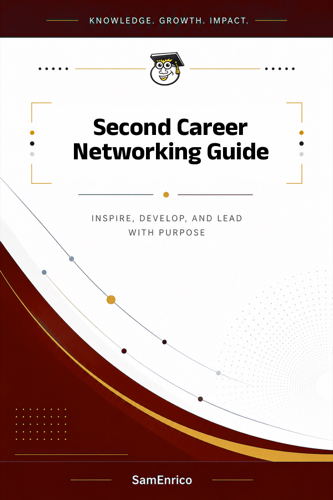
Non-FictionSelf-HelpCareer Change
Second Career Networking Guide eBook
Build new professional circles after switching ind
by Odonnell Jc
Build new professional circles after switching industries later in life.
Formats
Free sample
Chapter 1: The Pre-Mortem Audit...--–- The first mistake every second-career networker makes is also the most obvious: they start talking before they know what they’re talking about.You’ve felt it. That nervous itch to “do something.” So you update your Linked In headline to something vague like “Open to Work.” You message three former colleagues: “Hey, long time! Got a minute to catch up?” You sign up for a virtual networking event where fifty strangers stare at their own cameras in awkward silence. You collect business cards—digital or physical—like they’re lottery tickets, hoping one of them will be the winner.This is the Desperation Spiral. And it is the single fastest way to ensure your second career pivot fails before it starts.The Desperation Spiral feels like action.
It feels productive. You sent ten messages today! You attended a webinar! You updated your profile! But here’s the brutal truth that no one tells you: networking without a pre-mortem audit is like driving cross-country without a map, a full tank of gas, or any idea which direction you’re facing.
You’ll burn energy, you’ll get lost, and you’ll run out of fuel long before you reach your destination.This chapter is where we stop the spiral. Before you send one more message, attend one more event, or ask one more person for “just fifteen minutes of their time,” you are going to do something that feels counterintuitive: absolutely nothing external. You are going inward first.You are going to conduct a Pre-Mortem Audit.What Is a Pre-Mortem Audit?In corporate strategy, a “pre-mortem” is a simple but powerful exercise. Before a project launches, the team imagines that it has failed spectacularly. Then they work backward: What caused the failure?
What did we miss? What assumptions did we make that turned out to be wrong?For your second career pivot, the pre-mortem works the same way. Imagine it is six months from now. You have failed to break into your new industry. You are still sending desperate messages.
You have zero interviews. Your confidence is shattered. Now, work backward: What went wrong?For ninety percent of career switchers, the answer is the same: they never mapped their existing network. They never identified their unique value. They never translated their past expertise into the language of the new industry.
They started collecting business cards before they knew what business they were actually in.The Pre-Mortem Audit fixes this. It is a systematic, three-part assessment of everything you already have before you ask for anything new. It answers three questions:Who is already in my network that can help me? (The Three Circles)What specific value do I bring to my new industry? (The Pivot Point)Which of my past skills are actually useless here?
(The Dead-End Exception)Only after you answer these three questions do you get permission to talk to another human being. That is not a suggestion. It is a rule. Break it, and you will become another statistic—another mid-career professional who “tried networking” and gave up.Part One: The Three Circles – Mapping Your Hidden Goldmine Most people believe they need to build an entirely new network from scratch when they switch industries. This belief is not only wrong—it is actively destructive.
It makes you feel poor when you are actually rich.You already have a network. You have been building it for twenty, thirty, or forty years. The problem is not that you lack contacts. The problem is that you have not sorted your contacts by their actual usefulness for this specific pivot.Enter the Three Circles framework.Imagine three concentric circles, like a bullseye target. The smallest, innermost circle is your Operational Circle.
The middle circle is your Strategic Circle. The largest, outermost circle is your Personal Circle. Every person you know belongs in one of these three circles. And each circle serves a completely different function in your career pivot.The Operational Circle: People Who Know How You Work Your Operational Circle contains the people who have seen you do your job. These are former colleagues, direct reports, managers, cross-functional partners, and clients you worked with closely.
They know your work habits, your reliability, your problem-solving style, and your reputation under pressure.Why does this matter for a career pivot? Because these people can vouch for your process, even if they don't understand your new industry. When you ask someone in your Operational Circle for an introduction, they are not endorsing your industry knowledge. They are endorsing your character, your follow-through, and your ability to learn.Who belongs here:Former managers and direct reports Colleagues from previous companies Long-term clients or vendors you worked with directly Internal partners from other departments (HR, finance, legal, marketing)How to identify them: Scan your memory for the last three jobs you held. For each role, list the five people you communicated with most frequently.
Those are your Operational Circle.The Operational Circle Rule: Never ask these people for advice about your new industry. They don’t know it. Instead, ask them for character referrals and introductions to their networks. “You don’t know anything about Saa S, but you know how I work. Would you introduce me to three people in your network who are in tech?”The Strategic Circle: People Who Know What You Think Your Strategic Circle contains the people who have seen you make decisions.
These are mentors, executive coaches, board members you reported to, consultants you hired, and senior leaders who sought your opinion. They know how you analyze problems, how you handle ambiguity, and how you think under pressure.This circle is smaller than your Operational Circle. Most professionals have five to ten Strategic Circle contacts at any given time. These are the people who would trust you with a difficult decision without needing to supervise you.Who belongs here:Formal or informal mentors Executive coaches or career advisors Board members or advisory board members Senior leaders who sought your input on strategy Professors or teachers who mentored you closely How to identify them: Ask yourself: “Who has called me for advice in the last two years?” “Who has asked me to review a strategic document?” “Who has invited me to speak or present to their team?” These are your Strategic Circle.The Strategic Circle Rule: These people can help you frame your pivot as a logical evolution, not a random jump. Ask them to pressure-test your Pivot Point (coming in Part Two).
They will tell you whether your story makes sense.The Personal Circle: People Who Know Who You Are Your Personal Circle contains the people who know you outside of work. These are friends, family, neighbors, alumni network contacts, fellow volunteers, and members of your religious or community organizations. They know your values, your personality, and your character when no one is watching.This circle is the largest by far. Most professionals have fifty to one hundred Personal Circle contacts. And here is the secret that most networking books miss: your Personal Circle is often the most useful circle for a career pivot.Why?
Because people in your Personal Circle have diverse careers. Your college roommate might be a product manager at a tech…
This is the end of the free sample. Get the eBook to keep going. Buy now
About this book
Details
- Author
- Odonnell Jc
- Publisher
- SamEnrico
- Language
- English
- Genre
- Non-Fiction, Self-Help, Career Change
- Released
- 2026-06-10
- Pages (approx.)
- 148
- Available as
- eBook, Audiobook

Read better in the ZLOADR app
Your eBooks on your phone or tablet. Sign in with your SamEnrico account and start reading.
More by Odonnell Jc
 Loneliness Cycling Group GuideOdonnell Jc$11.99
 Slack Do Not Disturb ModeOdonnell Jc$11.99
 Political Fear TranceOdonnell Jc$11.99
 Quitting Your Job GracefullyOdonnell Jc$11.99
 Senior Mindfulness EsteemOdonnell Jc$11.99
 Burnout Recovery for Mental Health ProfessionalsOdonnell Jc$11.99
 Antwerp Heist Civil CaseOdonnell Jc$11.99
 Arm Levitation InductionOdonnell Jc$11.99
 Ride the Storm: The Untold Tale of Bose Ikard, the Buffalo Soldier Who Rode with the Pony ExpressOdonnell Jc$11.99
 Voltaire & Émilie: The Spark of EnlightenmentOdonnell Jc$11.99
 Ragnarok and the Fox’s Curse: Loki’s Pact with the KitsuneOdonnell Jc$11.99
 The Mineral Guide to TeruggiteOdonnell Jc$11.99
You may also like
 Hong Kong Handover 1997Dunn Johnnie$11.99
 Zumba For Postnatal Recovery CourseNeal Christian$11.99
 Zumba for BeginnersLadner Nikia$11.99
 YouTube Comment Mining GuideHumes Pandora$12.99
 Worry Box MeditationCarlin Rudy$11.99
 Workplace Stress MeditationNguyen Lynn$11.99
 Workplace Stress and Sleep RepairHawley Ivory$11.99
 Workplace Perfectionism CureDelaney Jeffry$11.99
 Workplace Injustice Anger GuideWallen Isabelle$11.99
 Work Addiction and Burnout LinkGreenwood Ester$11.99
 Women in Yoga and WellnessBeattie Galina$11.99
 Women in Stand Up ComedyChun Evangeline$11.99