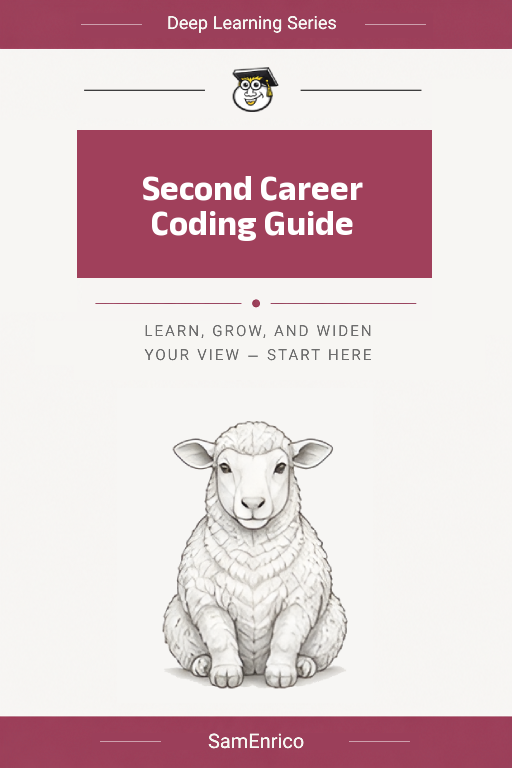
Second Career Coding Guide eBook
Choose between bootcamp and degree as a career cha
Choose between bootcamp and degree as a career changer with previous bachelor's degree and work experience.
Formats
Free sample
Chapter 1: The Remixer’s Advantage...--You are not a beginner.Let that sink in for a moment. If you are reading this book, you likely hold a bachelor’s degree in something—anything—and you have spent years in the workforce. You have sat through pointless meetings. You have negotiated with difficult clients. You have managed a budget, a project, or at the very least, your own time across competing priorities.
You have survived layoffs, performance reviews, and the quiet desperation of a Thursday afternoon when you realized you had thirty more years of this.And now you want to code.But somewhere along the way, you absorbed a dangerous belief: that switching to a career in software development means starting over. That you will be a novice again. That your previous education and experience count for nothing. That you will stand hat in hand before a twenty-two-year-old hiring manager who will judge you on your ability to reverse a linked list on a whiteboard.That belief is wrong. And it is the single biggest obstacle between you and a successful second career in tech.This chapter dismantles the myth of “starting over” and replaces it with a more accurate, more empowering, and more strategic reality: you are not a beginner.
You are a remixer. You already possess a portfolio of professional skills that no bootcamp teaches and no degree program certifies. Your job is not to learn everything from scratch. Your job is to translate what you already know into the language of software development.The Myth of the Blank Slate Every career changer I have ever coached has said some version of the same thing: “I feel like I’m starting from zero.” They look at a job description listing five years of experience in a programming language they have never used, and they despair. They compare themselves to computer science graduates who have been coding since they were teenagers, and they feel hopelessly behind.This feeling is understandable, but it is based on a category error.You are comparing apples to forklifts.
The twenty-two-year-old computer science graduate may know how to write a quicksort algorithm from memory, but they have never managed a stakeholder through a scope change. They have never de-escalated a client who was furious about a missed deadline. They have never had to explain a technical concept to a non-technical executive. They have never sat in a budget meeting and argued for headcount.You have.And here is the secret that successful career changers understand: those skills are not “soft skills” that take a backseat to technical ability. In most software development roles, especially beyond the most junior levels, those skills are the differentiator between someone who gets promoted and someone who gets piped out.Let me tell you about two hypothetical candidates for a mid-level software engineering role at a healthtech company.Candidate A is twenty-three years old.
She graduated summa cum laude with a computer science degree from a respectable state university. Her Git Hub is immaculate. She has completed five internships. She can solve a Leet Code hard in under twenty minutes. She has never spoken to a client.
She has never had to explain why a project was delayed. She has never had to choose between shipping with a known bug and missing a release date.Candidate B is thirty-six years old. He has a bachelor’s degree in history from a liberal arts college. He spent the last twelve years as a project manager in supply chain logistics. He started learning to code eighteen months ago.
His syntax is occasionally clumsy. He cannot solve a Leet Code hard without looking at the solution. But he has managed teams of up to fifteen people. He has negotiated with vendors across three continents. He has presented quarterly results to a vice president.
He has made the call to ship with a bug because the business impact of delaying was worse than the technical debt.Which candidate gets the job?If the hiring manager is smart, they hire Candidate B every single time. Not because Candidate A is unqualified—she is exceptionally qualified. But because Candidate B brings something that cannot be taught in a classroom: the judgment that comes from having made real decisions with real consequences.Of course, not every hiring manager is smart. Some will filter for the CS degree before reading the resume. We will deal with them in Chapter 4.
But the smart ones—the ones at startups, scale-ups, and progressive tech companies—are desperate for engineers who can communicate, collaborate, and exercise judgment. Those are exactly the skills you already have.The Remixer Framework Let me introduce you to a concept that will appear throughout this book: the Remixer.A remixer is someone who takes existing skills, experiences, and knowledge from one domain and recombines them into a new domain. In music, a remixer takes a familiar song and transforms it into something fresh by changing the instrumentation, the tempo, the arrangement. The original material is still there. It has just been repurposed.You are a remixer.
You are not learning to code in a vacuum. You are learning to code on top of a foundation of professional experience that gives you a massive head start over someone who has only ever been a student.Let me show you what this looks like in practice. Take a few minutes to complete the Transferable Skills Inventory below. This is the single most important exercise in this chapter, and it will form the backbone of your resume when we get to Chapter 9.The Transferable Skills Inventory For each of the following professional activities, write down one or two examples from your previous career. Do not worry about whether they “count” as technical skills.
Just write them down honestly.Requirements gathering. Have you ever had to figure out what someone actually needed, as opposed to what they initially asked for? This could be a client brief, a internal project request, or even planning a family vacation with multiple stakeholders. Write down an example.Risk management. Have you ever had to identify what could go wrong and plan for it?
This could be a project contingency plan, a budget buffer, or simply deciding to order extra supplies because the delivery might be late.Stakeholder communication. Have you ever had to explain something to someone who lacked your context? This could be presenting to executives, training a new hire, or writing an email that prevented a misunderstanding.Trade-off analysis. Have you ever had to choose between two imperfect options? Speed versus quality.
Cost versus features. Short-term gain versus long-term sustainability.Team collaboration. Have you ever worked with someone who saw things differently than you did? Have you ever had to give or receive feedback? Have you ever had to disagree with someone without destroying the relationship?Process improvement.
Have you ever looked at a repetitive task and figured out how to do it faster or more reliably? Have you ever documented a process so that others could follow it?Crisis management. Have you ever had to solve a problem under time pressure, with incomplete information, while people were counting on you?Now look at…
This is the end of the free sample. Get the eBook to keep going. Buy now
About this book
Details
- Author
- Fortune Sparkle
- Publisher
- SamEnrico
- Language
- English
- Genre
- Non-Fiction, Student's Shortcut, Career Transition
- Released
- 2026-05-30
- Pages (approx.)
- 156
- Available as
- eBook, Audiobook

Read better in the ZLOADR app
Your eBooks on your phone or tablet. Sign in with your SamEnrico account and start reading.
More by Fortune Sparkle
 Digital Adoption Divide AnalysisFortune Sparkle$11.99
 Paleo Immune Support GuideFortune Sparkle$11.99
 Self Doubt In Volunteering GuideFortune Sparkle$11.99
 The Attention Budgeting CourseFortune Sparkle$11.99
 Sam Cooke ChangeFortune Sparkle$11.99
 Sleep Memory For Law StudentsFortune Sparkle$11.99
 Anger and Blended FamiliesFortune Sparkle$11.99
 Spousal Survivor PlanningFortune Sparkle$11.99
 Sao Paulo Fashion Week: The Runway Revolution That Redefined Latin American Style (2001-Present)Fortune Sparkle$11.99
 The Healers of Nubia: Brewing Medicine from the NileFortune Sparkle$11.99
 How to Become a Marker IiFortune Sparkle$11.99
 A Collector's Handbook to the Cadillac 60Fortune Sparkle$11.99