
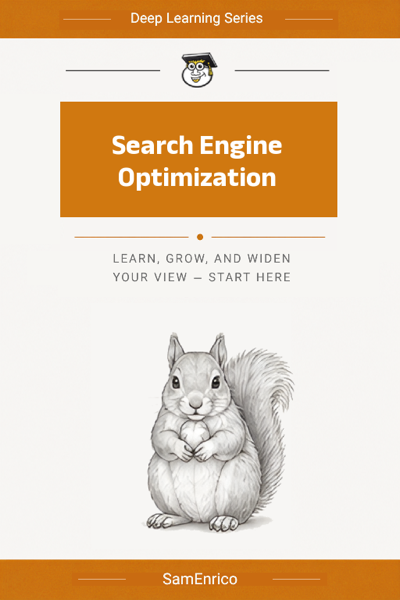
Search Engine Optimization eBook
A Coursebook on Search Engine Optimization
A Coursebook on Search Engine Optimization
Formats
Free sample
Chapter 1: The Gravity Machine--–- Before Google became a verb, before “ranking” determined the fate of businesses, and before artificial intelligence began whispering answers directly into search bars, the world of information was a library without a catalog. You could publish anything—a brilliant essay, a life-saving tutorial, a product that solved a real problem—and it would sit on an infinite shelf, invisible, collecting digital dust, waiting for someone who would never come. The problem wasn't your content. The problem was the machine that decided what anyone got to see.That machine is not magic. It is not fair. It is not driven by some benevolent mission to surface the “best” information. It is a programmable, logical, sometimes frustrating system of rules and trade-offs. And once you understand how it actually works—not the marketing blog version, not the “10 secrets to rank #1” version, but the mechanical, deeply logical reality—you stop being a victim of search engines and start being an operator of them.This chapter strips away every myth and replaces it with a single, useful truth: search engines are gravity machines. They pull order from chaos by following three immutable processes—crawling, indexing, and ranking. Nothing more. Nothing less. Master these three, and you master SEO. Ignore any one of them, and nothing else you do—no clever keyword strategy, no expensive link campaign, no beautiful design—will matter.The History You Actually Need to Know Before the web, there were directories. Humans typed lists. In 1994, Web Crawler became the first full-text search engine—meaning it actually read pages instead of just their titles. Then came Lycos, Alta Vista, and Ask Jeeves. They all had the same fatal flaw: they could be fooled. Stuff a page with the same word five hundred times in white text on a white background, and Alta Vista would rank it first. The internet became a race to the bottom, rewarding trickery over usefulness.Then, in 1996, two Stanford Ph D students named Larry Page and Sergey Brin had an idea that would change everything. They called it Back Rub—fortunately, they changed the name. Their insight was simple but radical: a link from one page to another is a vote. Not all votes are equal. A vote from a trusted, well-linked page matters more than a vote from a newly created, no-name page. They called this Page Rank, and it was the first time search had a real defense against spam.Google launched in 1998. By 2000, it was handling ten million searches per day. The reason wasn't advertising or branding. It was results. Page Rank worked.But the web grew faster than Page Rank alone could handle. People started gaming links—buying them, trading them, building networks of empty sites just to pass authority. Google responded with algorithm updates named after animals and engineers' inside jokes: Florida (2003), Big Daddy (2005), Caffeine (2010). Then came Panda (2011), which targeted thin content. Penguin (2012) came for spammy links. Hummingbird (2013) introduced conversational search. Rank Brain (2015) brought machine learning. BERT (2019) taught Google to understand natural language. MUM (2021) promised multitask understanding across text, images, and languages. And in 2023, Google began rolling out SGE—Search Generative Experience—which replaced some blue links with AI-written answers.Through every update, through every hype cycle, through every panic-stricken Facebook post about “another Google update destroying rankings,” three things have never changed. Crawling. Indexing. Ranking. The machines that implement these processes have grown smarter, but the processes themselves are the same as they were in 1998. Learn them once. Profit forever.The First Pillar: Crawling Imagine you are Google. You don't know the web exists. You have no map. You have no list of every website ever created. All you have is a starting list—a seed set—of a few known pages. Maybe the White House home page. Maybe Wikipedia. Maybe a few popular blogs.Your job: find every other public page on earth.This is crawling. A crawl is the act of a search engine's bot (called a crawler, spider, or robot) requesting a URL, downloading its content, extracting every link on that page, and adding those links to a queue of URLs to visit next. Then it repeats. Forever. Google's crawler never sleeps, never finishes, and never stops discovering new pages.Google's crawler is called Googlebot. It has two versions: Googlebot Smartphone (for mobile) and Googlebot Desktop (for desktop). Since 2020, Google primarily uses the smartphone version for crawling and indexing—a shift called mobile-first indexing. If your site works poorly on a phone, Googlebot will see a broken site, and your rankings will reflect that. We will cover mobile-first indexing in depth in Chapter 4 (Technical SEO), but for now, understand this: Google experiences the web the way a smartphone user does. If your mobile site is slow, buggy, or missing content, you are invisible to Google.Crawl Budget: What It Is and Who Should Care Crawl budget is one of the most misunderstood concepts in SEO. Many beginners worry about it unnecessarily, spending hours trying to “optimize crawl budget” on sites that don't need it. Here is the truth: crawl budget is the number of URLs Googlebot will crawl on your site within a given time period. For the vast majority of sites—those with fewer than ten thousand pages—crawl budget is irrelevant. Google will crawl every page it can find, often multiple times per day, and it will not run out of patience. You can ignore crawl budget completely and never see a negative effect.If your site has more than ten thousand pages, crawl budget starts to matter. If you have a hundred thousand pages, it matters a lot. If you have millions of pages—think Amazon, Wikipedia, or Zappos—crawl budget is a strategic daily concern. Google allocates crawl budget based on two factors: crawl demand (how often your content changes and how popular it is) and crawl rate (how fast your server can respond without breaking). Fast, popular sites get more budget. Slow, low-traffic sites get less.For 95% of readers of this book, you can ignore crawl budget. For the 5% who run large e-commerce sites or massive publishers, remember this: every parameter in a URL, every filter option, every session ID, and every paginated view consumes crawl budget. The more low-value URLs you force Googlebot to crawl, the less budget remains for your actual product pages and articles. A single faceted navigation filter (like “sort by price” or “filter by color”) can generate thousands of low-value URLs. We will solve this in Chapter 8.Controlling the Crawl: Robots.txt and Meta Robots You have two primary tools to tell crawlers what to do. The first is a text file called robots.txt, placed in the root directory of your website (yoursite.com/robots.txt). Its job is to say, “Crawler, do not request these paths.” It looks like this:text Copy Download User-agent: Googlebot
Disallow: /internal-search/ Disallow: /checkout/ Disallow: /admin/
User-agent: * Disallow: /tmp/The User-agent line specifies which crawler the rule applies to (* means all crawlers). Disallow tells the crawler not to request URLs starting with that path. Allow can override a Disallow for a more specific path.Critical warning: robots.txt prevents crawling but does not prevent indexing. If another site…
This is the end of the free sample. Get the eBook to keep going. Buy now
About this book
Details
- Author
- Aviles Yasmin
- Publisher
- SamEnrico
- Language
- English
- Genre
- Non-Fiction, Informative, Educational
- Released
- 2026-05-04
- Pages (approx.)
- 157
- Available as
- eBook, Audiobook

Read better in the ZLOADR app
Your eBooks on your phone or tablet. Sign in with your SamEnrico account and start reading.
More by Aviles Yasmin
 The Arthritis Foot GuideAviles Yasmin$11.99
 Discord Server Status Comparison GuideAviles Yasmin$11.99
 Kiribati Canned TunaAviles Yasmin$11.99
 Burnout Prevention Weekly RhythmAviles Yasmin$11.99
 The Social Engagement Memory GuideAviles Yasmin$11.99
 The Maestro of War: Andrea Doria and the Naval Revolution of the Italian WarsAviles Yasmin$11.99
 Understanding Shellfish Poisoning, Amnesic (Asp)Aviles Yasmin$17.99
 Shea Cooperative Export GuideAviles Yasmin$12.99
 TOPIK for Korean ScholarshipsAviles Yasmin$12.99
 How to Become a Poly-packer And Heat-sealerAviles Yasmin$11.99