
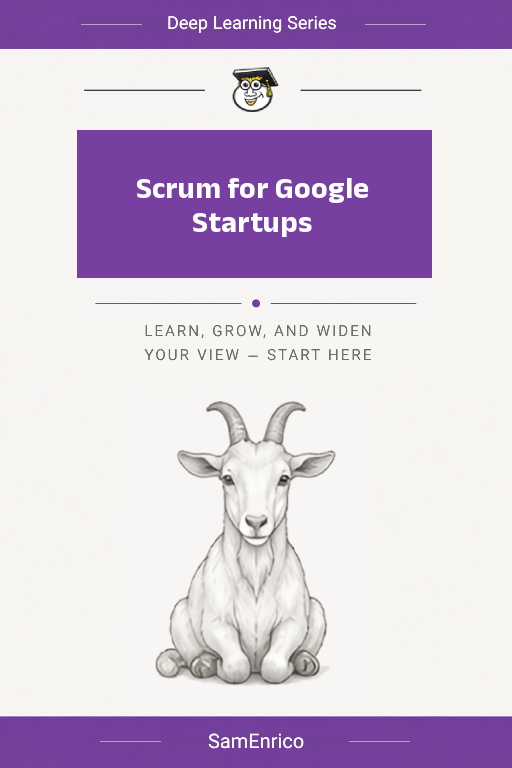
Scrum for Google Startups
Implement Google's blend of Scrum with OKRs for go
Implement Google's blend of Scrum with OKRs for goal-driven sprint planning in search and AI startups.
Formats
About this book
Free sample
Chapter 1: The Velocity Trap--–- In 2019, a search startup called Relevant.ly raised $15 million from a top-tier venture capital firm. The founders had impeccable credentials: Ph Ds from Stanford, engineering leads from Google Search, and a proprietary dataset that promised to revolutionize e-commerce discovery. They hired fifty engineers, product managers, and data scientists. They adopted Scrum with religious devotion. They ran two-week sprints, held daily standups, maintained a pristine Jira board, and never—not once in eighteen months—missed a sprint commitment.
They shipped forty-seven model updates, three major feature releases, and over two thousand individual tasks. Their burndown charts were works of art. Their velocity charts trended steadily upward. By every traditional measure of software engineering productivity, Relevant.ly was a world-class operation. And in the nineteenth month, they ran out of money and shut down.The post-mortem revealed a devastating truth: not a single one of those forty-seven model updates had improved their core business metric.
They had built a feature factory—a machine that produced output with astonishing efficiency but delivered zero outcome. The engineers had done everything right according to the Agile manifesto. The product managers had written pristine user stories. The Scrum Master had protected the team from interruptions. And none of it mattered because they had optimized for the wrong thing.This is the death that awaits AI startups who worship velocity.The Measure That Lies Every Scrum team knows velocity.
It is the number of story points a team completes per sprint. It is plotted on charts, celebrated when it rises, and mourned when it falls. It is used to forecast release dates, evaluate team performance, and justify hiring requests. And it is almost completely meaningless for AI startups.Velocity measures output—the quantity of work performed. But output is not outcome.
Output is shipping a model. Outcome is improving search relevance. Output is writing ten thousand lines of code. Outcome is reducing latency by fifty milliseconds. Output is closing one hundred Jira tickets.
Outcome is increasing user retention by five percent. The two are correlated only when you are building the right things.…
This is the end of the free sample. Get the eBook to keep going. Buy now
Contents
- Chapter 1
- Chapter 2
- Chapter 3
- Chapter 4
- Chapter 5
- Chapter 6
- Chapter 7
- Chapter 8
- Chapter 9
- Chapter 10
- Chapter 11
- Chapter 12
Details
- Author
- Wiseman Catharine
- Publisher
- SamEnrico
- Language
- English
- Genre
- Non-Fiction, Startup Guide, Scrum OKRs
- Released
- 2026-06-01
- Pages (approx.)
- 146
- Available as
- eBook, Audiobook

Read better in the ZLOADR app
Your eBooks on your phone or tablet. Sign in with your SamEnrico account and start reading.
More by Wiseman Catharine
 Self Hypnosis Progressive Relaxation CourseWiseman Catharine$11.99
 Beginner's Kettlebell SwingWiseman Catharine$11.99Beginner's Kettlebell SwingWiseman Catharine$11.99
 Anger in Long Distance RelationshipsWiseman Catharine$11.99
 Student Panic Attack ManagementWiseman Catharine$11.99
 Chunking for Bulletin JournalingWiseman Catharine$11.99
 Quantum Dreams in the Desert: The Pioneers of Middle Eastern Quantum ScienceWiseman Catharine$11.99
 The Silk Road’s Last Emperor: A Forgotten Dynasty’s RiseWiseman Catharine$11.99
 Understanding EndometriosisWiseman Catharine$17.99
 AI Art Niche SelectionWiseman Catharine$12.99
 Fruit Smoothie MakerWiseman Catharine$11.99
 How to Start a Continuous Cast Products Made of Steel Business (Beginners Guide)Wiseman Catharine$11.99