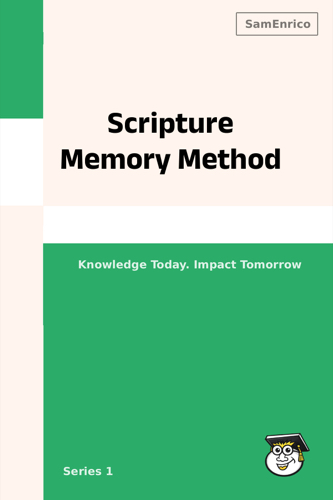
Scripture Memory Method eBook
Use loci and peg techniques to memorize Bible vers
Use loci and peg techniques to memorize Bible verses or sacred texts.
Formats
Free sample
Chapter 1: The Leaky Bucket...-- Every sincere believer knows the feeling. You sit down with your Bible, coffee in hand, and read a verse slowly. You say it aloud. You read it again. You close your eyes and repeat it back – success!
You feel a small glow of accomplishment. The Word of God is in you. Then life happens. The phone buzzes. The kids need something.
You go to work, cook dinner, fall into bed. The next morning, you try to recall that verse. It's gone. Not模糊 – just… absent. A blank wall where a sentence used to be.
You try again. Nothing. The familiar shame creeps in: Maybe I don't love God enough. Maybe my memory is just bad. Maybe I'm not disciplined enough.This chapter is here to tell you that those voices are lying.
The problem is not your love for God, your intelligence, or your willpower. The problem is your method. You have been using a broken tool. For your entire life, you have been trying to fill a bucket with a hole in the bottom. You have been relying on rote repetition – the simple act of saying something over and over – to store eternal truth in your brain.
And rote repetition, as we will prove in the next few pages, is perhaps the most inefficient and fragile way to remember anything longer than a grocery list.You are not the problem. The leaky bucket is the problem. And by the end of this chapter, you will understand exactly why your brain loses scripture, and more importantly, you will see the ancient, elegant solution that has been hiding in plain sight – a solution used by Greek poets, Reformation theologians, and memory champions today. We are going to plug the hole in your bucket.The Myth of the "Bad Memory"Let's start by demolishing a lie. There is no such thing as a "bad memory." There are only trained memories and untrained memories.
Consider this: can you remember the layout of the home you grew up in? Can you walk, in your mind, from the front door to your childhood bedroom? Can you remember the smell of the kitchen, the texture of the sofa, the spot on the floor where the sun hit in the afternoon? Of course you can. You can probably remember dozens of rooms, hundreds of objects, and thousands of sensory details from your past – effortlessly, without trying.Now consider this: can you recite the books of the Bible in order without hesitating?
Can you quote Psalm 23 word-perfect right now? For many of us, the answer is no. This reveals a profound truth. Your brain is not a faulty hard drive. It is an extraordinary supercomputer.
The problem is not storage – you have nearly unlimited capacity. The problem is encoding and retrieval. You have been trying to store abstract words (grace, propitiation, sanctification) in a system designed to remember concrete places, vivid images, and emotional events. You have been feeding a lion a salad.The ancient Greeks understood this. They did not have smartphones or search engines.
If an orator wanted to deliver a three-hour speech without notes, he had to remember it. And they discovered that the secret was not repetition – it was translation. They learned to translate the abstract (an argument about justice) into the concrete (a bloody sword on a specific temple step). This chapter is the beginning of your translation training. We are going to stop treating your brain like a filing cabinet and start treating it like a landscape.The Forgetting Curve: Why 90% of Your Effort is Wasted Let's look at the science, because the data is both sobering and liberating.
In the 1880s, a German psychologist named Hermann Ebbinghaus conducted a series of brutal experiments on himself. He memorized lists of nonsense syllables (meaningless combinations like "ZOF" and "KAE") and then tested himself at various intervals to see how much he had forgotten. The result was the Forgetting Curve, one of the most replicated findings in cognitive science.Here is what Ebbinghaus discovered. Within one hour of learning new information, your brain forgets approximately 50% of it. Within 24 hours, you have forgotten 70-80% – unless you do something specific to stop the decay.
Let that sink in. You can read a Bible verse ten times in a row, feel confident, and within a single day, eight out of ten of those repetitions have evaporated. You are pouring water into a sieve. This is not a moral failure. This is neurology.Why does this happen?
Your brain is not designed to hold onto every piece of information permanently. It is designed for survival. It prioritizes information that is: (a) emotionally charged, (b) visually unusual, (c) spatially relevant (where is the predator?), or (d) frequently used. A Bible verse read in a quiet room with no emotion, no image, and no spatial anchor is – to your brain – background noise. It gets swept away during sleep as your brain consolidates what actually matters.Rote repetition fails because it only creates a short-term memory trace.
That trace is like a pencil mark on wet sand. It looks good for a moment, but the next wave erases it. The only way rote repetition works is if you repeat the information hundreds or thousands of times over months – which is why you can still recite the Pledge of Allegiance but not the verse you read yesterday. The solution is not more repetitions. The solution is encoding depth.
You need to take that verse and carve it into stone, not scratch it into sand.The Two Pillars of Permanent Memory: Association and Location Now for the good news. You already possess the hardware for a supernatural memory. You just need the software. The ancient memory masters who could recite entire epics did not have superior brains – they had superior strategies. Those strategies rest on two unshakeable pillars.Pillar One: Association.
Your brain is a relational engine. It does not store isolated facts. It stores connections. Think about how you learn a new person's name. If someone says, "Hi, I'm Mike," and you just repeat "Mike" three times, you will forget it in sixty seconds.
But if you notice that Mike has the same haircut as your cousin Mike, and you say to yourself, "Cousin Mike's haircut on this new Mike," – bam, it sticks. You have associated the new information with something already familiar. That is the essence of Pillar One. To remember a verse, you must connect it to something you already know and can visualize. You cannot remember what you cannot see.
So you must turn every abstract word into a concrete image. Grace becomes a gift. Condemnation becomes a judge's gavel. Sin becomes a snake. These are not childish tricks; they are the language of your deepest memory systems.Pillar Two: Location.
This is the heavy artillery. Your brain has a dedicated "place memory" module that is vastly more powerful than its "word memory" module. Evolutionarily, this made sense. The hominid who remembered where the berry patch was located outlived the hominid who only remembered that berries were "sweet and red." Your brain is a spatial organ. It is constantly, unconsciously, mapping your environment.
You can walk into a dark kitchen at 3 AM and find a glass because your brain has a location…
This is the end of the free sample. Get the eBook to keep going. Buy now
About this book
Details
- Author
- Swisher Lacey
- Publisher
- SamEnrico
- Language
- English
- Genre
- Non-Fiction, Self-Help, Religious Study
- Released
- 2026-06-09
- Pages (approx.)
- 136
- Available as
- eBook, Audiobook

Read better in the ZLOADR app
Your eBooks on your phone or tablet. Sign in with your SamEnrico account and start reading.
More by Swisher Lacey
 Toxic Coworker Stress ManagementSwisher Lacey$11.99
 Natural HGH Boost ExerciseSwisher Lacey$11.99
 Two Year Diamond Heist PrepSwisher Lacey$11.99
 The Creative Constraint ChallengeSwisher Lacey$11.99
 Somali Pirate CaptiveSwisher Lacey$11.99
 Retirement Assets and Life InsuranceSwisher Lacey$11.99
 PMS Anxiety Reduction GuideSwisher Lacey$11.99
 Nicotine Cravings At Work GuideSwisher Lacey$11.99
 Tangaroa's Wrath: The Storm That Shaped the IslandsSwisher Lacey$11.99
 Frozen Betrayal: The Race to the South Pole's Dark SecretSwisher Lacey$11.99
 Bloodlines of the Silk Throne: The Emperor’s Forgotten HeirSwisher Lacey$11.99
 Multiple Choice Distractor GuideSwisher Lacey$12.99