
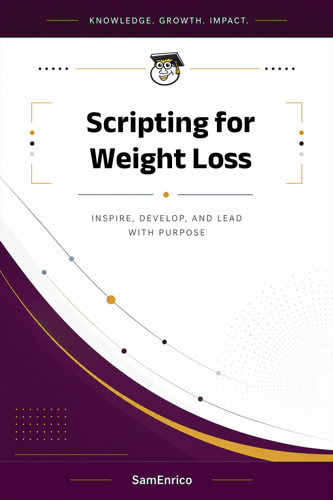
Scripting for Weight Loss eBook
Hypnosis scripts for eating habits.
Hypnosis scripts for eating habits.
Formats
Free sample
Chapter 1: Beyond Willpower--–- You have been lied to. Not accidentally, not through well-meaning misinformation, but systematically and profitably. The diet industry—a $70 billion global enterprise—has built its fortune on a single, damaging falsehood: that your weight is a direct reflection of your willpower. If you were simply stronger, more disciplined, more committed, you would be thin. Since you are not thin, you must be weak.
This lie has been repeated so often, in so many forms, that it has seeped into your subconscious and taken up permanent residence. You believe it because everyone around you believes it. Your mother believes it. Your doctor believes it. The magazine covers at the grocery store checkout scream it monthly.
Even your friends, the ones who love you, have probably said something like “I just need to find the willpower to stick to my diet.”They are all wrong. And being wrong has caused incalculable suffering.The truth is that willpower is not a muscle you can strengthen through repeated use. It is a limited cognitive resource that depletes with every decision you make, every temptation you resist, every rule you enforce upon yourself. By 3:00 PM on any given day, your willpower reserves are significantly lower than they were at 8:00 AM. By 8:00 PM, after a full day of deciding what to wear, what to say in meetings, which emails to answer first, how to respond to your partner’s comment about dinner, the tank is nearly empty.
And that is precisely when the refrigerator calls most loudly.This is not a character flaw. This is neuroscience. And once you understand the neuroscience, you will stop blaming yourself for failed diets and start doing something that actually works.The Myth of the Strong-Willed Thin Person Let us begin by dismantling a cherished cultural icon: the thin person with iron willpower. You have probably imagined that naturally thin people walk through life constantly saying no to dessert, pushing away half-eaten plates, and experiencing the same cravings you do but possessing some superhuman capacity to resist them. This image is pure fantasy.Decades of research on eating behavior have consistently shown that people who maintain a healthy weight without conscious effort do not use willpower at all.
They do not say no to dessert because they do not experience the desire for dessert in the first place. They push away half-eaten plates not because they are restraining themselves but because they feel genuinely full. Their brains are programmed differently. The habit loop that runs for them—cue, routine, reward—produces different behaviors automatically, without any conscious intervention.Consider the difference between a skilled pianist and someone who has never played piano. When the pianist sits at a keyboard, their fingers move across the keys without conscious thought.
They do not decide to place the index finger on C and the thumb on G. The pattern is automatic, learned through thousands of hours of practice until it became encoded in the subconscious. The non-pianist, by contrast, must think about every finger placement. Every note requires a conscious decision. Playing even a simple song is exhausting.The same principle applies to eating.
The “naturally thin” person has practiced thin behaviors—eating slowly, stopping when full, preferring vegetables to fried foods—until those behaviors became automatic. They are not using willpower at the dinner table any more than the pianist is using willpower at the keyboard. The person who struggles with weight, by contrast, is the non-pianist at the keyboard. Every food choice requires a conscious decision. Every bite requires monitoring.
Every meal is exhausting.Here is the good news: you can learn to play the piano. The subconscious mind is capable of acquiring new automatic programs at any age. Neuroplasticity—the brain’s ability to reorganize itself by forming new neural connections—does not stop when you turn thirty or forty or sixty. It continues for your entire life, provided you give it the right input. The pianists were not born knowing how to play.
They practiced. And you will practice, not with finger exercises but with hypnotic scripts designed to encode new eating behaviors directly into your subconscious.The Architecture of the Two Brains To understand why hypnosis works and willpower fails, you need a basic map of your own mind. Neuroscientists and psychologists generally agree on a useful simplification: you have two brains. They are not separate organs, of course, but two distinct systems operating within the same three-pound mass of neural tissue.The first brain is your conscious mind. This is the part of you that is reading these words right now.
It processes language, makes plans, sets goals, solves problems, and engages in logical reasoning. It is the part of you that decided to buy this book, that wants to lose weight, that knows which foods are healthy and which are not. The conscious mind is brilliant at abstract thinking and terrible at automatic behavior. It can only focus on one thing at a time. It tires easily.
It requires glucose to function, which means that when your blood sugar drops, your conscious mind becomes sluggish and prone to poor decisions.The second brain is your subconscious mind. This is the vast, silent operating system running beneath conscious awareness. It controls your heartbeat, your breathing, your digestion, and every other automatic function of your body. It also controls your habits—the thousands of small behaviors you perform every day without thinking. Tying your shoes.
Brushing your teeth. Driving your car. And eating.The subconscious mind is incredibly powerful. It processes approximately eleven million bits of information per second, compared to the conscious mind’s paltry 120 bits. It never tires.
It never needs a break. It simply executes the programs that have been installed in it, over and over, with flawless efficiency. When you find yourself standing in front of the open refrigerator with no memory of having walked there, that is your subconscious mind executing a program. When you finish a bag of chips while watching television and cannot remember the last ten minutes, that is your subconscious at work.Here is the crucial insight: your subconscious mind does not judge. It does not evaluate whether a program is good for you or bad for you.
It simply runs whatever program it has been given. If you have spent years eating when you are bored, your subconscious has installed a program: boredom → seek food. If you have spent years eating when you are sad, your subconscious has installed a program: sadness → seek food. If you have spent years finishing everything on your plate regardless of hunger, your subconscious has installed a program: plate has food → keep eating until plate is empty.These programs are not moral failures. They are simply code.
And code can be rewritten.Why Diets Target the Wrong Brain Every diet you have ever tried has made the same fundamental error: it has targeted your conscious mind while ignoring your subconscious. The diet tells you what to eat, when to eat it, and how much to eat. These are conscious instructions. They require you to think, to plan, to measure, to track, to remember. They demand that your conscious mind override…
This is the end of the free sample. Get the eBook to keep going. Buy now
About this book
Details
- Author
- Andres Loreen
- Publisher
- SamEnrico
- Language
- English
- Genre
- Non-Fiction, Self-Help, Weight Loss
- Released
- 2026-06-09
- Pages (approx.)
- 132
- Available as
- eBook, Audiobook

Read better in the ZLOADR app
Your eBooks on your phone or tablet. Sign in with your SamEnrico account and start reading.
More by Andres Loreen
 The Personal Brand Video GuideAndres Loreen$11.99
 Menopause And Divorce GuideAndres Loreen$11.99
 Strava Athlete Comparison GuideAndres Loreen$11.99
 Freshman Senator First YearAndres Loreen$11.99
 Energy Based SchedulingAndres Loreen$11.99
 Email Automation Zapier UseAndres Loreen$11.99
 Shallow Work Batching GuideAndres Loreen$11.99
 Blood and Bronze: The Siege of Potidaea and the Fracturing of GreeceAndres Loreen$11.99
 The Centennial Symphony: How a 19th-Century Music Festival United a Divided AmericaAndres Loreen$11.99
 How to Produce Plumbing TrapsAndres Loreen$11.99
 How to Produce Dj and Specialty Audio EquipmentAndres Loreen$11.99
 Exploring Gouache: Opaque Watercolor TechniquesAndres Loreen$11.99
You may also like
 Envy in Weight LossGould Bernetta$11.99
 Transcendental Meditation for Weight ManagementRankin Jamee$11.99
 Self Hypnosis for Weight LossStrickland Sophie$11.99
 Weight Loss Affirmations That WorkWorley Felton$11.99
 Self Esteem After Weight LossBermudez Leisa$11.99
 Weight Loss Goal Setting GuideMartz Santana$11.99