
Non-FictionSelf-HelpRelationships
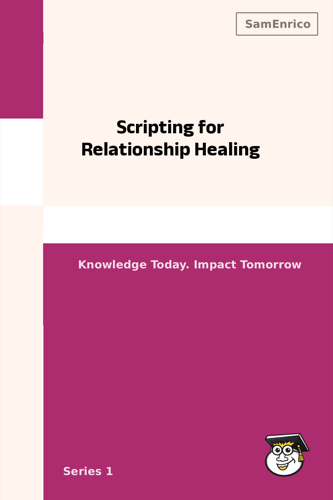
Scripting for Relationship Healing eBook
Connection focused hypnosis scripts.
by Talbot Rivka
Connection focused hypnosis scripts.
Formats
Free sample
Chapter 1: The Ghost in the Room--–- Every relationship has a ghost. It sits in the room during every argument, every silence, every moment when one partner reaches out and the other turns away. You cannot see it, but you can feel its weight. It is the ghost of every fight you have had before. It is the echo of every word that was never said.
And most importantly – most painfully – it is the shape of a wound you thought you had buried long ago.Before you learn a single hypnotic script, before you guide a single client into trance, before you even open your mouth to speak the words that might heal or harm – you must understand one thing: relationship injuries are not merely emotional memories. They are structural changes in the subconscious mind. They are rewired neural pathways. They are conditioned responses that fire automatically, without permission, every time your partner comes too close or too far away.This book is not about positive thinking. It is not about communication techniques you could learn from a marriage counseling workbook.
It is not about trying harder, loving better, or being more patient. Those approaches fail because they address the conscious mind – the part of you that already knows what to do. The problem is not that you do not know how to love. The problem is that your subconscious has learned, through real and repeated experience, that love is dangerous, unpredictable, or conditional.This chapter establishes the clinical framework for everything that follows. We will explore what the author calls the Injured Interaction – the moment when past trauma hijacks present intimacy.
We will introduce the Diagnostic Trance, a unique hypnotic intervention that locates the physical shape of a recurring relational wound. And we will uncover the concept of Unfinished Business – the reason why your relationship with your partner so often feels like a sequel to your relationship with your parents.If you are a therapist reading this book, you will learn how to identify these patterns in your clients before you ever induce trance. If you are a hurting partner reading this book alone, you will learn how to recognize the ghost in your own room – and you will take the first step toward laying it to rest.Let us begin.The Primary Injury: Why Pain Is Not the Real Problem When a client arrives in your office – or when you yourself sit down to examine your own relationship – the presenting complaint is almost always pain. "We fight all the time." "He never listens." "She criticizes everything I do." "I feel like I am disappearing." "I cannot trust him anymore."Pain is real. Pain is urgent.
Pain demands attention. And pain is not the primary injury.The neo-Ericksonian view – which forms the backbone of this book – makes a critical distinction that most therapists miss. Pain is the symptom. Isolation is the wound.Think of it this way. If you break your leg, the pain is excruciating.
You will cry out, you will limp, you will seek relief. But the pain is not the injury. The injury is the fractured bone. Treat the pain alone – with medication, distraction, or willpower – and the leg will heal wrong. You will walk with a limp for the rest of your life.
You must set the bone. You must address the structural damage beneath the symptom.In relationship distress, the bone is the subconscious belief that "no one can reach me here." The limp is the isolation – the quiet, private conviction that even in a crowded room, even in a marriage of twenty years, you are fundamentally alone in your suffering.This is not metaphor. This is neurobiology.When a child experiences inconsistent caregiving – a mother who is loving one moment and dismissive the next, a father who is present only when the child performs perfectly – the child's developing brain does something remarkable and tragic. It learns that connection is unreliable. It learns that reaching out might result in rejection.
And it builds a neural template – a hypnotic script, if you will – that says: "Do not expect comfort. Do not trust closeness. Prepare to be alone."This template operates below conscious awareness. It is not a choice. It is not a character flaw.
It is a survival adaptation.Decades later, when that child – now an adult – sits across the dinner table from a partner who seems distant, the old template activates. The partner says, "I am tired from work." The subconscious hears, "You are not worth my attention." The partner forgets to call. The subconscious concludes, "I have been abandoned."The pain comes roaring back. But the primary injury – the isolation – never left.This is why couples counseling often fails. Traditional approaches ask partners to communicate better, to listen more, to validate each other's feelings.
These are good skills. But they address the conscious mind. The client already knows they should not scream. They already know they should say "I feel hurt" instead of "You are an idiot." The problem is not knowledge. The problem is that when the old template activates, the conscious mind is offline.
The client is in trance.The goal of this book is not to teach you better communication. The goal is to locate the old template – the injured interaction – and rewrite it at the subconscious level. Only then will the conscious skills have a chance to work.The Diagnostic Trance: Locating the Shape of the Wound Before you can heal an injury, you must know where it lives. This is obvious in medicine. A surgeon does not cut randomly.
A physical therapist does not massage a healthy muscle. They locate the site of the injury, and they work there.Most talk therapy violates this principle. It asks the client to describe the pain. "Tell me about your childhood." "Tell me about the fight you had last night." "How did that make you feel?" The client talks. The client intellectualizes.
The client produces a narrative. But the narrative is not the wound. The wound lives somewhere else entirely.It lives in the body.Every injured interaction – every recurring fight, every patterned response, every time you react to your partner as if they were someone from your past – has a physical location. A knot in the stomach. A tightness in the chest.
A hollow sensation in the throat. A burning behind the eyes. A cold numbness in the hands.These are not metaphors. These are somatic markers. They are the body's way of saying: here.
Here is where the old wound lives. Here is where the trance begins.The Diagnostic Trance is a hypnotic intervention designed to locate these somatic markers with surgical precision. Unlike general hypnosis for relaxation, which disperses attention and soothes the nervous system, the Diagnostic Trance does something almost counterintuitive. It asks the client to focus on the discomfort. To move toward it.
To describe its shape, its temperature, its weight, its edges.A typical induction might sound like this:"And I am going to ask you to do something unusual now. I am going to ask you to bring to mind the last time you had that fight – the one that happens over and over. Not…
This is the end of the free sample. Get the eBook to keep going. Buy now
About this book
Details
- Author
- Talbot Rivka
- Publisher
- SamEnrico
- Language
- English
- Genre
- Non-Fiction, Self-Help, Relationships
- Released
- 2026-06-05
- Pages (approx.)
- 151
- Available as
- eBook, Audiobook

Read better in the ZLOADR app
Your eBooks on your phone or tablet. Sign in with your SamEnrico account and start reading.
More by Talbot Rivka
 Meeting Water Cooler SlotTalbot Rivka$11.99
 Tina Turner Simply Best LifeTalbot Rivka$11.99
 Future Goals DisagreementTalbot Rivka$11.99
 Congressional Hearings SpectaclesTalbot Rivka$11.99
 Deep Work for Remote WorkersTalbot Rivka$11.99
 Time Blocking for Project ManagersTalbot Rivka$11.99
 Job Loss and Children GuideTalbot Rivka$11.99
 The Lion of Aleppo: How a Syrian Wrestler Defied the Ottoman EmpireTalbot Rivka$11.99
 The Gilded Vision: How a Railway Tycoon Built America’s First Great Art MuseumTalbot Rivka$11.99
 Exploring Jewish Art: Ritual Objects & Illuminated TextsTalbot Rivka$11.99
 How to Produce Dog TreadmillsTalbot Rivka$11.99
 How to Produce a Polar S625xTalbot Rivka$11.99
You may also like
 Hong Kong Handover 1997Dunn Johnnie$11.99
 Zumba For Postnatal Recovery CourseNeal Christian$11.99
 Zumba for BeginnersLadner Nikia$11.99
 YouTube Comment Mining GuideHumes Pandora$12.99
 Worry Box MeditationCarlin Rudy$11.99
 Workplace Stress MeditationNguyen Lynn$11.99
 Workplace Stress and Sleep RepairHawley Ivory$11.99
 Workplace Perfectionism CureDelaney Jeffry$11.99
 Workplace Injustice Anger GuideWallen Isabelle$11.99
 Work Addiction and Burnout LinkGreenwood Ester$11.99
 Women in Yoga and WellnessBeattie Galina$11.99
 Women in Stand Up ComedyChun Evangeline$11.99