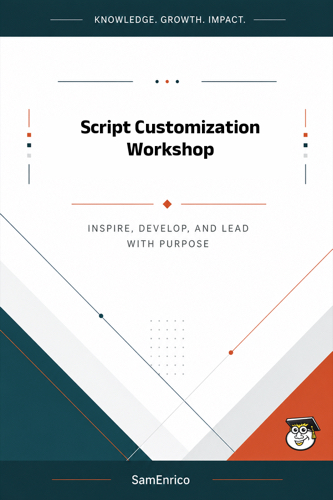
Script Customization Workshop eBook
Teaches adapting generic scripts for individual cl
by Place Cathi
Teaches adapting generic scripts for individual client needs.
Formats
Free sample
Chapter 1: The Copy-Paste Epidemic...--–- The email arrived at 9:47 AM on a Tuesday. It was from a regional sales director at a mid-sized software company. The subject line read "Urgent: Lost $47k Deal – Need Script Review." I opened it expecting to find a complex failure—a product-market fit problem, a pricing issue, a competitor with superior features. Instead, I found a two-paragraph email that began with the words: "I used the script exactly as written. I don't understand what went wrong."That sentence stopped me cold.
Not because it was unusual, but because I had heard it so many times before. In fact, I had said it myself earlier in my career, staring at my computer screen after a client hung up, convinced that the words on my monitor had somehow betrayed me. The script had worked yesterday. It had worked with the previous client. Why had it failed today?The answer, which took me years to fully understand, is both simple and devastating: generic scripts don't just fail to persuade—they actively repel.
They trigger a neurological response in the human brain that is the exact opposite of what we intend. When a client detects that you are reading from a script, or even that your words have been scripted for a generic audience, their brain begins building defenses before you finish your first sentence.This chapter is about understanding that phenomenon. It is about why the copy-paste approach to communication is not merely ineffective but counterproductive. And it is about the foundational mindset shift that transforms everything that follows in this book.The Illusion of Efficiency Let us begin with a confession that most communication training materials will never admit: scripts are seductive. They promise efficiency, consistency, and safety.
With a script, you never have to wonder what to say next. You never have to worry about forgetting a key point. You never have to trust your instincts in a high-pressure moment. A script is a security blanket for the anxious communicator, and almost all of us are anxious communicators at some level.The seduction works like this. A manager writes a script that sounds good to them—clear, logical, comprehensive.
They train their team on the script. The team uses the script. Some calls go well. Some calls go poorly. But because the script provides a sense of control, the manager assumes the poor calls were anomalies—difficult clients, bad timing, external factors.
The script itself is rarely questioned because questioning the script would mean facing the uncomfortable truth that communication cannot be fully automated.I have seen this dynamic play out in organizations ranging from two-person startups to Fortune 500 companies. The pattern is always the same. Someone writes a script that works reasonably well in a few test cases. The script gets shared, then codified, then mandated. Over time, the script becomes sacred—not because it continues to work, but because the organization has invested in it.
Changing the script feels like admitting failure. So the script persists, even as clients become more resistant, even as conversion rates decline, even as customer satisfaction scores drop.This is the Copy-Paste Epidemic: the widespread, largely unexamined assumption that words can be written once and deployed many times with equal effectiveness. It is an assumption that violates everything we know about how human beings process language, make decisions, and build trust.The Neuroscience of Resistance To understand why generic scripts fail, we need to look inside the brain. The specific neurological mechanism at work is called psychological reactance, a term coined by psychologist Jack Brehm in the 1960s but only fully understood through modern neuroimaging.Psychological reactance is the brain's automatic response to perceived threats to its freedom of choice. When you feel that someone is trying to control you, manipulate you, or constrain your options, your brain activates a cascade of neural events.
The amygdala—your brain's threat detection center—lights up. Stress hormones like cortisol enter your bloodstream. Your prefrontal cortex, responsible for rational decision-making, receives less blood flow and oxygen. In other words, the moment a client suspects they are being scripted, their brain becomes less rational and more defensive.Here is the cruel irony: the very tool you use to try to control the conversation—the script—triggers the client's psychological reactance, which makes them harder to persuade. You brought a script to gain control, and the script cost you control.Research by social psychologist Sharon Brehm (no relation to Jack) found that reactance is strongest when two conditions are met.
First, the person perceives that their freedom is being eliminated entirely rather than merely reduced. Second, the person perceives that the controlling message comes from a source with authority over them. A generic script often meets both conditions: it leaves the client no room to shape the conversation, and it comes from an organization that the client already mistrusts at some level.Consider a simple experiment that you can run yourself. The next time you receive a customer service call that sounds scripted, notice your internal response. Do you feel more cooperative or more skeptical?
Do you feel like the agent is trying to help you or process you? Most people report feeling the latter. They feel processed, not helped. They feel like a ticket number rather than a person. And that feeling is not an accident—it is their brain's reactance system doing exactly what evolution designed it to do: protect them from perceived manipulation.The Three Costs of Generic Scripts The damage caused by generic scripts falls into three distinct categories.
Each category is measurable, each is avoidable, and each compounds the others over time.Cost One: Lost Revenue The most visible cost is the deal that dies. A prospect who was interested, engaged, and ready to buy suddenly goes cold. A client who had agreed to the next step suddenly stops returning emails. A negotiation that seemed to be progressing suddenly stalls.These failures are often attributed to price, timing, or competition. But in many cases, the real cause is something more subtle: the client detected that they were being scripted, their reactance activated, and they found a reason to say no that had nothing to do with the actual value of the offer.I once analyzed three months of lost deals for a B2B software company.
The sales team had documented their primary loss reasons as "price too high" (42 percent), "competitor product better" (28 percent), and "timing not right" (18 percent). But when I listened to the call recordings, a different pattern emerged. In over half of the "price too high" losses, the prospect had never actually asked for a discount or compared prices with a competitor. Instead, they had simply said "We need to think about it" after a particularly scripted-sounding pricing presentation. The script had triggered reactance, the reactance had manifested as hesitation, and the hesitation had been recorded as a pricing objection.The revenue loss from generic scripts is not small.
In my consulting work, I have seen organizations increase close rates by 15 to 30 percent simply by replacing generic scripts with flexible frameworks—no change to product, price, or market. The words changed; the outcomes followed.Cost…
This is the end of the free sample. Get the eBook to keep going. Buy now
About this book
Details
- Author
- Place Cathi
- Publisher
- SamEnrico
- Language
- English
- Genre
- Non-Fiction, Self-Help, Customization
- Released
- 2026-06-07
- Pages (approx.)
- 148
- Available as
- eBook, Audiobook

Read better in the ZLOADR app
Your eBooks on your phone or tablet. Sign in with your SamEnrico account and start reading.
More by Place Cathi
 OCD Myths DebunkedPlace Cathi$11.99
 Pet Loss For JewsPlace Cathi$11.99
 Sunset Horizon VisualizationPlace Cathi$11.99
 Self Hypnosis for Sleep InductionPlace Cathi$11.99
 Participation Rights AnalysisPlace Cathi$11.99
 The Midwife Critical StressPlace Cathi$11.99
 Anger And NeurodivergencePlace Cathi$11.99
 Time Blocking For DadsPlace Cathi$11.99
 The Jade Emperor's Celestial Bureaucracy: How Myth Shaped China's Cosmic OrderPlace Cathi$11.99
 The Bitten Apple: Steve Jobs and the Birth of the iPod RevolutionPlace Cathi$11.99
 Growing VrieseaPlace Cathi$11.99
 The 101 Handbook: ForestryPlace Cathi$11.99